






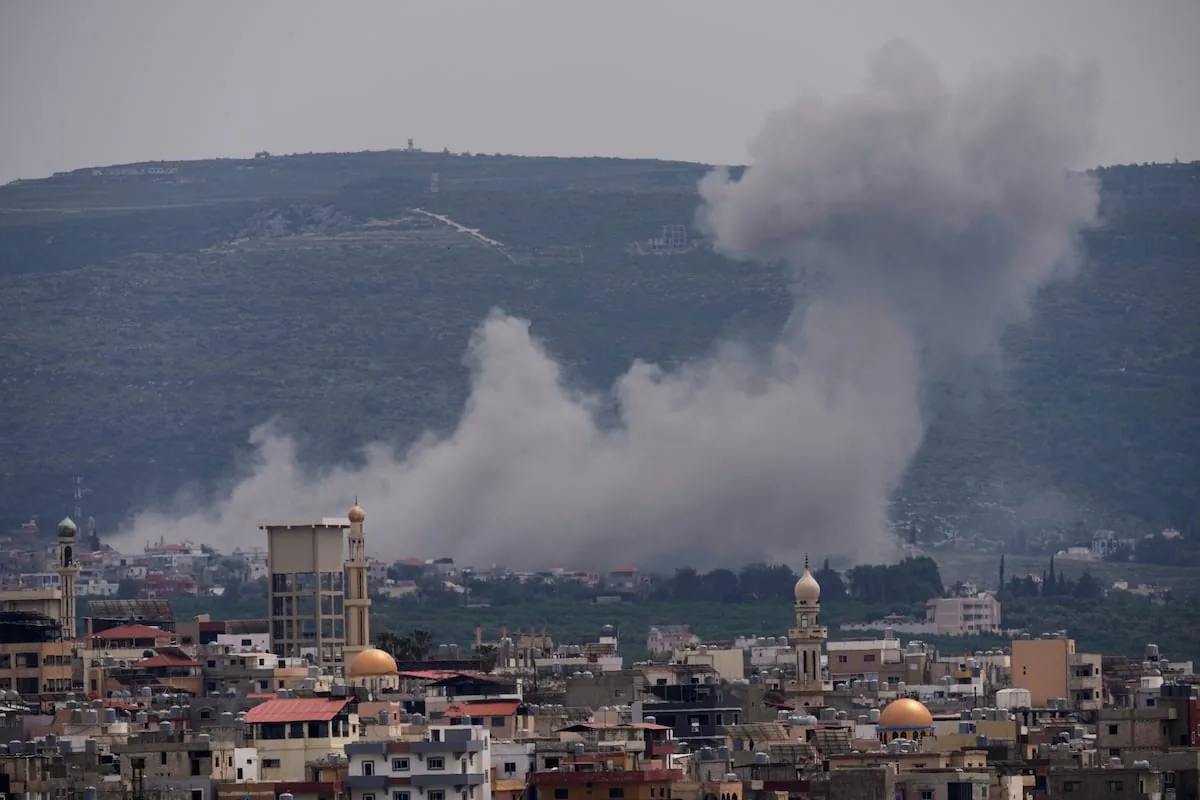
In a regional landscape in the Middle East where hardly any progress is made, the fact that Israel and Lebanon have sat down to negotiate directly for the first time since 1948, in Washington and under the auspices of the US Department of State, is in itself positive. However, the fact that the dialogue takes place while the Israeli military offensive continues — with bombings across much of Lebanese territory and an Israeli plan to occupy the south of the country and expel its population — and that there is a clear disparity of views on the very objective of the negotiation, not only diminishes its value but unfortunately places it more in the realm of a declaration of intent than a truly effective milestone.
Read more Egypt tries to counteract the economic turbulence of the war in Iran
The imperative is that an immediate ceasefire takes place in Lebanon. That would be the first obvious step to give credibility of intent to talks that, so far, seem to respond more to a propaganda move by US diplomacy — which suddenly aims to act as a mediator who can be trusted — imposed as a minimum toll on a Benjamin Netanyahu accustomed to acting with total US carte blanche in the Middle East.
Lebanon comes with a single point on the agenda: to achieve an immediate ceasefire. This would allow addressing other more complex issues such as the disarmament of the pro-Iranian party-militia Hezbollah, the establishment of a definitive border and, ultimately, the recognition of Israel and the establishment of diplomatic relations. For its part, Israel considers that its offensive is not an obstacle to negotiating and seeks, first, to agree on the disarmament of Hezbollah, and secondly a peace agreement that involves Beirut renouncing the 2002 Arab Peace Initiative, which included recognition of a Palestinian State and demanded the end of Israeli presence in the occupied territories.
These are two very different starting points, but by no means equidistant. While Lebanon calls for the immediate cessation of a state of war that has already caused around 2,000 deaths, 6,000 injuries and 1,200,000 displaced among its population, the destruction of its infrastructure and the occupation of 10% of its territory, Israel refuses to cease attacks until its military target is disarmed and, moreover, Lebanon makes a political renunciation with historic consequences in the region. However, the distorting role played by Hezbollah in this conflict is undeniable; an armed political party that truly serves the interests of Iran and not the Lebanese citizens and whose indiscriminate attacks against the civilian population of Israel provide the perfect political cover for Netanyahu’s aggression against Lebanon. Its disarmament is something that cannot be left off the agenda.
But in the same way, it cannot be left out that Israel immediately stops its unacceptable application in Lebanon of the Gaza model, that is: the massive destruction of homes and infrastructure and the expulsion of the civilian population in the strip south of the Litani River. Lebanon is a sovereign country and the de facto annexation of part of its territory by Israel — a violation of humanitarian law — is intolerable. In this regard, it is necessary to highlight the crucial role that the United Nations mission in Lebanon (UNIFIL), in which 650 Spanish soldiers are deployed, must play and which must stop being harassed by Israel and Hezbollah. This mission embodies a fundamental reminder: without the international community represented by the United Nations there will be no realistic and lasting solution.
Read more AEK Athens — Rayo: schedule and where to watch the Conference League quarter-final match