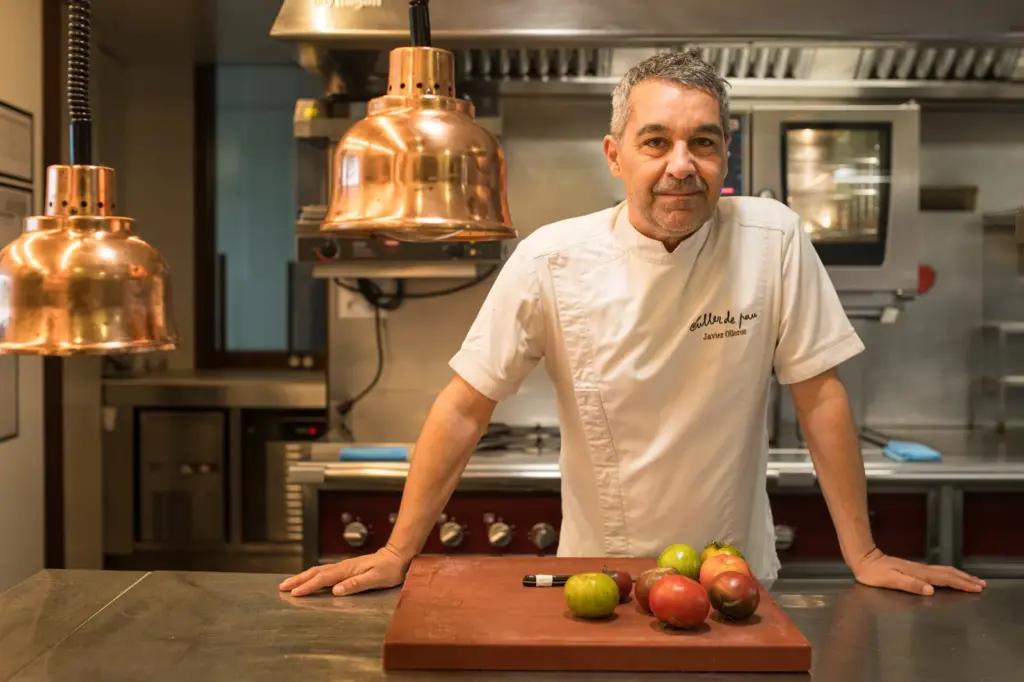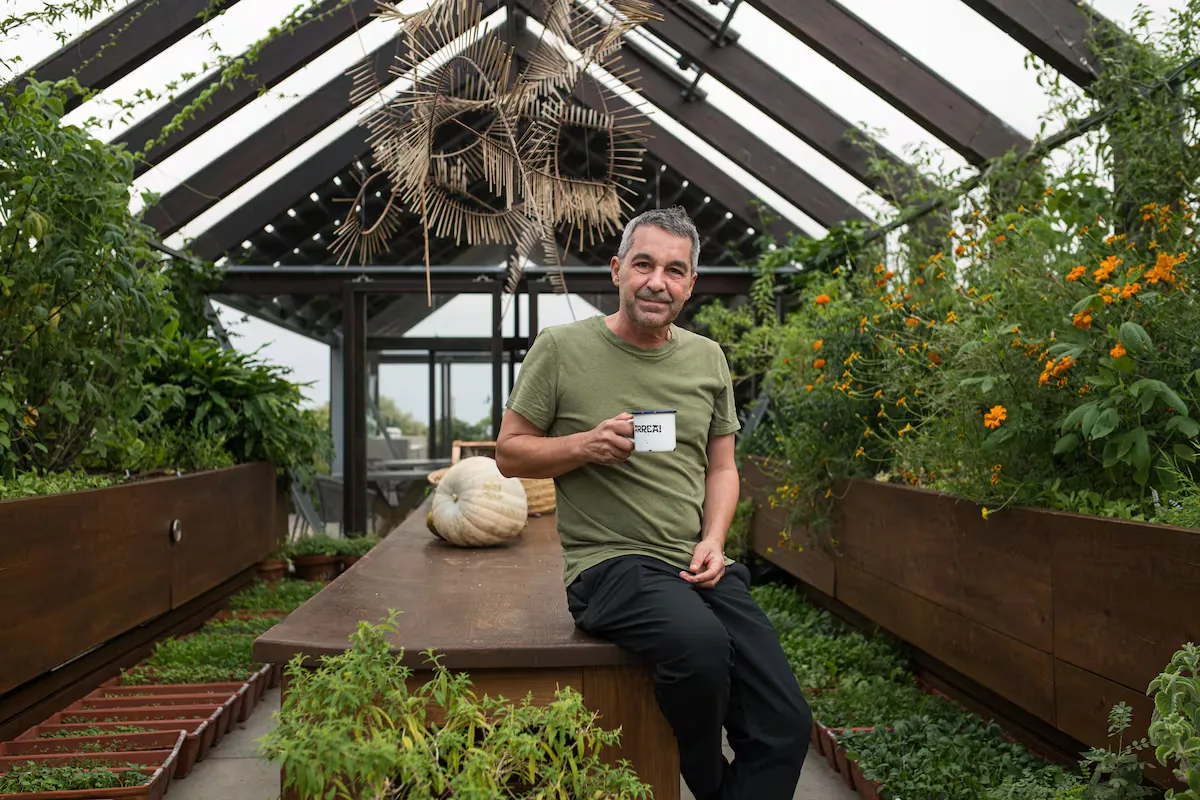
When Javier Olleros (Lucerne, Switzerland, 1975) and Amaranta Rodríguez (O Grove, 1983) saw a lone, suited man enter the dining room of Culler de Pau, their restaurant, in 2012, they speculated that he might be a medical representative. But after finishing his meal, the man asked them a few brief and quick questions before revealing his identity: a Michelin inspector. They earned one star that year and another eight years later, in 2020. Through the huge windows of the dining room, there is an impressive view of the Ría de Arousa and, if the timing is right, you can see the sun setting. Olleros’ father had left at 15, an orphan, with a wooden suitcase to Switzerland. Amaranta and Javi, in the early days at Culler, fought to answer the phone when it rang, because it rang rarely. Life is a mystery of dark rules, but sometimes work gives back what you put in. Olleros speaks — sitting in his greenhouse, next to his own garden, in front of a glass of wine — Olleros.
Read more Cassandra Wilson dies, diva of contemporary jazz with her versatile blues voice
Question. Your first memory.
Answer. Some big, white, beautiful sausages that my father brought home from Switzerland.
Q. What kind of cook was your father?
A. He is, he is. A cook of substance and flavor: everything he made was very tasty and with a different depth. He still cooks for everyone because that never goes away. I worked with him and for a time I made him my enemy.
Q. Father and son in their twenties doing the same thing and working together in a kitchen. Say no more.
A. Difficult. Besides being a mess and a troublemaker, I wanted to teach my father things when I was the one who had to learn. Over the years I began to understand what my father had given me through cooking: sensitivity, humility to accept that you always have something to learn and, above all, the value of substance, flavor, and doing things well. Also discipline, cleanliness, and order that he had learned in Switzerland. I was chaos. And I have managed to organize my life outside the restaurant as well.
Q. You try to disconnect. Is it hard?
A. At first, there were few of us, many doubts, the bank was always knocking on the door and you had to give your all. It happens to anyone who puts their savings and future into a project: there is a period where you clear doubts through hard work. I worked 15, 16, or 17 hours normally. I knew I was going to take time away from my friends, my children, my hobbies. There were dark times when I only thought about the restaurant. But I was clear that when everything was in order and I started to see it more clearly, I would have to give that time back: first to myself and then to my children and the other people I had taken it from. I’ve been trying for years.
Q. The first dish you were proud of?
A. Look, at first one thinks creativity is reserved for gods or the chosen ones. But in reality, things arise with experience and knowledge. I was a troublemaker, a bad student, and was marked by everyone; I doubted myself and thought I would never be able to create a dish alone, to have the spontaneous idea to combine one thing with another. The first was pressed octopus with a potato cream and sautéed grelos. I had learned to make the octopus that way with Toñi Vicente and had seen the potato foam at elBulli. It was a little Frankenstein. It didn’t turn out badly.
Q. You opened Culler de Pau in 2009. Were there nights when no one came in?
A. Yes. It was terrible and, at the same time, very beautiful. When the phone rang, we fought to answer it: we knew we had to win over the customer from the first gesture. Living in a wonderful town, with its peaks of influx, guaranteed us some work, but there were lonely and sad nights. During the first two years, we turned them into an opportunity to learn, search for recipes, and try new dishes. We had no customers, but we did have a large recipe archive. When the rush came, we already had that prior work.
Q. When the Michelin inspector arrived, did he make himself noticed?
A. We thought he was a medical representative because he was so well dressed. He introduced himself when he finished eating and was polite and very kind. One idealizes these things and thinks an inspector comes to judge you with a sharp tooth, but he understood our madness. And he helped me demystify the world of stars. He asked why we hadn’t sent a report earlier so they would know we were there; I answered that I had no idea what he was talking about. I went home thinking: “Shit, instead of telling him we wanted to get into Michelin, I told him I don’t know how it works.”
Q. The first star.
A. They called us on the phone. I hung up and went to get Amaranta: “Damn, honey, we got a star.” Michelin puts you on the map and attracts an audience that wouldn’t come without that star. But soon journalists started calling. There was one who threw little stones at our house window — we live just above the restaurant — to get an interview. I wasn’t enjoying it and thought: “If this is having stars…”
Q. What did you do?
A. We disconnected the phone, put on our slippers, which always comfort and help you feel you’re on the other side, and watched The Name of the Rose for the eighth time.
Q. Amaranta.
A. She is the one on top of everything: the director, the advisor, the one who tells you what no one else tells you, plugs holes, and stitches the seams of an increasingly complex suit. She also takes care of the apartments [they have created Dormideira, rental apartments attached to the restaurant].
Q. The product.
A. It is born from the vital need to be part of a place that welcomed me and allows me to be who I am: my town, O Grove. I understand cooking as an extension of its culture, its idiosyncrasy, and its way of life. I cook what I have nearby out of common sense: in front of the window is the Ría de Arousa, 800 meters away, one of the ecosystems with the greatest biological diversity in the world, and I am surrounded by gardens and fields. You just have to observe and listen to that environment to be part of it through cooking. I decided to return to O Grove and set up the restaurant here because I am from here, I know the locals, the places, and a culture of which cooking is part. Understanding this logic was natural.
Q. Is there a flavor from your childhood that you have been trying to reproduce your whole life?
A. There was a herb, a kind of clover that we called chucha here, that we ate for an acidity that made you cry. It wasn’t pleasant, but we liked to suck on it. When we jumped to get apples in the village priest’s orchard, its acidity mixed with that of those still unripe apples. That unique flavor was etched in my memory. Since Culler opened, I wanted to bring that herbaceous and acidic combination to a dish. We made a sorrel ice cream and a vinaigrette with some yellow chuchamel flowers.
Q. Any Galician product still undervalued?
A. Vegetables, greens. They need more prominence on tables. Galicia is mainly recognized for the sea and its good cows, but it has an incredible garden and a wonderful diversity in the countryside. Culturally, we still don’t have them so present. The plant world has been the great forgotten.
Q. Is there too much cooking made to impress other cooks?
A. There is a lot of cooking made to impress, I don’t know if cooks, critics, guides, or influencers. We lack cooking for people and to come down a bit from that pedestal. There is a lot of cooking that doesn’t come from within.
Q. Can haute cuisine exist without luxury?
A. Of course. This has caused me many contradictions: I like the village and the humble ingredient, but I have a restaurant that is not cheap and can only feed certain people. The expression haute cuisine, which appeared in the 18th century, was always intended for the upper classes of society, emperors, religion. The time has come to bring it down from that ivory tower and bring it closer to the earth and the people. Our idea of luxury must also change. Luxury can be, for example, offering a diner something freshly picked, ephemeral, prepared just for them and capable of connecting them with authenticity and nature, from which haute gastronomy has also distanced itself. Haute cuisine must be sensitive to the world that helped it become what it is. Hierarchies must be blurred.
Q. …
A. Culler de Pau has prestige. It is in a village and cooks its environment in a place devoid of glamour and those lights that sometimes blind us. The key to Culler is the village and understanding the local. If we have visibility and importance, it is thanks to that micro-world that is not above, but in the primary sector, in nature and the closest things. Without small producers, farmers, fishermen, cheesemakers, women of the sea, and even the humblest grass, Culler would cease to be what it is. From there we can start to change things.
Read more The average salary is no longer enough to buy a 75 square meter house in most of Europe