








If you want to receive the Ola Mundial newsletter to your email you can click here.
Read more Migrations begin regularization with 13,000 applications from foreigners
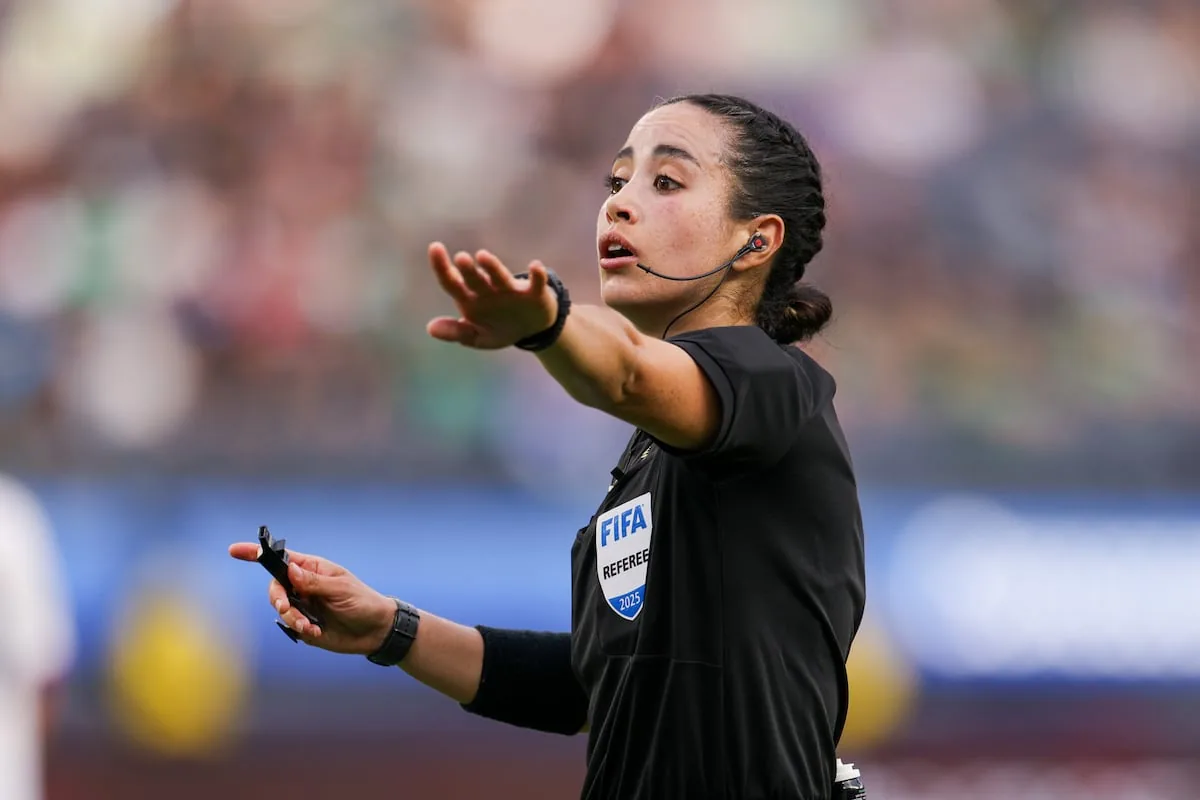
To become a World Cup referee, it is necessary to pass various quality filters that include high-performance physical tests, technical knowledge, and FIFA observation for three years in national and international tournaments. Since Qatar 2022, this process also includes women. This year, among hundreds of candidates, the highest football authority chose six female referees, only two as central referees, and one of them is the Mexican Katia Itzel García. The achievement is historic, as she will be the first national to achieve it. However, sexist reactions have not been long in coming.
García was chosen on Thursday to represent Mexico in refereeing the most important football tournament, and three days later she was already receiving insults for a match in her own country’s men’s league. Some journalists and photographers who were there accuse Mazatlán’s coach, Sergio Bueno, of saying: “now it turns out that a woman wants to come and prove she has balls,” after García blew the whistle for the end of the first half in a play that could have favored his team.
The referee later clarified in an interview that she did not hear and cannot confirm that phrase. But the comments that demean her are indeed there, where machismo is neither disguised nor hidden: on social media. Tweets from her own colleagues stand out. “Let’s not mix gender into the equation, it’s simply about ability and Katia Itzel doesn’t have it… If she were a man, based on her ability, she wouldn’t have the slightest chance of being a FIFA referee,” wrote retired referee Francisco Chacón.
Refereeing decisions often go hand in hand with controversy. There will always be those who doubt the person holding the whistle. However, despite claims to the contrary, the criticisms towards García are not limited to her work. The rejection starts with not calling her by her title. Fernando Guerrero, also a retired referee, wrote after the same match: “The referee prevents a clear goal opportunity for Mazatlán, the female referee stops the advance and benefits Pumas.” Both Chacón and Guerrero find it hard to say it as it is: referee (female).
Read more The near-impossible rescue of the stranded whale: Germany seeks how to save ‘Timmy’
These and other aggressions function as a symbolic strategy to discourage the presence of women in football. Minimizing their work is the first step: their performance, knowledge, technique, the quality of their work. And of course, this is not new. In a match between Monterrey and Cincinnati in the Leagues Cup, García received messages like “old woman, you had to be,” “we will dissolve you in acid,” “you will die,” or “we will kill your whole family.” The wave of threats was so serious that it reached FIFA president Gianni Infantino.
The Mexican Football Federation has not commented on the recent attacks, but the Council to Prevent and Eliminate Discrimination of Mexico City (COPRED) did, urging an investigation. National football is plagued with similar episodes. Nearly 80% of women in Mexican football have suffered this type of aggression, in a country that still lacks effective mechanisms to address them. The attacks against players, referees, and journalists seek to expel women from a sport historically dominated by men.
Six female referees have been selected for the FIFA World Cup 2026, continuing a trend started in Qatar 2022, the first World Cup with female participation in refereeing. This year, in addition to García as central referee, Mexican Sandra Ramírez will attend as an assistant referee. The positive: despite resistance, the presence of women in Mexican football continues to grow. García will referee a Mexican league match again this Saturday and, in two months, will do so in the most important men’s football tournament. She, Ramírez, and those who follow earned that place and have come to stay.