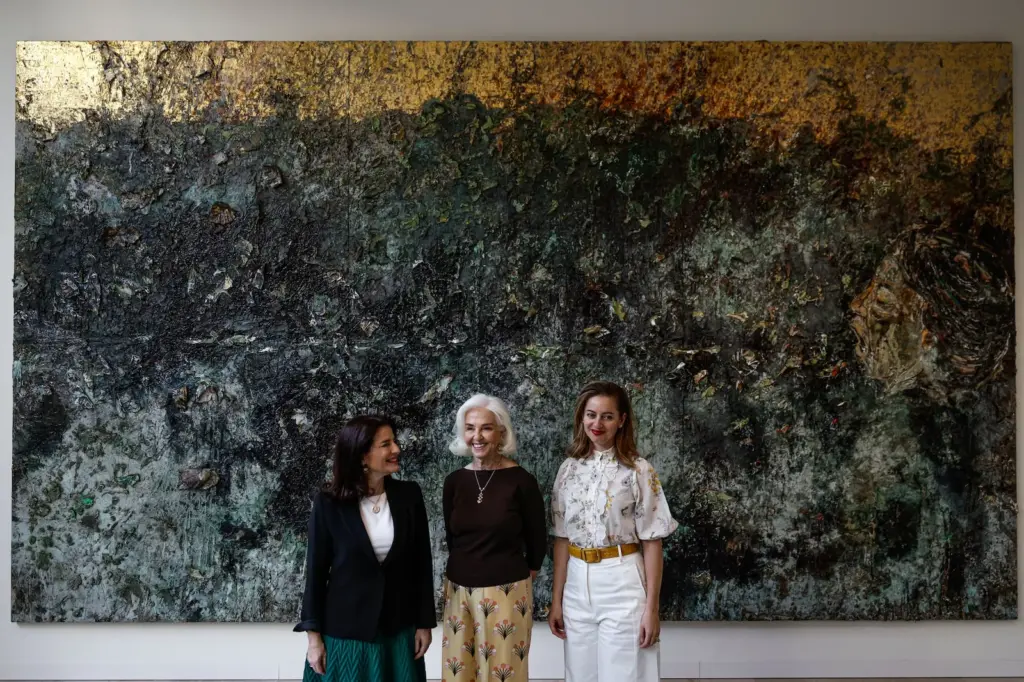









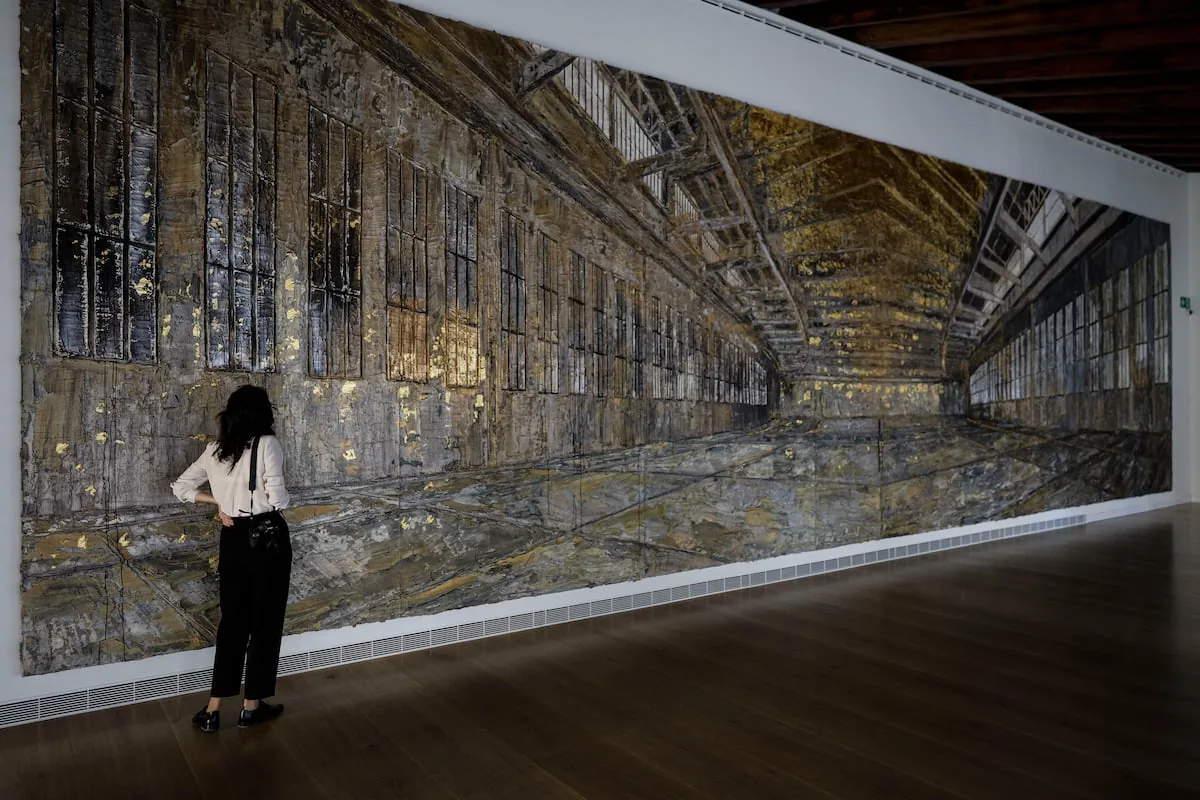
The canvas Danaë is the main protagonist of the exhibition dedicated to Anselm Kiefer that opens this Wednesday in Valencia. Not only because of its gigantic size of 13 meters wide by almost four meters high, nor because it has only been seen previously in New York before arriving at an old 17th-century palace in the city center, but also because it represents a synthesis, a compendium of the artistic concerns of the renowned German creator who combines layers of painting, history, and literature in his work, marked by matter, texture, and monumentality.
Read more The National Court acquits former Mercasa directors accused of bribing authorities in Angola
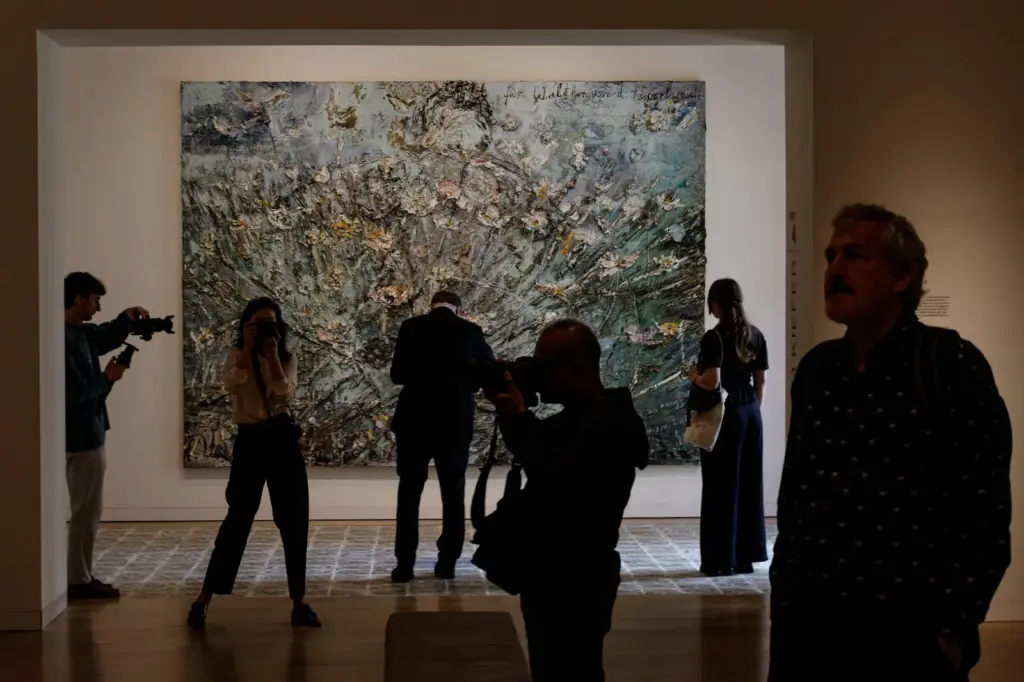
These concerns are also present in the 11 large-format works created in the last 20 years, with the exception of a 1974 canvas, which make up the exhibition at the Hortensia Herrero Art Center, on display until October. It is the first temporary exhibition at the center, opened two and a half years ago by collector and vice-president of Mercadona, Hortensia Herrero, and the first in Spain by Kiefer, whose work is present in the main contemporary art museums worldwide, since the Guggenheim Bilbao retrospective in 2007.
The enormous canvas (divided into seven panels for transport) recreates the interior of the endless and old passenger terminal of Tempelhof Airport in Berlin, designed by the Nazis, over which a shower of gold falls, with which Zeus possessed Danaë, locked in a tower. The princess thus conceived Perseus, who ended up fulfilling the prophecy that foretold the death of King Acrisius at the hands of a grandson. It is a classical myth reproduced in art history by painters such as Titian or Klimt, to which Kiefer gives a new dimension by reappropriating a Nazi symbol through architecture.
The terminal, today a cultural center, was conceived as part of Albert Speer’s urban project for Berlin, Hitler’s chief architect. “There is nothing inherently objectionable in Speer’s architecture. If Hausmann had not existed, Paris would not be one of the most beautiful cities in the world today. That said, as a person, Speer was an opportunist who used his intelligence and personal charm to convince the victorious powers. He never thought that the death of millions of people in concentration camps was a crime (…)”, the 81-year-old German artist replies to the exhibition curator, Javier Molins, in an interview published in the exhibition catalog. Kiefer, who has denounced his country’s past and reflected on the Shoah in numerous works, was unable to travel to Valencia for Tuesday’s presentation due to “a minor health problem”.
Textures and electrolysis
Molins emphasized the idea of the different layers that constitute history and also Kiefer’s material works, highlighting the use of lead and techniques such as electrolysis (to transform and generate textures), the presence of flowers and nature, and allusions, sometimes through painted words, to literature. The German artist was very pleased to exhibit his work in an old palace, which condenses the city’s history through vestiges preserved from Roman times to the present day, passing through Muslim, Jewish, and Christian cultures, the curator added.
Hortensia Herrero, wife of Mercadona’s president, Juan Roig, recalled that she bought the first of the four works she owns by the highly sought-after artist (and which are part of the exhibition) in 2016. She described her visit to one of Kiefer’s two studios in France as “amazing,” where he had reproduced the rooms of the Valeriola palace to scale to prepare for the exhibition, a palace rehabilitated and expanded by her foundation with an investment of 40 million euros. Herrero highlighted the artist’s “great energy,” who moves around his studio by bicycle, and his “generosity.”
When asked if, in their conversations with the artist, the curator and the collector had noticed any “concern” about the current rise of the far-right and populism, also in his country of origin, Herrero stated that he had not, and that in these relationships the author “gets straight to the point,” while also commenting that what he wants to say he “expresses” in his work.
The exhibition itinerary is structured around the “aesthetic affinities” of the works “I think in images. Poems help me. They are like buoys in the sea. I swim towards them, from one to the other; among them, without them, I would be lost,” in the words of the artist, born in Donaueschingen (Germany) in 1945. In 1992, he moved to France, where he lives and works between Paris and Barjac, near Avignon. He was a disciple of Joseph Beuys and in 2007 became the first artist since Georges Braque to receive a commission for a permanent installation at the Louvre Museum in Paris.