







The latest allocation of positions for the new specialists in Pediatrics and Family and Community Medicine, who have completed the official MIR training in the Community of Madrid, highlights the low attractiveness of the working conditions offered by the Primary Care Management. This is denounced by the Amyts medical union after revealing that out of the 139 residents called after finishing their specialized training, only 49 have accepted a position, which represents 35.3% of the total. More than half of the professionals that the region has just trained, evaluated, and certified choose not to join the system. “Residents do not leave out of whim or professional immaturity, they leave because the institutional message is clear: we do not care who you are, where you live, or how you organize your life, only that you fill a vacancy,” the union denounces. They oppose the so-called 4+1 contract, which establishes that professionals carry out their activity four days at their reference center and a fifth day in other care devices designated by the Administration to cover service needs.
“It is systematically expelling professionals,” insist Amyts after defending that Primary Care is based on proximity, trust, and continuous follow-up. “What pedagogical or care sense does it make to train medical specialists only to turn them on the fifth day into flying reinforcements who do not even know the clinical history of the patients they attend to?” the union asks. But they report that management has repeatedly defended this formula as a structural measure that “is here to stay.” However, two out of three new specialists have chosen not to join Madrid’s Primary Care under these offered conditions.
The union describes the situation as paradigmatic. “The aim is to perpetuate a policy whose only measurable result is the brain drain. Added to this is that the Administration talks about voluntariness in this contract when the alternative to not signing is dismissal before the first day of work,” they denounce. In their view, the rhetoric of stability, “which the Health Department tries to sell,” clashes with the reality of fragmented contracts, travel of more than 50 kilometers without computable travel time, and “unilateral imposition without binding union negotiation.”
If the declared objective was to retain recent graduates, the failure is absolute for Amyts, which argues that Primary Care needs permanent positions, real compensation, geographic proximity, and above all, a pact of respect with those who choose to sustain it. Otherwise, they warn, “residents will not stay and Madrid’s healthcare will suffer.” They insist that accumulated fatigue, forced travel, road risk in itinere, and loss of professional identity within a healthcare team are not side effects but design.” And when suffering is naturalized as a logistical virtue, the sentence of a Primary Care without anchorage, sustained by individual resilience until it collapses by pure human physics, is being signed.”
The Health Department points out that “the selection period has not yet ended” and that the “so-called 4+1 contract is voluntary.” But Amyts insists that people who applied to enter the process have already been called. “It is another matter that now they are doing a second round due to the failure of the first,” they clarify.
Read more One arrested for the massive leak of personal data of members of various State institutions
Specialists without overtime
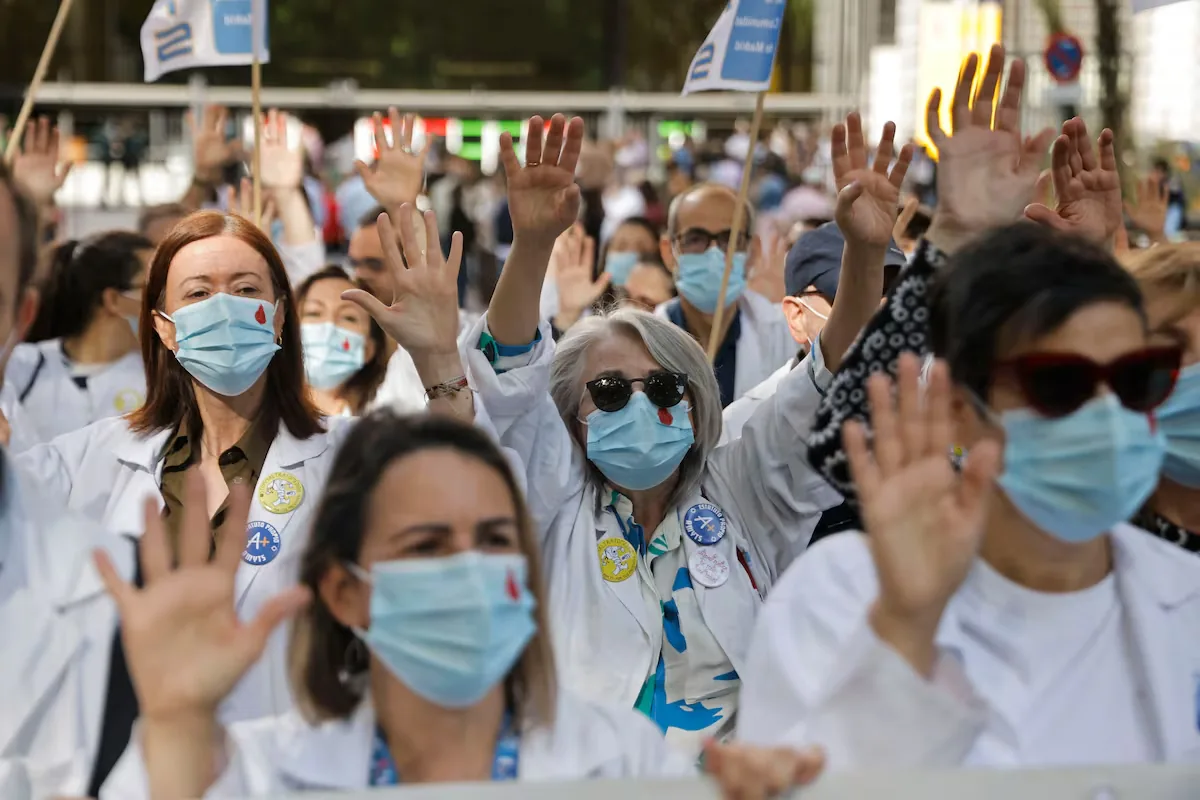
The situation seems to be complicated not only in health centers but also in hospitals. Starting this Monday, overtime shifts will cease in 19 hospitals of the Madrid Public Health Service, more than 80 services, covering 16 specialties. “It is a map of medical discontent,” Amyts recalls after apologizing to patients. “If nothing is done, there will be fewer and fewer doctors in the public sector,” they warn.
The initiative came from the Anesthesiology and Resuscitation service of the 12 de Octubre hospital, which last week announced the suspension of all extraordinary activity, called overtime shifts or management agreements, until the department responds to their demands, some on the table for more than a decade, including the increase of base salary supplements, the increase in on-call hour pay, and the return to a 35-hour workweek. The Community of Madrid, however, assures that it is the Ministry of Health led by Mónica García “who must act” in this regard.
The suspension of extraordinary activity by Madrid doctors will have a direct effect on the region’s waiting lists. According to doctors consulted by EL PAÍS, the Community of Madrid “encourages” them to do these extraordinary shifts with which it manages to carry out part of the outpatient consultations and surgeries that are pending.
Read more The French Navy intercepts a Russian tanker in the Atlantic