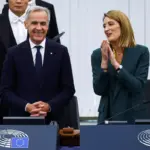







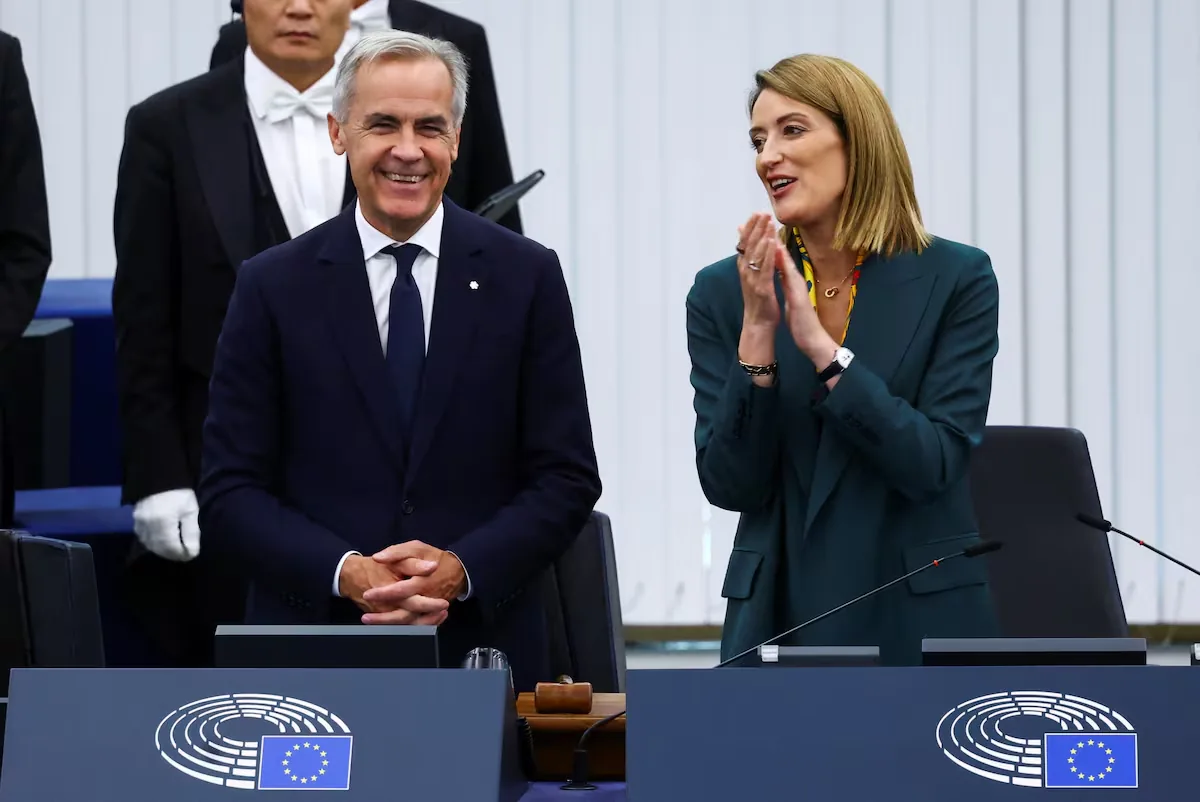
Canada’s Prime Minister, Mark Carney, stated this Thursday from the heart of the European Union, the European Parliament, that his country and the European bloc are “stronger together” and that a “deeper” cooperation between two regions that “share values” beyond interests, whatever form it takes or whatever it is called, will allow them to become a “beacon for other democracies” in times when the international order is shaking. “I am not proposing a third bloc to become a great rival power, even if with better manners,” Carney clarified in a speech before the plenary in Strasbourg.
Although not explicitly named in his speech, the U.S. President, Donald Trump, and the tariff threats made this Wednesday due to the rapprochement between Ottawa and Brussels, hovered throughout the hemicycle.
“We do not seek power to dominate others. On the contrary, we seek resilience so that no one can control our open markets, undermine our sovereignty, threaten our territorial integrity, or undermine our freedoms, our democracies, and our rule of law,” Carney defended a day after, from the same podium, the President of the European Commission, Ursula von der Leyen, proposed Canada become the “first associate member” of the EU.
“An alliance between Canada and the EU would become a beacon for other democracies, an alliance defined not by what we oppose, but by what we stand for: freedom, solidarity, prosperity, sustainability,” emphasized the Canadian Prime Minister, who did not hesitate to quote Goethe to underline that “one must fight for ideas” because, he recalled, “values do not defend themselves.”
Soon after, before the press, the Canadian insisted that the rapprochement with Europe is something “positive” and that Washington has no say in it: “No one is going to tell us what language we speak, no one is going to impose our culture or with whom we can sign agreements internationally,” he stated.
Carney’s presence this week at the plenary of the European Parliament — and no less than as an “honorary guest” at the State of the Union speech the day before — is further evidence of the willingness to get closer between the community bloc and Canada, reinforced since the sudden return of Trump to the White House to turn the world order upside down. There have been multiple gestures and nods with a country also a NATO member and also, like many European allies, under Washington’s scrutiny for its allegedly low defense spending.
Transatlantic sympathies intensified especially since Carney’s now famous speech at the Davos Forum earlier this year when, amid tensions over the Republican’s expansionist ambitions over Greenland, the Canadian Prime Minister spoke of the need for “middle powers” — a term that, however, does not convince everyone in a European bloc with about 450 million inhabitants — to ally to present a common front against abusive powers.
It is in this context that Von der Leyen, in the speech marking the start — and the shift — of the political year, announced this Wednesday her intention to “open the door to Canada” so that it can become the first “associate member of the European Union.”
Although it is not even clear in Brussels or other European capitals what that means — simply put, that figure does not exist in the treaties — the intended gesture of rapprochement threatens to become a new rift, which neither the EU nor Canada wants, with the volatile United States under Trump.
Although Von der Leyen made sure, just before making her “associate member” proposal before Carney, that the rapprochement between the EU and Canada “is not an alliance against anyone,” in Washington the reading has been precisely the opposite: hours after the European Executive’s chief speech, the U.S. President again launched his favorite threat, imposing “high tariffs” on the EU if that rapprochement with its northern neighbor occurs, with whom he maintains a renewed tariff dispute.
The Republican magnate even said he does not rule out “cutting trade” with the traditional European ally, one of the few with whom he has maintained, at least for now, the trade agreement with which Brussels managed to contain the Republican’s first global tariff onslaught.
“If I consider that [this EU and Canada project] is a hostile act, I will impose very severe tariffs or even cut trade with Europe in many areas. So, if they do it — if Europe takes that step with bad intentions (if the intention is good, no problem) — we will impose very high tariffs on Europe; it is a possibility,” Trump warned upon arriving in North Carolina for a rally.
Still, Brussels insists that it is not an aggressive move nor even passive-aggressive: “As our president made clear yesterday, the proposed strengthening of our cooperation with Canada is not against anyone, but aims to strengthen our union,” a community spokesperson reiterated this Thursday.
Read more From ‘digital friends’ to parental control: Brussels demands new conditions for AI used by minors