


The death of opera was staged, with almost liturgical solemnity, just over a century ago. On the night of April 25, 1926, at La Scala in Milan, Arturo Toscanini conducted the world premiere of Turandot, the work that Giacomo Puccini had left unfinished when he died 17 months earlier. The conductor stopped it exactly where the composer had laid down his pen: at the general pause in the third act that follows the chorus’s lament for the death of the slave Liù. He then put down his baton, turned to the audience, and announced: “Qui finisce l’opera, perché a questo punto il maestro è morto” (“here the opera ends, because at this point the master died”). The curtain slowly fell. The ending written by Franco Alfano would not be heard until the second performance.
Read more Education calls teacher unions this Friday to negotiate a way out in the fourth week of the strike
One hundred years later, the question posed that night remains open: how to conclude the unconcludable. The problem is musical, but also dramaturgical. Alfano’s vertical orchestration, devoid of inner life, does not help, nor does his inability to weld the voices in the final love duet. Nor does that mosaic of motifs guarantee a true dramatic progression. Not even Luciano Berio, with much more skill, managed to resolve the immense stumbling block of Turandot‘s ending in 2002.
The dramaturgical difficulty persists: how to make the metamorphosis of a mythical and ruthless character like Princess Turandot into a sensitive and vulnerable woman believable during the final 15 minutes without stripping her of her heroic character? It is becoming increasingly convincing to re-edit the solution adopted by Toscanini on opening night. This has been done by Barrie Kosky in Amsterdam, in 2022, and Sebastian Baumgarten in Zurich, in 2023.
Àlex Ollé‘s production, premiered last June 3 as the culmination of the excellent season at the Palau de Les Arts, precisely founders on that problematic ending. The proposal by the Barcelona stage director, coming from the New National Theatre of Tokyo and the Tokyo Bunka Kaikan, where it premiered in 2019, maintains Alfano’s conclusion, but suppresses the brief monologue where Turandot recognizes her love for Calaf and has the protagonist cut her own throat in the final bars. The idea is not new: Núria Espert proposed something similar in 1999, in the production that reopened the Liceu in Barcelona. But the moment chosen by Ollé, at the end of the chorus that fervently celebrates the princely couple on the motif of the famous Nessun dorma, in a luminous D major, goes against all logic of musical dramaturgy. Such an outcome would require other conclusive chords.
In the final bows, musical director Mark Elder showed some discomfort with the revival’s stage team, whom he did not invite to come out and bow alongside the singers and choir director. The veteran British maestro perhaps did not want any boos to mar the enormous ovation he had just received, with a good part of the Valencian audience on their feet. And it is that his direction was once again the most outstanding aspect of the entire production.
The new principal conductor of the Orquestra de la Comunitat Valenciana offered a reading of rare precision of Puccini’s most modern orchestral score. Attentive to the composer’s metronomic indications, he brought out his entire modernist palette —the bitonal attacks that punctuate the work, the tension accumulated in the ostinati, the brilliance of the celesta that runs through numerous passages— without sacrificing the late-Romantic breath of the most lyrical pages. But perhaps the most revealing aspect was his mastery of transitions: the way in which, in the first act, the frenzy of the crowd gradually dissolved into the invocation to the moon. The result was a sound control of great power, extraordinarily clear in the choral scenes and always sustained by admirable narrative fluidity.
In the cast, soprano Carolina López Moreno shone brightly as Liù. The 35-year-old Bolivian-Albanian singer, raised in Germany, began her international career with this very character in 2021, at the Puccini Festival in Torre del Lago. Since then, she has moved towards more spinto roles, such as the protagonists of Madama Butterfly and Manon Lescaut, and her current Liù benefits from this vocal maturation. Already in the first act, she made a difference with Signore, ascolta, thanks to her timbral beauty, the solidity of her emission, and a melting pianissimo in the high register that drew the first applause of the night. But it was in Tu che di gel sei cinta, the aria that precedes her death in the third act, where she reached the peak of the performance: an interpretation of intense emotional voltage, also sustained by an exemplary dramatic delivery.
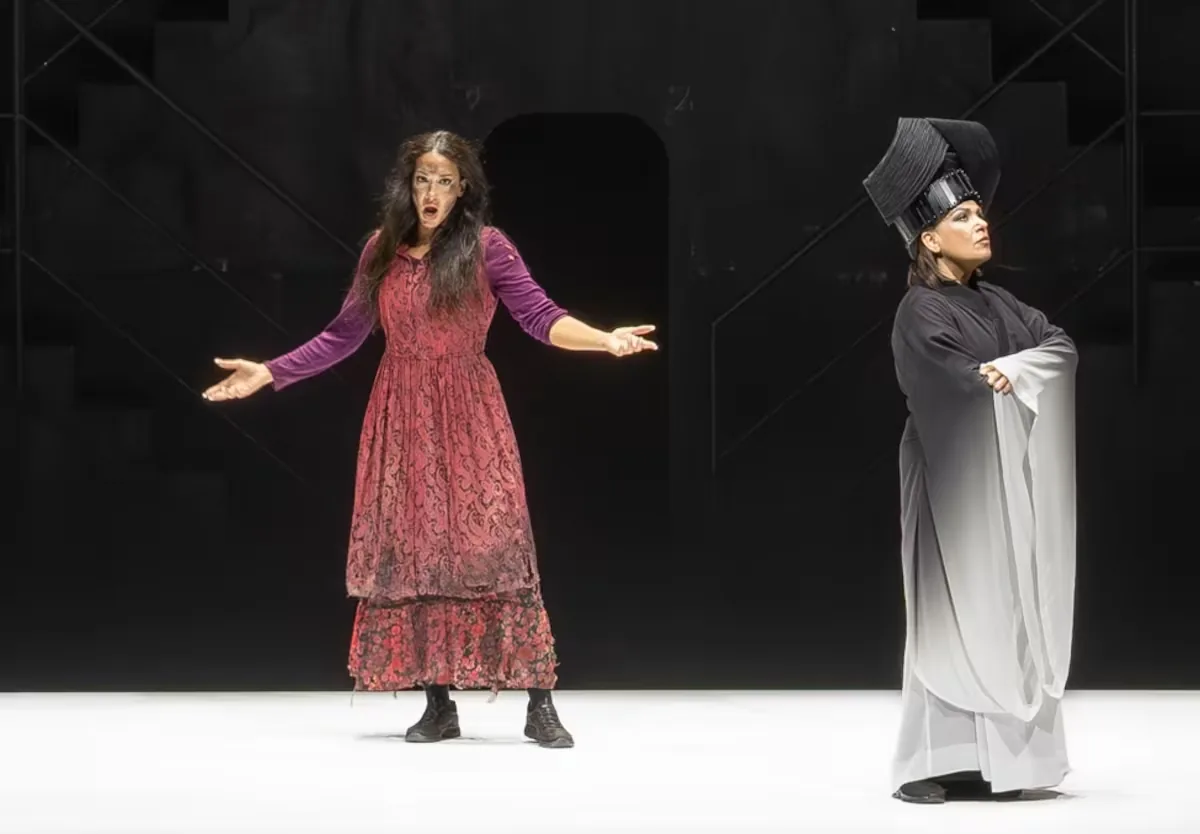
The leading couple was a point below. It was a challenge for mezzosoprano Ekaterina Semenchuk to embody the dramatic soprano role of Turandot, which she has been singing since 2023. The Belarusian singer’s voice was solid, although it sounded strained and strident in some high notes, as happened in the climax of In questa reggia, although she endowed the character with very powerful middle and low registers. The Calaf of veteran Gregory Kunde was also convincing; at 72, he did not shy away from the difficulties of the role and resolved them with nobility and good phrasing. His stamina in Nessun dorma was admirable, where he lingered on the high B natural of the climatic Vincerò, although his voice already showed signs of wear, with a rather widened vibrato.
Read more ChatGPT becomes the fastest app to reach 1 billion users
In the trio of ministers, the young Barcelona baritone Jan Antem stood out, a Ping as lyrical as he was ironic. Alongside him, the Bilbao character tenor Mikeldi Atxalandabaso, as Pong, and his Cordovan colleague Pablo García-López, a former student of the Centre de Perfeccionament de Les Arts, as Pang, showed their skill. The experienced Chinese bass Liang Li was very persuasive as Timur, especially after Liù’s death. Tenor Josep Fadó showed good vocal means as Emperor Altoum, and baritone Agshin Khudaverdiyev was a resounding Mandarin at the beginning of the opera.
Special mention goes to the Cor de la Generalitat Valenciana, which shone in the choral scene of the first act, from bloodthirsty fervor to lunar invocation. The young people from the Escola Coral Veus Juntes and the Escolania de la Mare de Déu dels Desemparats also brought freshness to the repetitions of the Chinese folk song Mo Li Hua (jasmine flower), which Puccini learned about thanks to a music box from his friend Baron Edoardo Fassini-Camossi, a former diplomat in China.
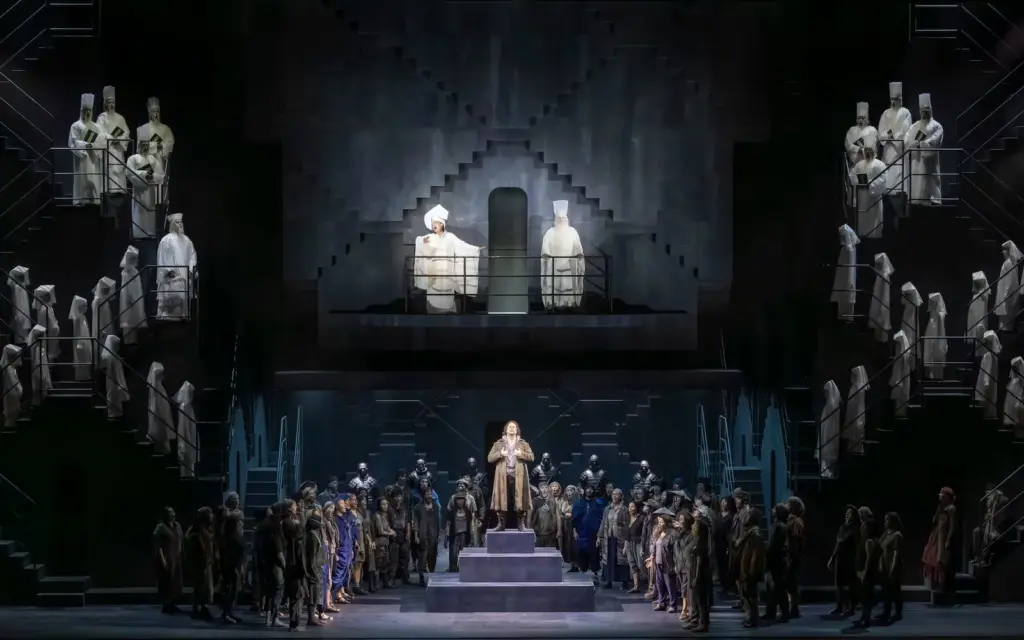
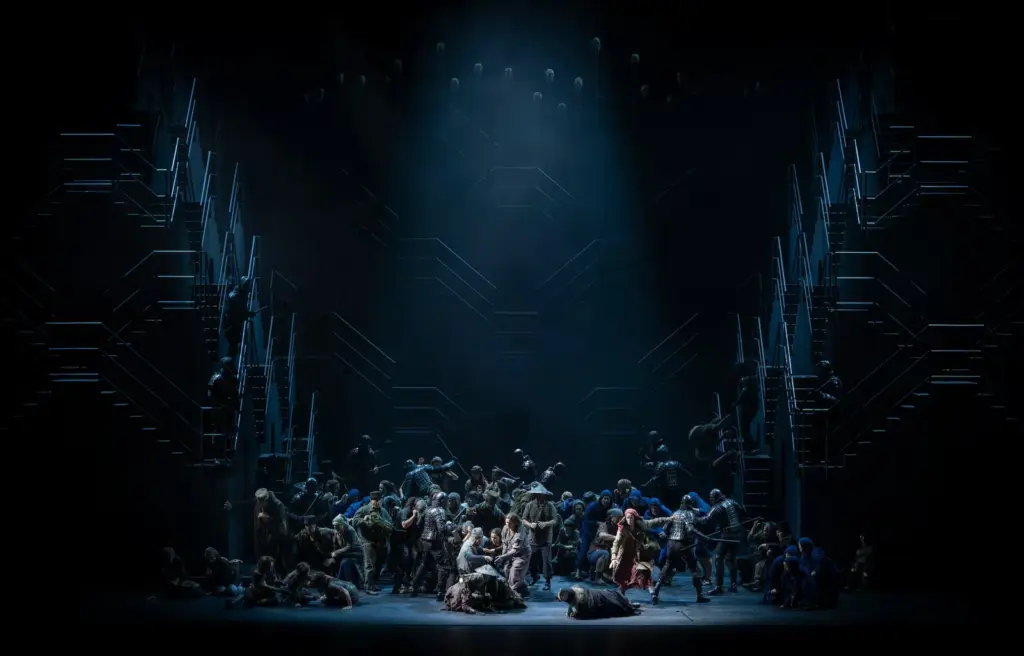
The production actually begins with an unnecessary addition before a single note is played: a silent staging of Turandot’s trauma based on the story of Princess Lou-Ling, abducted and murdered by a foreign prince. Once this prologue is overcome, and with the exception of the aforementioned ending, Àlex Ollé‘s production boldly and visually meets the opera’s scenic demands. It does, however, suffer from a lack of true actor direction, although the movement of the ensembles is effective within the monumental stepped steel and stone structures of Alfons Flores‘s set design.
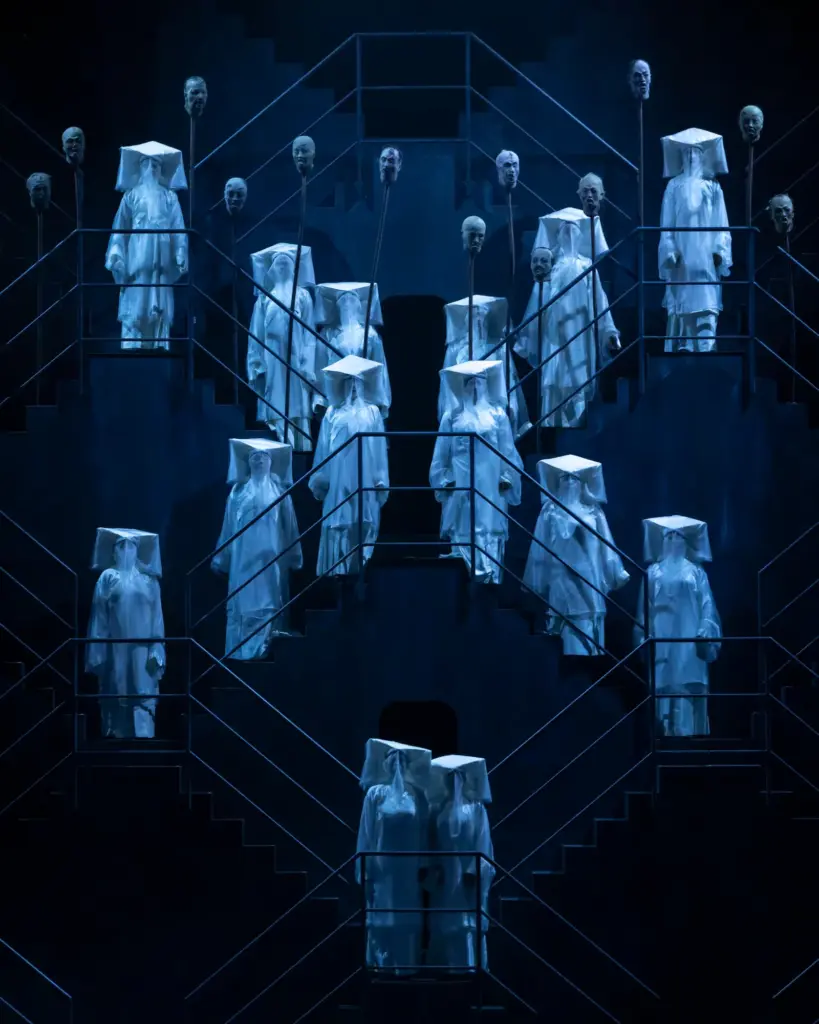
It is a cold and brutalist space, underscored by Urs Schönebaum‘s stark lighting and complemented by Lluc Castells‘s apt costumes which, far from chinoiserie, function as visual and hierarchical separation: from the hieratic monumentality of the emperor and princess to the dehumanization of the people, passing through the terrifying guards and the ceremonial maidens of the princess.
But the paradox of the ending persists. Toscanini stopped the music so as not to betray the drama; Ollé keeps the sonic apotheosis intact —that radiant D major on the theme of Nessun dorma— and contradicts it on stage. The score proclaims a triumph of love that the scene denies with a knife. The eye and the ear contradict each other, and it is the music that, this time, claims the last word.
‘Turandot’
Music by Giacomo Puccini & Franco Alfano (end of the third act). Libretto by Giuseppe Adami and Renato Simoni, based on La fiaba cinese teatrale tragicomica (1762) by Carlo Gozzi and on the German adaptation Turandot, Prinzessin von China. Ein tragikomisches Märchen (1802) by Friedrich von Schiller, in the Italian translation by Andrea Maffei (1857)
Ekaterina Semenchuk, mezzosoprano (Turandot); Liang Li, bass (Timur); Gregory Kunde, tenor (Calaf); Carolina López Moreno, soprano (Liù); Jan Antem, baritone (Ping); Pablo García-López, tenor (Pang); Mikeldi Atxalandabaso, tenor (Pong); Josep Fadó, tenor (Altoum); Agshin Khudaverdiyev, baritone (A Mandarin).
Read more The Government is finalizing a 400 million plan for energy rehabilitation of hospitals and schools
Escola Coral Veus Juntes (Directors: Marta Mármol, Roser Gabaldó)
Escolania de la Mare de Déu dels Desemparats (Director: Luis Garrido)
Cor de la Generalitat Valenciana (Director: Jordi Blanch Tordera)
Orquestra de la Comunitat Valenciana.
Musical direction: Mark Elder.
Stage direction: Àlex Ollé. Revival director: Anna Ponces.
Palau de les Arts, June 3. Until June 16.