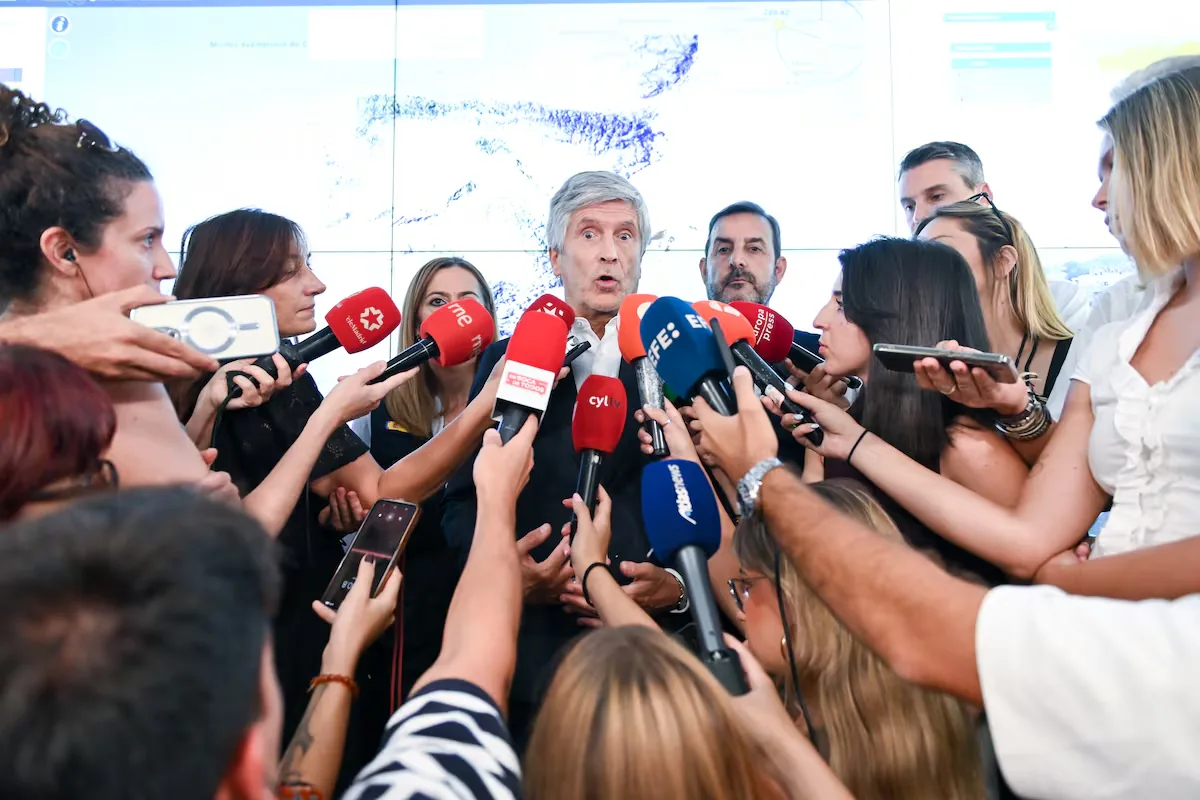
The Minister of the Interior, Fernando Grande-Marlaska, announced this Thursday the arrival in Ceuta of about twenty agents from the Central Brigade of Immigration and Borders of the National Police to expedite the necessary bureaucratic procedures to proceed with the expulsion of the 5,000 irregular migrants who, he acknowledged, still remain in the city after the massive entry on July 30. The agents thus join another team of six agents from the Central Unit of Expulsions and Repatriations (UCER) who arrived in the city when the migration crisis broke out with the sole objective of supporting the Ceuta staff in the tasks of identification, registration, and documentation of the hundreds of adults still in the city to proceed with their return to Morocco. “The vast majority will return to Morocco as soon as possible,” he emphasized.
Marlaska stressed in the press conference that of those thousands of people who still remain in the autonomous city, “no person will stay in Ceuta, none will go to the peninsula, none will be regularized,” except for “those exceptional cases and of maximum vulnerability,” he added. The minister wanted to send a message “to those who long” to reach the autonomous cities so that “they do not listen to the mafias that play with their lives.”
So far, the Interior Ministry has estimated that 72,000 people entered the city that day, of whom it claims that 70,000 returned to the Maghreb country. However, government sources have begun to raise the first figure to 80,000, in line with what the president of Ceuta, Juan José Vivas, has been defending for some time. This Tuesday, Marlaska also implicitly raised the number, as he went from stating days ago that 2,000 people remained to talking about 5,000.
Along with the immigration experts, the minister announced the arrival of 45 members of the Prevention and Reaction Unit (UPR) from the staff of Madrid, Alicante, and Seville. The objective of these, experts in maintaining public order and preventing crime, is to increase police presence on the streets following complaints from Ceuta residents about an alleged increase in crime. Last Wednesday, the Superior Court of Justice of Andalusia detailed that the courts of the autonomous city have sent nine immigrants who arrived in the massive entry to prison in recent days as alleged perpetrators of crimes. Two of them are accused of separate sexual assaults on minors who had also arrived in the city on July 30. The judges also ordered the expulsion of two others for different crimes. Marlaska reiterated this Tuesday that he had given orders to the security forces for the immediate expulsion with judicial authorization of all those detained.
The reinforcement announced this Thursday by Marlaska is not the first since the crisis broke out. On the same day of the massive entry, the Interior Ministry sent about 350 agents to support the staff of both forces in the city, which that day were overwhelmed by the massive entry of migrants swimming from Morocco. Currently, there are 880 national police officers (270 more than usual) and 714 civil guards (200 more) in the city.
Read more Ariana Grande makes her relationship with Ricky Álvarez official with a post on Instagram
Thus, the National Police sent a first immigration team and deployed five teams (225 agents) of the Police Intervention Units (UIP, the so-called riot police) from Seville, Malaga, and Madrid to carry out citizen security tasks on the streets. The UIP group and the UPR personnel who are part of the autonomous city’s staff, and whose personnel have doubled shifts to maintain a significant police presence on the streets, joined this same function. Finally, it incorporated another 45 UIP agents and six from the General Commissariat of Information, responsible for the fight against terrorism.
For its part, the Civil Guard sent three platoons (a total of 60 agents) to reinforce border surveillance to the personnel of the Reserve and Security Group (ARS) permanently assigned to Ceuta. Another 160 civil guards from different units in Andalusia joined citizen security tasks, in which they have had the support of 2,000 members of the Armed Forces stationed in the autonomous city.
For sea and coastal line control, since the entries have occurred by water bordering the El Tarajal breakwater, the armed institute sent two groups of divers (eight personnel) from the Special Group of Underwater Activities (GEAS) and the Duque de Ahumada ship, the largest of the armed institute, with a crew of 12 civil guards. In Ceuta, the Maritime Service permanently has two medium boats and four zodiac-type boats assigned. Subsequently, five boat captains, three sailor-mechanics, and drone pilots joined. The Air Service was reinforced with a helicopter.