









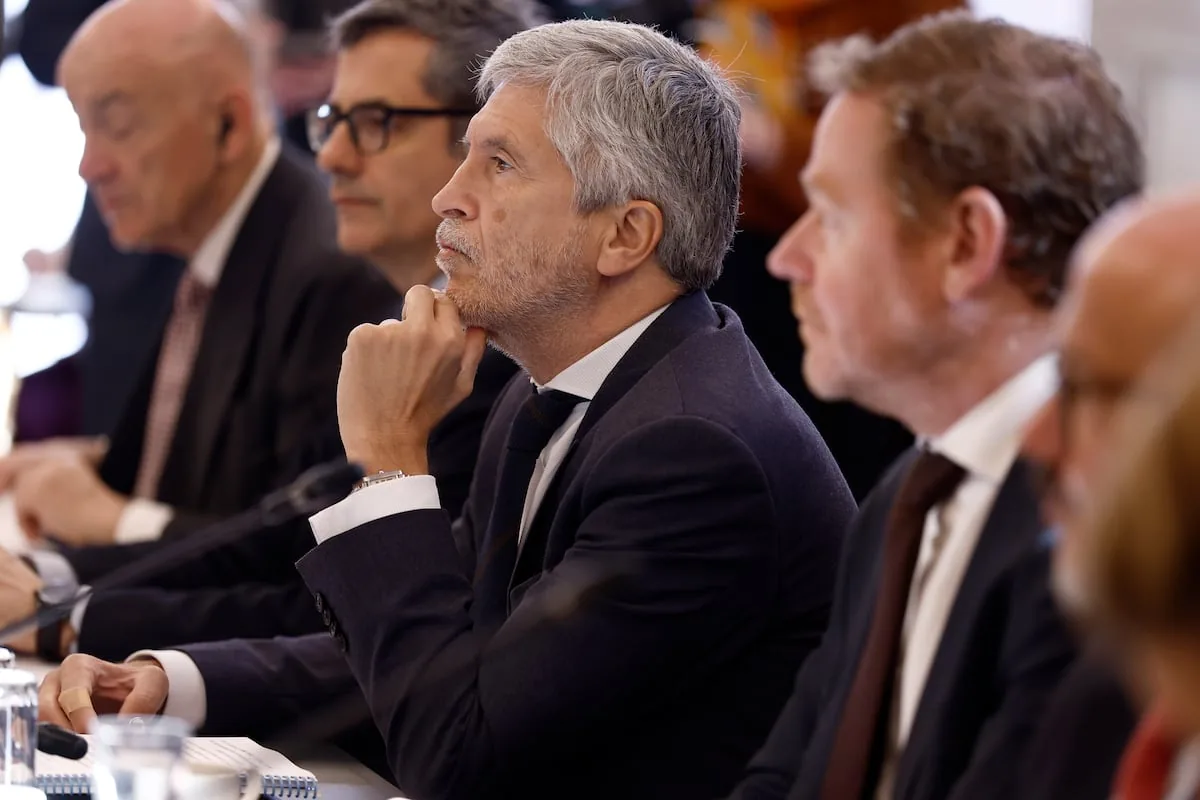
The Minister of Interior, Fernando Grande-Marlaska, has urged the European Union to prohibit the manufacture, possession, and crewing of high-speed vessels and semi-submersibles, known respectively as narco-boats and narco-submarines, and for its member countries to include in their penal codes legal provisions that contemplate prison sentences for violating them, as Spain has done since 2018. He did so during the meeting held this Monday in Paris by representatives of the so-called Coalition of European Countries against Organized Crime ―of which, in addition to Spain, France, Germany, the Netherlands, Italy, Belgium, and Sweden are members― and in which the European Commissioner for Home Affairs and Migration, the Austrian Magnus Brunner, also participated.
Read more Bárcenas’ mission to another inmate and the secret recording of Rajoy
Grande-Marlaska, who was accompanied by the Minister of Justice, Félix Bolaños, insisted before the representatives of the seven coalition countries on the need to “intensify the response” against fast boats, known by the English term go-fast, and semi-submersibles in the new EU strategy against drug trafficking that will cover the period 2026-2030. “We must act more firmly against the logistical facilitators who support the activity of these networks,” insisted the minister.
Since Spain changed its legislation almost eight years ago to prosecute the transport of drugs and immigrants in fast semi-rigid boats and prohibited their private use, the results have been significant. Although the official statistics of the Special Security Plan for the Campo de Gibraltar do not specify the exact number of these vessels seized by security forces, a substantial increase in the total number of intercepted vessels is evident. It has gone from 22 in 2018 to 1,699 in 2024, the last year available. From 2019 to 2024, the annual average of seized vessels is 238.
Along these lines, Grande-Marlaska has requested that the other country that penalizes the manufacture, possession, and crewing of narco-boats, Portugal, join the coalition, considering that it has a “key geostrategic position” between Europe, Africa, and America and its coast “is an essential node in maritime and logistical flows, very relevant for the early detection and interruption of illicit routes in the Atlantic.” The proposal has been approved by assent from the other six countries, according to ministry sources.
Read more Unions call to turn May Day into “a cry against war and vassalage to Trump”
Precisely, the Lisbon authorities enacted a law last October that increased control over the manufacture, possession, and crewing of high-speed vessels, which included prison sentences for violating it. Coincidentally, it came into force one day after a corporal of the Republican National Guard died in the Guadiana River while pursuing a narco-boat. Even then, Grande-Marlaska described Portugal’s decision as “a great step against organized crime.” Following the tightening of Spanish laws against narco-boats, the coasts of this country had become a refuge for manufacturing and storing these vessels used in cocaine and hashish trafficking by mafias from northern and southern Spain.
In his speech, the minister stressed the importance of extending the fight against drug trafficking beyond the EU and seeking the collaboration of drug origin and transit countries. “Latin America and the Caribbean are priorities,” he emphasized. Along the same lines, Bolaños has called for action against what is known as petaqueo, the supply of fuel to narco-boats, which since last February has been an autonomous crime in the Spanish Penal Code, punishable by up to five years in prison.
Finally, the members of the Coalition, which was born in 2021 in Brussels at the initiative of the Netherlands, have approved a joint declaration that includes their action plan until 2028. In it, the seven countries set five priorities in the fight against organized crime: dismantling international criminal networks; advancing towards resilient logistical nodes and maritime security, in support of the European Ports Alliance; attacking illicit financial flows and assets; acting on prevention; and strengthening international cooperation.
Read more Thousands of people queue in L’Hospitalet: “With regularization, I’m looking for some stability”