









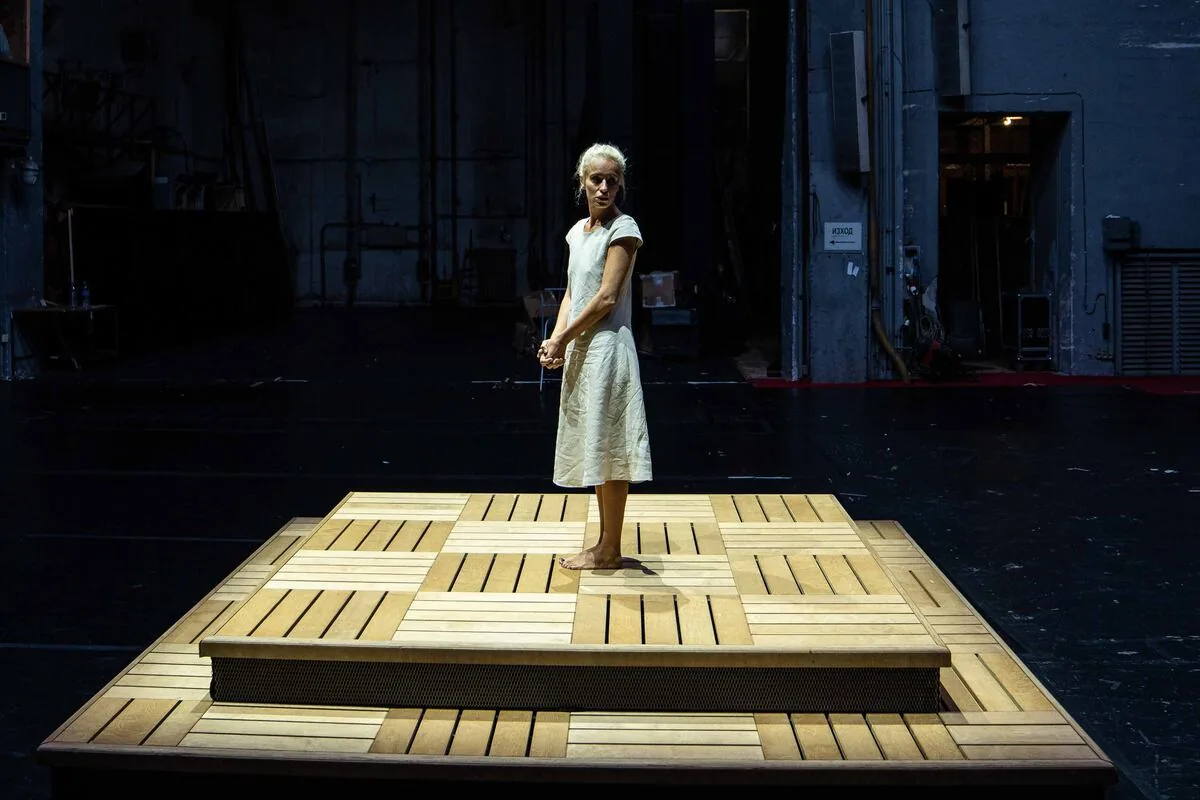
Declan Donnellan loves working with actors from countries with Catholic traditions and Orthodox roots, such as the troupe from the Ivan Vazov National Theatre in Sofia, with whom he premiered an exact and vibrant Medea in Madrid this Thursday, which was intensely applauded. Perhaps these elective affinities are because he was born into a Catholic Irish family: Catholics and Orthodox have the belief in free will imprinted, while the Reformation established a deterministic view of existence.
Read more Sinner, as always, reaches another final and points: he, the absolute dominator of this spring
Although most of Donnellan’s youth and early maturity career took place in the United Kingdom, about two decades ago he began working frequently with French companies and forged a close relationship with a Moscow theater, with which he visited Spain twice. After the sanctions imposed by the European Union on Russia, he began working in Romania, where he staged a memorable Oedipus Rex. This production, in which the audience wandered among the performers, side by side, all on stage, enchanted the audience at the Teatros del Canal, which also showcased a less celebrated Hamlet. In Spain, Donnellan made a powerful staging of Life is a Dream, which he took with the National Classical Theatre Company throughout Europe. He then staged The Two Gentlemen of Verona, an early work by Shakespeare, with the same company.
In the Medea premiered yesterday, the audience is also standing on stage, but this time around a platform symbolizing several central places of the turbulent love between Medea and Jason: their shared home in Corinth; a raft torn from the Argo (the ship that brought them there); and that human island that is Medea herself. It is an island because she is separated from her family, whom she betrayed; she is exiled in a country where a foreign language is spoken, and she has just been cast aside by her husband. Jason, who could not claim the hereditary throne in his native Iolcus, usurped by Pelias, his paternal uncle. The leader of the Argonauts has just made a catch. He is going to marry Creusa, daughter of Creon, king of Corinth. Medea knows that the offspring Jason has with the princess will displace the two little ones she bore during their decade of marriage.
Medea may be as much a sorceress as one wants, but she was always a woman blinded by passion. Since she met Jason in her native Colchis (a Caucasian territory corresponding to today’s Georgia), the adventurer used her to snatch the Golden Fleece from Medea’s father, a ram’s skin with magical properties. Pelias had tasked Jason some time ago with the search for the Fleece to keep him away. Seduced, Medea acted against her father’s interests. Not only did she give Jason the keys to overcome the two fire bulls and the serpent guarding the prize, but she also killed her own brother, dismembered him, and threw his remains into the waves so that the sailors of her father’s ship, about to board the Argonauts’ ship, would be distracted fishing out the pieces of the unfortunate Acastus. In short, she herself was quite a piece.
Since the Greek audience knew this whole story inside out, Euripides skips it Olympian-style to begin his tragedy in media res: Medea has just taken the blow Jason announces to her. He is going to marry Creusa. In Donnellan’s production, the young couple dances holding each other, strangely, because Jason holds her from behind, his chest against her back. The audience has surrounded them, expectant, which is a way of embracing them in turn, when the tutor bursts in, here transformed into a physical trainer who plays ball with the couple’s two children. That is the instruction that matters: the one that can ensure the future of the children of princes removed from the throne who await stepbrothers, who will in turn displace them.
The announcement that she will be banished in 24 hours determines Medea to kill the promised princess, but also her own children, to leave Jason without descendants. In this production, the reflective protagonist approaches a group of female spectators and addresses them one by one: “How will I kill them? In which city will I find refuge?” she asks them. More than the empowerment process of the protagonist, appreciable in the Televisión Española production starring Lola Gaos in 1966, in Donnellan’s production we witness the revolt of a feverish woman, with features and physiognomy as sharp as those of the Spanish actress.
Radina Kardzhilova is a powerful performer, whose active presence tightens the dialogues with her antagonists. Her sun-kissed complexion sets her apart from the pale women of Corinth, with whom she maintains a close complicity: they do not share her decisions, but they understand her. Velislav Pavlov’s Jason is a Tartessian, Gaditan, Sardinian, bearded heartthrob, very full of himself: “I gave you the chance to be famous,” he tells her, like a film producer would say to a star displaced by a younger one. It is glimpsed that he is a guy with a lot of style and little substance, compared to a Medea who seems about to lose herself. She occupies the center of the stage: she is almost permanently on the platform, while Jason enters and exits among the audience, seeking other horizons.
Read more Reduced fees when paying for gasoline with card or vouchers: what changes from May 1?
Between Aegeus by Asen Dankov and Kardzhilova’s murderous wife there is more than words. Medea is not going to give him a potion to cure his infertility: the potion is herself. Once she opens the doors of her womb to him, she will give him a child if he swears loyalty and protection. Since Aegeus agrees, Medea leaves her inner turmoil for the first time since the play began and approaches several female spectators to give them a happy kiss.
The show runs smoothly, energetically, and perfectly. It presents no novelties nor does it intend to. It tells the story cleanly and vigorously. Nothing more can be asked here. Donnellan has a loyal audience to whom he is indebted. While I think about this, a critic without a notebook makes notes on his own hand. The play reaches its tragic ending as happily as it began, and Donnellan came out to greet, with Kardzhilova on his arm.
The darkness of Medea is comparable to that of the protagonists of Ugly, who are physically the antipodes of her. This piece by Guillermo Calderón, inspired by The Night of the Ugly by Mario Benedetti, is a diamond of puppet theater for adults. It is performed by Aline Kuppenheim and De Teatro y su Doble, a Chilean bunraku company also at the Teatros del Canal, in their Negra hall. It took them two years of work to complete this show that combines film, puppets, shadow actors, and voices of top figures from the country’s stage and cinema.
The love story between two helpless characters surprises, captivates, and stirs the soul until it dissolves the dregs. Calderón has filled the brief but inspired Benedettian tale with nuances and completed it with forcefulness. The staging, subtle and mathematical, and the virtuosic manipulation of these almost human puppets, which even have their intimate parts, lead the spectator through an emotional labyrinth, in which the two protagonists, characterized by their deformity, awaken unease and empathy, also because Kuppenheim has arranged for them always to show their best profile. Only at the moment of the bows do we get to see the full faces of the woman bitten by a dog as a child and the man born twisted from the root. It is a shame that Ugly is not performed for one or two weeks, given its exceptionality.
Medea
Text: Euripides. Direction: Declan Donnellan. Cast: Radina Kardzhilova, Velislav Pavlov, Valentin Ganev, Asen Dankov, Yavor Valkanov, Stelian Radev, Vyara Tabakova, Radena Valkanova, Joreta Nikolova, Stafania Koleva, Elena Ivanova, Nadya Keranova, Ana Papadopolu and the children Nikola Sarzhev and Petar Sardzhev. Teatros del Canal. Madrid. Until May 3.
Ugly
Text: Guillermo Calderón. Direction: Aline Kuppenheim. Company De Teatro y su Doble. Teatros del Canal. Madrid. Until May 2.