









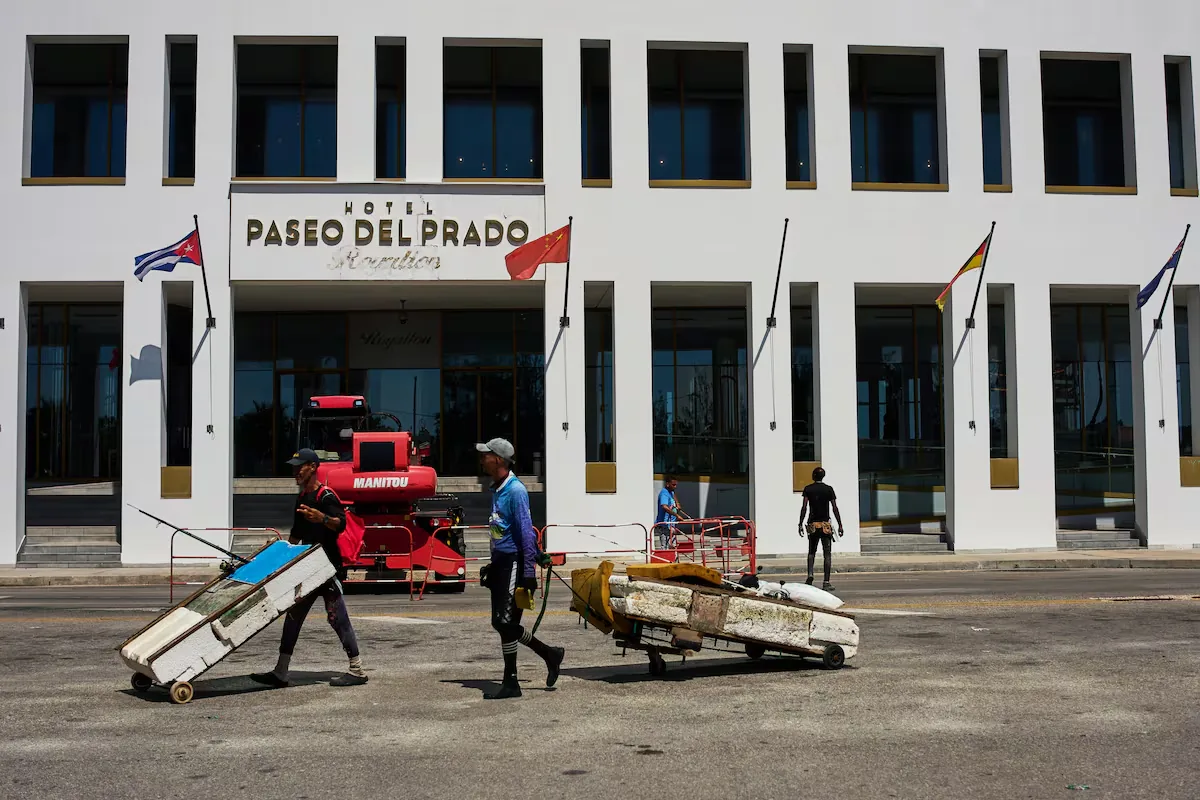
Foreign companies working with Gaesa, the military conglomerate that controls 70% of Cuba’s GDP and which the US president accuses of economically suffocating the population, have not waited until this Friday, June 5, the deadline set by the United States, to announce their disengagement from the military arm of the Cuban Executive and thus avoid the millionaire sanctions they could suffer. But the threat of economic punishment also looms from another direction: the lawsuits that the Cuban Administration may file due to the decision already adopted by major hotel chains to abandon the management of establishments owned by Gaesa.
This is the case of Meliá and Iberostar, the two largest hotel chains on the island, which have ceased operating 15 and 12 hotels, respectively, that belonged to the Cuban military giant. The Escarrer family’s hotel chain will, however, maintain the operation of 19 assets, whose owner is the Ministry of Tourism, and the Fluxá family’s will retain 6 properties, whose owners are the companies Cubanacán and Caribe, also disassociated from Gaesa.
But this operation does not end the problems of the two hotel chains in Cuba. Legal experts consulted by this newspaper rather point in the opposite direction. Ignacio Aparicio, executive partner at Andersen and director of the Cuban Desk, believes there are two levels for litigation. “The first is the partnership agreement. Hotels in Cuba, generally, are managed through joint ventures in which the Cuban Government participates, through various entities, and the operator. Given the unilateral departure of the latter, Cuba could argue that it finds no legal or contractual basis to terminate the contract and will request to resolve the dispute before third parties, a common mechanism being to resort to arbitration before the Cuban Chamber of Commerce or arbitration institutions abroad, a mechanism the latter rarely opts for,” he emphasizes.
In his opinion, Cuban authorities will argue that the threat of sanctions by the Trump Administration is not an element that per se forces the breaking of contracts, as US sanctions against Cuba have existed for decades. Furthermore, it is usually a common clause in contracts that regulatory changes operating outside their borders are not considered as force majeure enabling their termination.
Possibly, Aparicio continues, it will be argued that the drastic change in circumstances could force the parties to rebalance the contract’s provisions rather than terminate them, so Spanish companies must focus their defense on proving that, due to extraordinary and unforeseen supervening circumstances, such a serious alteration of the balance of the parties in the contract occurs that makes fulfillment impossible. “They must argue that they are leaving their contract for a strictly economic reason and not just solely because of the American sanctions, as the absence of electricity supply, food, or air connectivity have been supervening circumstances that have left them without business, frustrating the purpose of the association,” Aparicio recommends.
That was precisely the argument used by the Canadian hotelier Blue Diamond to justify its disengagement from 15 properties in Cuba. “The decision has not been taken due to actions adopted by the United States Government, but rather must be attributed to a combination of causes, including the reduction and subsequent suspension of flights between Canada [the primary tourist source market] and Cuba, via Air Canada, which affects service and the deterioration of operational conditions at the destination, preventing the maintenance of quality standards,” it stressed in a statement.
In parallel to their defense before the courts, companies, both those leaving the island and those accumulating significant unpaid debts from the Cuban Government, are already redoubling their pressure on the Executive to, firstly, deploy an aid plan for affected companies and for the European Commission to intensify its rejection of the extraterritorial application of the Helms-Burton Act, in force since 1996. This norm is the basis for the sanctions with which the US threatened companies (including foreign ones) that “trafficked” with goods embargoed by the Castro regime. That prerogative is included in its Title III, which enables US citizens to sue in US courts any person or company that “traffics” with assets that have been expropriated from them by the Cuban government.
This title was suspended until April 2019. It was then reactivated by Donald Trump in his first term, causing an avalanche of claims (5,913) worth 1.851 billion dollars (1.592 billion euros), according to the latest count from the Secretary of State for Commerce. Among the main affected parties have been Meliá and Iberostar, who have won all claims filed to date.
For now, the only line of defense they have is the blocking statute, in force since 1996, as a response by the European Union authorities to US legislation on extraterritorial sanctions. This statute enables sanctioned community bloc operators, as could have happened to Meliá or Iberostar if they had continued managing Gaesa’s assets beyond June 5, to claim compensation for damages caused as a result of the extraterritorial application of the norm regulating the US embargo on Cuba.
Read more Cultural activities of the Social World Cup: venues, schedules and activities