








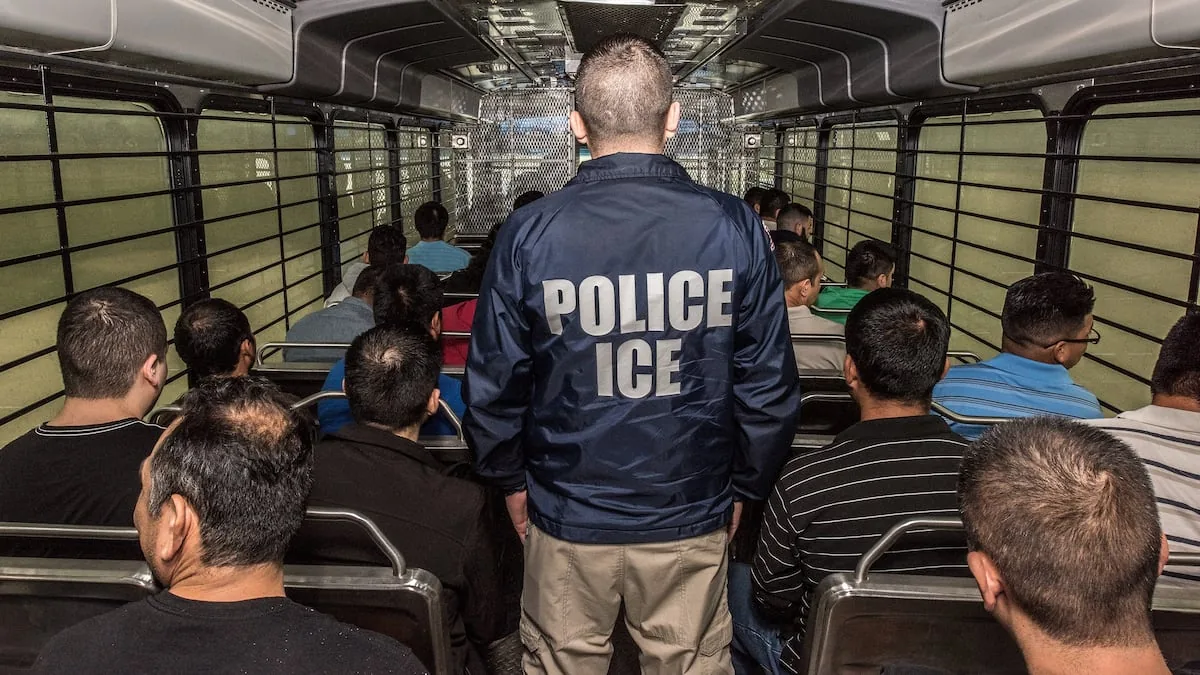
After years of decline, mortality in United States immigration detention centers has skyrocketed to its highest level in more than two decades, even surpassing records during the coronavirus pandemic, according to a report published in the scientific journal of the American Medical Association (JAMA).
The surge comes amid a rapid increase in immigration-related detentions under the Donald Trump administration and complaints about conditions in the centers, combined with limitations on access to medical care and oversight mechanisms. For the experts cited in an editorial accompanying the work, the increase is a warning sign about the health of a population in state custody.
The research found, beyond isolated failures, patterns showing “structural weaknesses in medical care, mental health protection, and death review in a population entirely dependent on the state.”
The report analyzed 272 deaths in custody of the Immigration and Customs Enforcement (ICE) over a 22-year period. Although the number of deaths has varied from year to year, the analysis focuses on the mortality rate — the number of deaths relative to the detained population — to compare periods.
After a prolonged decline since the early years of the article — except for a peak in 2020 during the covid pandemic — the mortality rate has increased since 2023, when it reached its lowest point in two decades. That year saw 13 deaths per 100,000 people; in 2024 it rose to 31.8; in 2025, to 47.5; and in January 2026 it reached 88.9, nearly double the previous year and even above the 2020 peak, which was 75.6.

The author of the research warns that it is limited by the lack of detailed data, and that the figures are based on public records, so they may underestimate the actual number of deaths. In 2023, four deaths were reported; in 2024, 12; in 2025, 23; and up to January 19, 2026, 18.
Most of the deceased were men and the average age was 45 years. In nearly half of the cases, there is no clearly determined cause of death, which prevents identifying preventable causes and limits accountability, the report notes.
The increase occurs amid an anti-immigrant offensive driven by President Trump, who has promised the largest deportation in history. Since his return to the White House, the number of detainees by ICE has risen from about 39,000 to more than 70,000, most of whom are people without criminal records.
Immigration authorities have conducted large-scale operations in cities controlled by Democrats, arrested asylum seekers at their immigration hearings, and signed collaboration agreements known as 287(g) with more than 1,300 state and local police forces. At the same time, the administration has left hundreds of thousands of people without legal status and has suspended immigration procedures for citizens of a list of countries that has been expanding.
In an editorial accompanying the report, scientists warn that the country is facing “the highest level of immigration detention in history.” The number of detainees has increased by 84% in the last year and is expected to continue rising. Trump’s “big and beautiful” tax law, passed last summer, has tripled ICE’s budget and includes $45 billion to expand detention capacity to 100,000 beds, they warn.

In Florida, where nearly half of the deaths in custody occurred last year, conditions in the centers have been the subject of complaints by human rights organizations, lawyers, and activists. Amnesty International described treatment and conditions amounting to “torture” at the Alligator Alcatraz center in the Everglades, west of Miami. Detainees have reported medical negligence, lack of drinking water, poor hygiene, restrictions on access to legal advice, and abusive treatment by guards. Human Rights Watch also found “dehumanizing” conditions at the Krome processing center, southwest of Miami, where detainees formed SOS signals in the yard. Similar problems have been reported at other facilities, such as Deportation Depot, north of the peninsula.
The pattern matches what the report points out, warning of widespread deterioration of conditions in the centers, with facilities operating above capacity, people sleeping on the floor without bedding, and reports of insufficient food, poor hygiene, and extreme temperatures, calling into question compliance with basic standards and due process guarantees.
The article notes “persistent deficiencies in the control of chronic diseases,” such as cardiovascular diseases, which have been a constant throughout the 22 years analyzed. Suicide accounted for nearly a quarter of deaths between 2017 and 2020 and “has remained a significant cause,” suggesting serious mental health deficiencies.
Only 12% of deaths occurred in hospitals, suggesting that many detainees with serious illnesses did not receive specialized care in time.
The doctors signing the editorial warn that the Department of Homeland Security has practically dismantled the bodies responsible for overseeing detainees, such as the Office for Civil Rights and Liberties and the Ombudsman’s Office for Immigrant Detention. They also note that although ICE is legally required to inspect centers twice a year, in 2025 no facility received more than one inspection, while capacity increased by more than 90% and the number of detainees nearly doubled.
“The administration has also denied Congress access to detention centers, despite federal law explicitly recognizing that right for legislators. The result is a detention system that is simultaneously larger, more overcrowded, with less medical support and subject to less external oversight than at any recent time, conditions that likely increase the risk of mortality,” the authors point out.
The editorial states that the report’s findings demand an urgent response from authorities and the medical community, and recommends strengthening oversight mechanisms, ensuring unannounced access for independent medical monitors to detention centers, and improving mortality surveillance systems. “Behind every data point is a person who died in state custody — and a system that could have prevented it. Addressing that failure is a matter of political will, not clinical uncertainty,” the authors remind.
Read more Sant Jordi moves to Portal de l’Àngel and the Cathedral to avoid the works on the Ramblas