









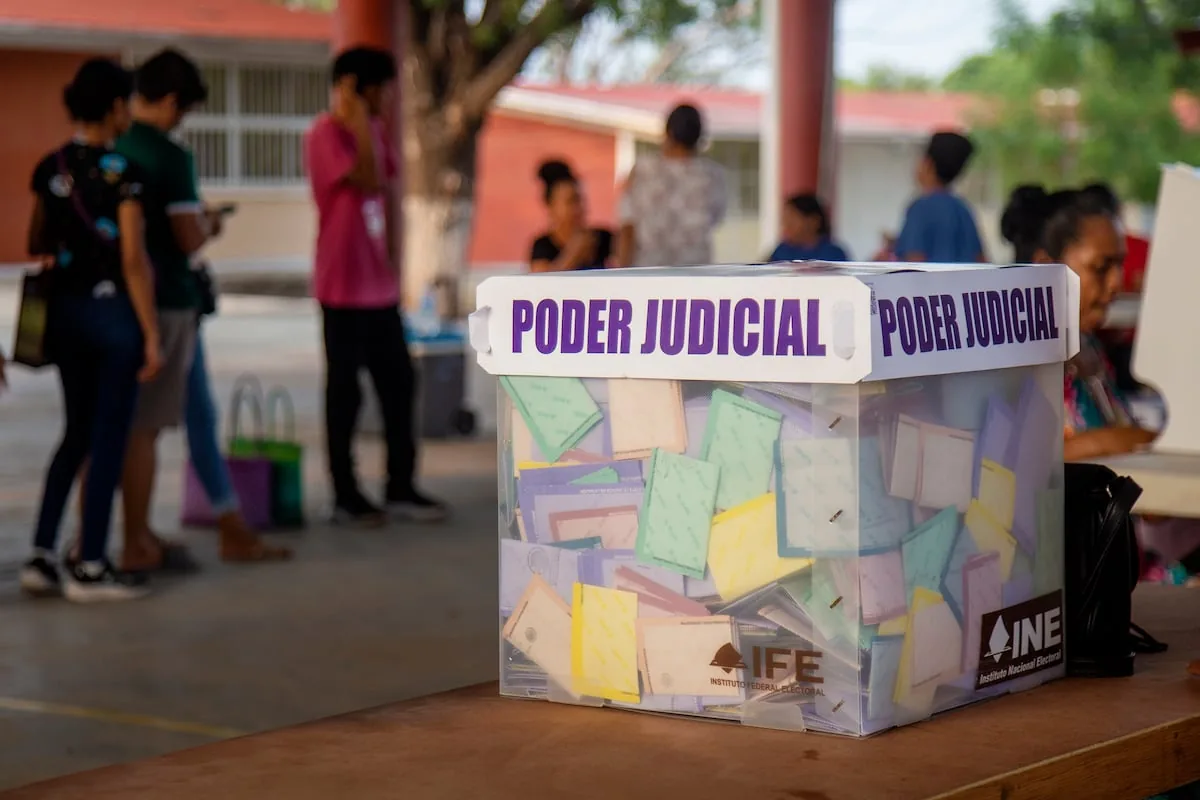
Self-criticism within Mexico’s ruling party is wrapped in euphemisms. The unprecedented election of judges, magistrates, and ministers in 2025 — the core of the judicial reform inherited by Andrés Manuel López Obrador from Claudia Sheinbaum — left a trail of uncomfortable results for Morena: low citizen participation, blurred campaigns, but mainly, the arrival of profiles without the expected experience, technical solidity, and probity to key positions. Today, less than two years before the second electoral appointment at the polls to elect justice administrators, the ruling party is preparing a fundamental correction that involves postponing the judicial election until 2028 so that it does not coincide with the midterms and redesigning the rules of the process to contain the effects of that first failed experiment.
Read more Locate valuable objects with the most desired high-sensitivity handheld metal detector on Amazon
A new constitutional reform initiative, which will be presented in the coming days by ruling party legislators simultaneously in the Chamber of Deputies and the Senate, seeks to reconfigure the recently implemented judicial election model. Although the rhetoric will be “improvement” and “technical adjustments,” sources close to the process acknowledge that the objective is to prevent a repeat of the 2025 disorder and to shield the legitimacy of the mechanism before its second major test, which is currently contemplated for next year.
The redesign includes substantial changes. The first, and perhaps most relevant, is to postpone the next judicial election until the first Sunday of June 2028, to prevent it from coinciding with the 2027 federal midterm elections, in which 17 governorships, deputyships, and thousands of local positions will be renewed. The decision responds to the diagnosis that mixing both elections operationally complicates the elections, dilutes public deliberation on judicial candidates, and subjects the process to partisan dynamics.
Alfonso Ramírez Cuéllar, Morena’s vice-coordinator in the lower house and one of the main promoters of the reform, frames it in institutional terms: separating the dates will allow citizens to evaluate candidates more carefully and reduce political pressure on a power that, in theory, should be independent. But privately, voices within the ruling party admit that the aim is to avoid electoral coattails, the so-called acordeones (cheat sheets) to induce, and uninformed voting that characterized the previous election, in addition to curbing the operational quagmire foreseen for the National Electoral Institute if both elections are held simultaneously.
The second pillar of the initiative directly addresses the heart of the problem: the profiles. The reform proposes replacing criteria such as letters of recommendation from neighbors with homogeneous technical evaluation mechanisms. Among these, mandatory knowledge exams, certifications issued by the National School of Judicial Training, and stricter professional experience requirements stand out: ten years for ministerial aspirants and seven for circuit magistracies.
The intention is clear: to block improvised candidacies or those driven by political capital rather than legal trajectory. In 2025, the breadth of candidacies, coupled with the lack of effective filters, resulted in a pool of candidates almost impossible for the electorate to process and, in some cases, to the victory of profiles questioned even within the ruling party itself.
Another key change is the elimination of the three evaluation committees — one for each branch of the Union — to replace them with a Single Evaluation Committee composed of nine people, with three appointments from each branch. The measure seeks to standardize criteria, but also to concentrate responsibility in a single body. For its promoters, it is a way to avoid disparities, discretion, and errors like those that occurred in 2025.
The amendment also incorporates a clause prohibiting having been a militant or leader of a political party in the year prior to the call for elections. Although limited in its temporal scope, the provision responds to a recurring criticism: the politicization of judicial candidacies. Nevertheless, a question remains: Is one year enough to guarantee a true partisan disengagement?
In parallel, it is proposed to reduce the number of candidacies per position. Fewer aspirants would allow for more rigorous scrutiny by citizens. In practice, it also implies greater control in the selection phase, where it is defined who makes it onto the ballot. The reform package is not limited to the electoral process. It also includes a reorganization of the Supreme Court of Justice of the Nation into two sections: administrative and jurisdictional, with the aim of streamlining case resolution and reducing backlogs. Likewise, it proposes strengthening the institutional architecture of the judicial system, improving coordination between the administrative body, the disciplinary court, and the Court itself.
Despite the narrative of continuity, the initiative has a political background. Legislative sources agree that, although the project will be presented by Morena senators and deputies, its design has the approval — and direct intervention — of President Sheinbaum. The inevitable question is why these adjustments were not included in the president’s so-called plan B for electoral reform. The answer points to the atmosphere of tension experienced with the ruling party’s allies, the Labor Party and the Green Ecologist Party of Mexico, which led to discarding additional changes that could complicate negotiations. Ramírez Cuéllar avoids looking back. “What’s past is past,” he says when questioned about the omission.
Morena will have to build consensus not only with its allies but also with members of the Judicial Branch itself, including ministers and magistrates who have been critical of the model. The promise of “perfecting” judicial democratization could clash with the perception that it is an attempt to correct a bad experiment. “We are building consensus. We want to talk to everyone, also to the ministers of the Court, to the magistrates of the Judicial Disciplinary Tribunal,” the vice-coordinator of the Morena caucus has stated.
The 2025 experience showed that opening the polls does not, by itself, guarantee better results. Now, the ruling party is betting on introducing filters that correct this contradiction without renouncing the principle of direct election and without openly admitting that they erred. The second election of the judicial reform will not only test the model but also the ruling party’s ability to correct its own experiments.