







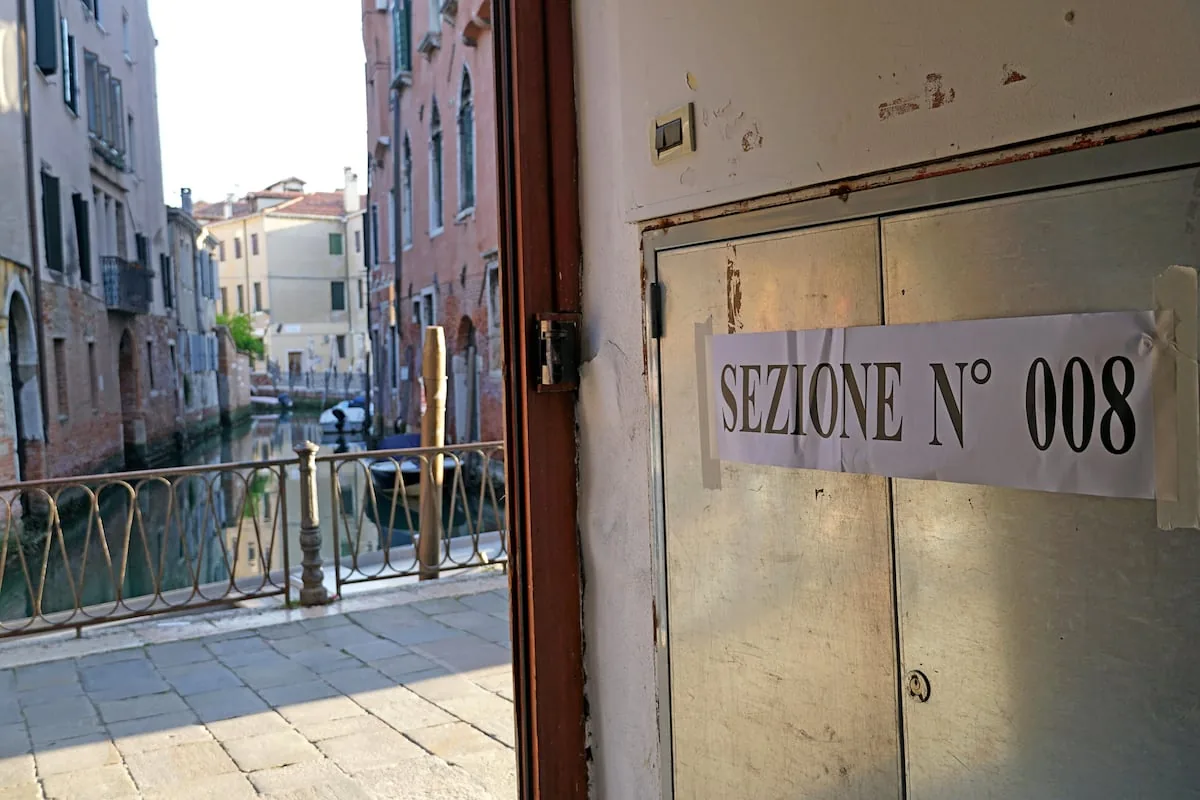
The right-wing coalition of Italy’s Prime Minister Giorgia Meloni has managed to save face in the municipal elections held between Sunday and Monday in more than 700 municipalities across the country, according to exit polls and the first provisional results. The victory of the candidate supported by the right-wing alliance in Venice — the most important city at stake — and the recapture of Reggio Calabria in the south have allowed the conservative coalition to avoid a clearly negative interpretation of the election day and maintain a competitive position at the territorial level.
At the national level, after weeks of tension with the opposition and a weakened government following the electoral setback in the referendum on justice reform, the polls have given Meloni a breather. In this way, it was avoided that these important local elections — seen as a testing ground for the government in the final stretch of the legislature, a year before the general elections — would become, after the referendum defeat, a new political setback for the government.
These elections were watched with particular attention in the transalpine country for their value as a political barometer to assess the real state of Meloni’s leadership. The goal with which the coalition supporting the central government — Brothers of Italy, led by Giorgia Meloni, Matteo Salvini’s League, and Antonio Tajani’s Forza Italia — approached the polls was to maintain positions and avoid losses in strategic cities, such as Venice (250,000 inhabitants).
There, the first provisional results and exit polls gave a clear advantage to the conservative candidate, councilor Simone Venturini, the protégé of outgoing mayor Luigi Brugnaro, who has governed the city over the last decade. With 85% of the vote counted, Venturini obtains nearly 52%, compared to the Democratic Party senator and progressive bloc candidate Andrea Martella, who would fall below 40%.
Late in the afternoon, when his victory was practically assured, Venturini celebrated that Giorgia Meloni had called to congratulate him and confirmed that she would soon visit the city to work together on some important issues. The over-tourism of the city has been one of the most debated topics during the campaign.
The city was the most coveted prize, being the only regional capital at stake in this round of elections. The latest polls published had given a slight advantage to the progressive candidate, but according to the results published by the media and exit polls, the right-wing candidate has managed to prevail.
This enclave was also important because it had become the political laboratory of a broad left-wing coalition around candidate Andrea Martella, conceived as a possible alliance model that could extend to the 2027 general elections. Throughout the electoral campaign, analysts have considered Venice an important test to measure the viability of a united alternative against the compact right led by Giorgia Meloni.
In fact, in the last days of the campaign, various representatives of the national center-left parties traveled to the city to show their support for the progressive candidate, such as Giuseppe Conte, leader of the Five Star Movement, and the secretary of the Democratic Party, Elly Schlein.
Change of hands
On the other hand, in the south, the right has found another reason to celebrate in Reggio Calabria (170,000 inhabitants), which will change hands. After more than a decade governed by the left, the right has managed to recapture the city with its candidate, Francesco Cannizzaro, who has swept with more than 65% of the votes — with 75% of the count completed.
These elections in the last year of the legislature, although local votes, are considered relevant at the national level because they will serve to measure the strength of the two main blocs that will compete for the government of Italy in 2027.
Read more Firouzja tumbles Carlsen with a horizontal leg in the Norway Chess tournament
The Prime Minister has congratulated the winning mayors and sent a message to her detractors, claiming the resilience of the conservative coalition: “And, also today, the much-anticipated collapse of the center-right we leave for tomorrow,” she wrote on her social networks.
Matteo Salvini’s League has suffered a symbolic blow that worsens its internal crisis, losing the first town hall it conquered after its foundation in 1990, that of the small northern town of Cene, where it had governed uninterruptedly until now. The new mayor will be Roberto Radici, who is not affiliated with any party.
More than six million Italians (around 11% of the country’s electorate) from 745 municipalities were called to the polls in elections perceived as an important test for Giorgia Meloni after the electoral setback in the referendum on justice reform, especially considering that the legislature is in its final stretch and that general elections will be held next year.
This electoral event is a key testing ground for Meloni’s government, as it offers a timely opportunity to measure the strength of the Prime Minister’s leadership after losing the referendum on magistrate reform in March, which had become her great battle horse.
If the result given by the first counting data is confirmed, the confidence of the center-right coalition is reinforced and, for the moment, the nascent large progressive coalition proposed by the left is weakened.
Although the center-left has also had reasons to celebrate in these elections in several cities where it has managed to hold on. Like Prato, in Tuscany, a traditional ‘red’ stronghold in the transalpine country, where progressive candidate Matteo Biffoni has secured more than 55% of the votes. He achieved victory despite the fact that this northern city had been under intervention since the previous mayor, from the Democratic Party, Ilaria Brugetti, resigned due to corruption.
It has also taken small towns from the right, such as Avellino in the south, or Pistoia in the center of the country.
In eight of the 18 provincial capitals that were called to the polls, the race remains open and a second round will be necessary, in the absence of majorities this Monday, which will be held on June 7 and 8.
Read more Damián Castaño and the emotion of truth before a Miura bull