









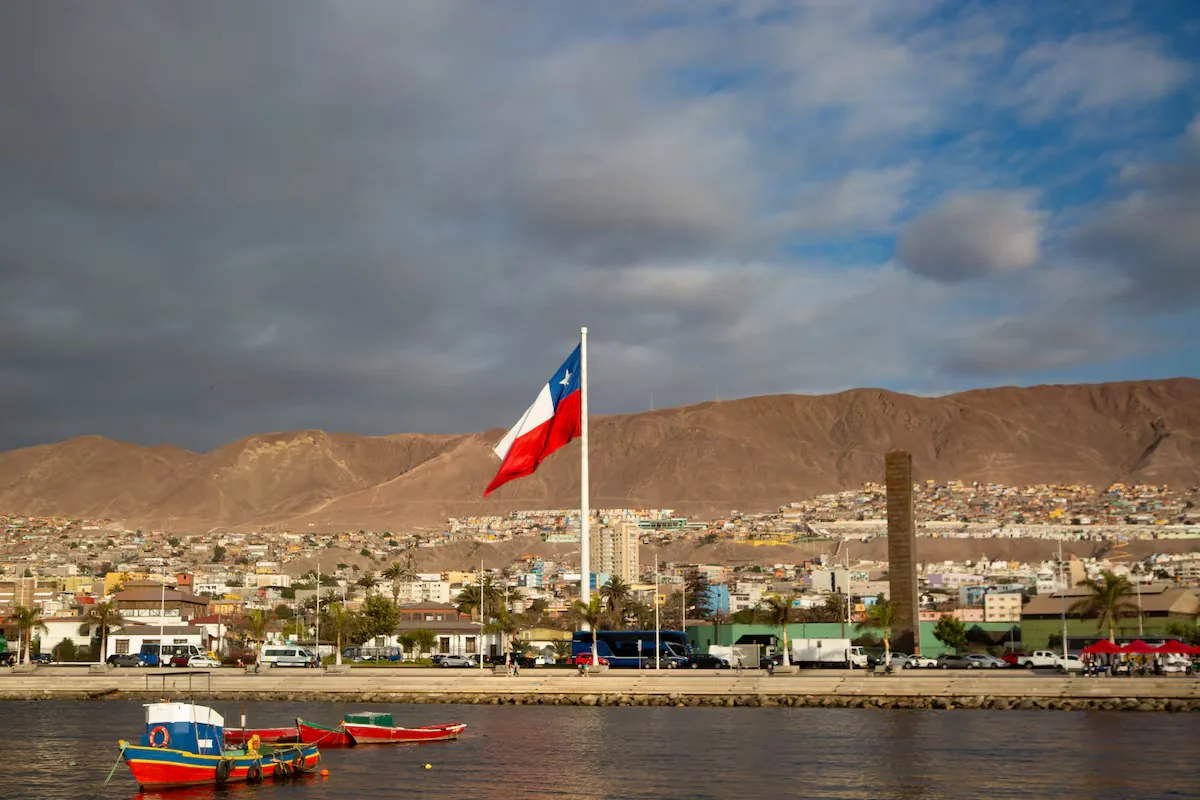
Chile celebrates its National Holidays on September 18 and 19, a day when the independence of the South American country from the Spanish colony is celebrated and some symbolic and identity elements such as the tricolor flag with the solitary star are highlighted. The tradition is that all houses, apartments, offices, and multiple public or private venues are decorated with flags. This custom is already established by a law that sets when and how the national emblem is installed in a home, as well as establishing a fine for not using it at the appropriate times and in the proper manner.
Read more Euromillions: check draw for Friday, September 4
Chilean regulations state that the Chilean flag must be raised at all homes, both in urban and rural areas, throughout the territory. There is a special format for placing the symbol on buildings, where the agreement among community members is key.
Is it mandatory to raise the flag on National Holidays?
Yes. In Chile, Law 20.537, which was processed during 2011, establishes the rules for the use of the National Flag or National Banner both in the case of public services and the Armed Forces. In the case of civilians, the correct installation for the National Holidays is also established.
When is it mandatory to install the Chilean flag
According to Chilean law, all homes in the country must have the national symbol installed on September 18, when the National Holidays are commemorated; and on September 19, when the Army’s Glories are celebrated. During the rest of the year, the flag can be raised or used without prior authorization, as long as respect for the national symbol is guaranteed and regulatory provisions are followed.
What is the fine for not using the flag
Owners or residents of houses who do not install the Chilean flag risk receiving fines ranging from one to five monthly tax units (UTM), which are equivalent to between 71,721 pesos (76 dollars) and 358,605 pesos (383 dollars). The enforcement of the use of the emblem is carried out by Carabineros, the country’s uniformed police.
Read more ONCE Big Coupon: check the draw for Friday, September 4
How is the flag raised?
The rules state that the Chilean flag must be raised on a white mast, to the top, and placed so that the star is on the left side of the viewer. For those who place the symbol horizontally (hung in a window), the star must be in the upper left corner when viewed from the front. In the case that the flag is used vertically (hung in a window), the star must be in the upper left corner when viewed from the front.
Is it mandatory to raise the flag in apartments
In the case of buildings, it is not mandatory for each apartment to have a flag, since in that case the one used by the entire building at its entrance is considered. What is recommended in these cases is that the community appoints a person responsible for correctly placing the emblem during September 18 and 19.
What is the origin of the Chilean flag
The current flag of Chile was created by Bernardo O’Higgins, the greatest hero of Independence, and Colonel José Ignacio Zenteno and was established by Decree Law on October 18, 1817. Regarding the meaning of the colors, there are several versions, although the most accepted is that blue represents the skies and the Pacific Ocean; white is the snow of the Andes mountain range; and red is for the blood shed by the heroes of Independence. The white five-pointed star is associated with a symbol of national unity and the legacy of the Mapuche people.
In Chile, Flag Day is commemorated every July 9, on a date that is not related to the origin of the republic. On that day, the Battle of Concepción is commemorated, one of the emblematic episodes of the War of the Pacific (1879-1884), the armed conflict that faced the South American country against its neighbors Peru and Bolivia and ended with the annexation of the current regions of Arica and Parinacota, Tarapacá, and Antofagasta to Chilean territory, as well as establishing Bolivia’s landlocked status.