









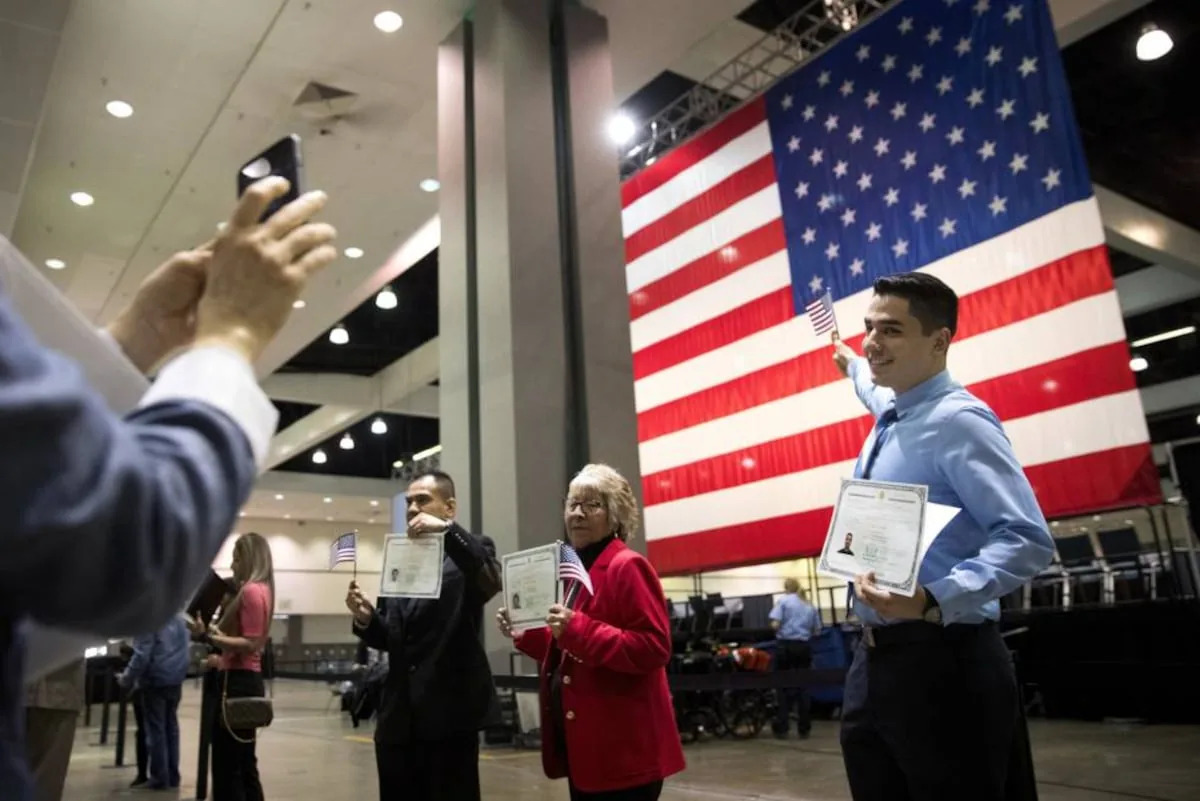
One of the objectives of immigration policy in Donald Trump’s second term is to change the definition of American, which the Republican considers a privilege he wants to ration at his discretion. If, on the one hand, he fights in the courts for the elimination of birthright citizenship, enshrined in the Fourteenth Amendment of the Constitution; on the other, he has restricted the naturalization process, through which people born in another country obtain U.S. nationality. In January of this year, the number of approved naturalization cases was 32,862, the lowest figure since the United States Citizenship and Immigration Services (USCIS) began recording data.
Read more Bitter anniversaries?
“The Trump Administration has initiated or instituted certain obstacles that make it much more difficult for USCIS to resolve your citizenship application,” says Margy O’Herron, senior researcher at the Brennan Center’s Liberty and National Security Program. “This is part of a broader effort to define who is American. And there are many ways to do it. One is to try to strip people of their citizenship—or link it to their place of birth—; the other is what they are currently doing: simply slowing down the number of people who can become citizens,” she adds.
The Administration has tightened the requirements for obtaining citizenship, leaving out many candidates who would previously have been accepted; it has automatically canceled applications from 39 countries and has generated such a climate of fear among foreigners that they prefer to stay away from interactions with federal authorities. In fact, the number of applicants has plummeted. In January, only 46,385 applications were submitted, almost half the number from a year earlier.
The arrests and deportations that the Administration is indiscriminately carrying out against people with legal resident status and even citizens have spread fear in such a way that those who could opt for citizenship prefer not to do so and remain unnoticed by the authorities for as long as possible. “ICE is arresting people who come to their citizenship interviews. They are using the data in the system to go after people. And there has been an extremely aggressive push to go after anyone. This creates a climate of fear. Even if someone meets the requirements for citizenship, they simply don’t want to raise their hand or draw attention to themselves or their family,” explains O’Herron.
Paradoxically, the fear generated by Trump’s return to the White House, with his anti-immigration agenda, also triggered an increase in applications to get papers in order and protect against expulsion, according to media and analysts.
These cases were joined by those already initiated during the Joe Biden Administration, which sought to promote regularizations. Thus, in the first months of the Trump administration, naturalization cases set records. More people were naturalized in each of the months of March, April, and May 2025 than in any month of 2024, Biden’s last year in the White House. Between February and April, 270,290 people applied to become U.S. citizens.
Read more Do we need presidents?
In the following months, however, the changes introduced by the Administration led to a decline in applications that is still ongoing. In August, USCIS announced that it would implement more rigorous evaluations to ensure that every new citizen possesses “good moral character,” which includes “increased scrutiny of disqualifying conduct and actions.” One of the changes introduced, announced in September, included a revised version of the naturalization test: the range of questions to prepare for increased from 100 to 128; the number of questions on each test increased from 10 to 20; the passing score was raised from 6 to 12 correct answers, and the questions were revised “to ensure that the test provides a more meaningful assessment of the applicant’s knowledge and understanding of U.S. history and government,” according to USCIS.
Additionally, neighborhood investigations were reinstated, a practice unused since the early nineties. Immigration officers visit the homes and neighborhoods of individuals aspiring to naturalize to question them. “The purpose of a neighborhood investigation is to verify the eligibility of foreigners for naturalization, by reviewing their residence, their moral character, their loyalty to the United States Constitution, and their commitment to the well-being of the nation,” the agency justified.
The increased scrutiny has also resulted in an increase in the time it takes to process an application and has altered the planned schedule of celebrations that are the final step of naturalization. In recent months, several states saw Oath of Allegiance ceremonies, a requirement for obtaining nationality, postponed or canceled, leaving many applicants whose applications had already been approved in limbo. In Austin, Texas, an internal memo signed by Lindsey Wilson, Director of Equity and Inclusion, warned in January that “USCIS informed the City that, due to a significant decrease in N-400 (naturalization application) filings, they will not be able to conduct naturalization ceremonies starting in February 2026 and for the foreseeable future.” By the end of March, it was reported that they would resume in April. In other cities, such as New York and Washington D.C., ceremonies were also paused.
In Minnesota, one of the states where operations by Immigration and Customs Enforcement (ICE) and Border Patrol have had the most impact, ceremonies went from gathering hundreds of new citizens to just a few dozen. Although the drop in applications may have influenced this, critics denounce that the pause is due to the Administration’s reluctance to grant citizenship.
The oath marks an important milestone in the lives of new citizens and is the end of a long journey that requires several years of dedication. In past months, many saw their dream frustrated when ceremonies were suspended. This is the case for citizens of 39 countries that form a blacklist established by Trump and for those who possessed travel documents issued by the Palestinian Authority, whose immigration procedures were canceled by his Administration. The suspension occurred after an Afghan citizen was accused of shooting two National Guard members in Washington D.C. in late November, causing the death of one of them. After the incident and well into 2026, some people were surprised to find their entry to scheduled citizenship ceremonies denied.
Read more AI proves a veteran Marxist right