


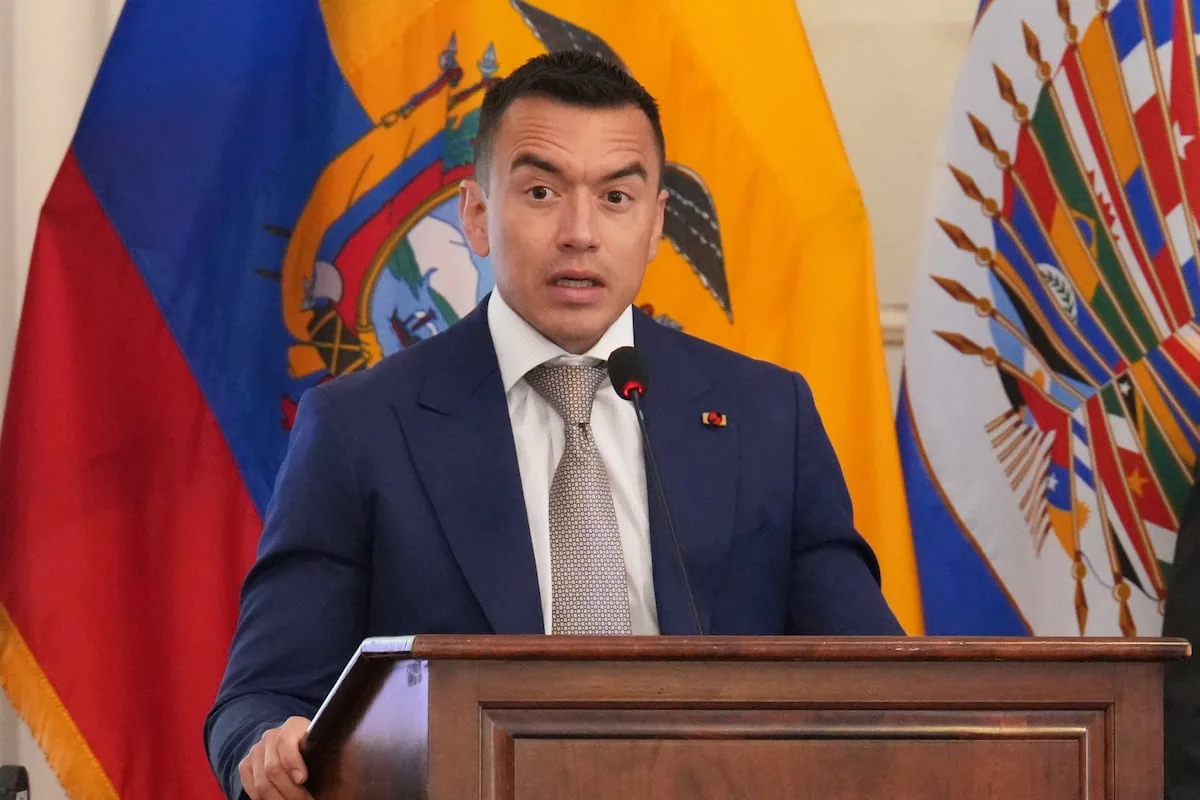
The president of Ecuador, Daniel Noboa, an ideological ally of Donald Trump, has received a round of applause during his two-day visit to Washington. While a group of legislators in Congress demanded the suspension of joint military operations between his army and that of the United States against alleged drug traffickers, the Andean country’s leader promoted his tough-on-crime policy at each of his activities. Regarding the joint military missions, he assures that the initial series that sparked criticism has already ended, but he maintains that there could be others in the near future. “We are at war,” he argued. However, he points out that the state of emergency that has been in effect in his country will not be extended when the new deadline expires on June 1.
One of Trump’s favorite presidents in Latin America — with permission from Javier Milei in Argentina or Nayib Bukele in El Salvador — Noboa received — despite the absence of his ally, who was on a state visit to Beijing — the red carpet. On Wednesday, he met with Vice President J.D. Vance and received the award from the Hispanic Leadership Institute in Congress (CHLI, by its acronym in English). This Thursday, he gave a talk at the think tank Atlantic Council and participated as guest of honor in a protocol session at the Organization of American States (OAS). The Mexican ambassador, Alejandro Encinas, was not present at the latter: both countries have not maintained diplomatic relations since April 2024, when Ecuadorian police raided the North American country’s Embassy in Quito to arrest former Vice President Jorge Glas, who was sheltered in those facilities after being convicted of corruption.
Ecuador launched a vast police and military offensive against drug cartels, highly praised by the Donald Trump administration, amid escalating violence by organized crime: in the last five years, the country went from having one of the lowest homicide rates in Latin America to exceeding 50 per 100,000 inhabitants in 2025, the most violent year in its history.
To counter this, in two and a half years, the country has been in a state of emergency for 849 days, almost the same time Noboa has been in power. During this period, the president — criticized by human rights organizations for his authoritarian drift, in which he has attacked the Constitutional Court and the media, among others — has decreed seven curfews: his main strategy against violence, which has restricted the free movement of people for 275 days. He has tightened his collaboration with U.S. forces to combat alleged drug traffickers, whether in attacks against supposed drug-running boats in the eastern Pacific or in joint missions that last May bombed alleged targets in the northern border area with Colombia.
About twenty congressmen have demanded the end of these joint missions — which, they specify, do not have the required authorization from the U.S. Congress — while an investigation into possible human rights violations and the death of innocent civilians is opened and developed: a New York Times report found that a dairy farm with no links to drug trafficking was attacked in those operations. The Ecuadorian president defended that action this Thursday: the accusations, according to him, are “unfounded.” “We act based on intelligence data. Those allegations cannot prove that they were simply civilians who had nothing to do with narcoterrorism or sheltering guerrillas,” he maintained in his talk at the Atlantic Council.
Increasing military cooperation
Still, Noboa has expressed his desire to increase military cooperation with the United States. “I hope so, yes,” he responded to a question from the moderator during his intervention at the think tank. “Forty percent of the drugs leaving the region end up in the United States, another 40% in Europe. It is a continental problem,” he explained. “It is cheaper, better, and safer for Americans to solve the problem at its source.”
The president also defended the attacks against the alleged drug-running boats, despite experts, international humanitarian organizations, and some U.S. legislators denouncing them as extrajudicial executions. “We have clear data on thousands of fishing boats intercepted along the entire Ecuadorian coast, up to El Salvador, transporting drugs, because that is the system,” he pointed out, after insisting that those vessels are not genuine fishing boats. “It is strange for a small fishing boat to venture into open sea in international waters; it would normally have to be much closer to the coast; it makes no sense for it to be there if it is fishing,” he declared.
What he will not do, he pointed out, is extend the current state of emergency after the current 60-day period. “It will not be extended. If there were another time when we had to carry out special operations, we would have to have a new state of emergency,” he said in his comments at the Atlantic Council.
Ecuador is one of the member countries of the Shield of the Americas, the association of Latin American countries with a conservative ideology launched by Trump at a summit in Florida in April to collaborate on security issues. The U.S. president’s special envoy for that association, Kristi Noem, former Secretary of Homeland Security, was one of those present this Thursday at Noboa’s appearance in the OAS plenary session.
In the Hall of Ambassadors, the impressive room the organization reserves for its solemn sessions, Noboa — who spoke in Spanish before switching to English — warned that his government will maintain “distance” from countries that do not cooperate in this fight against drug trafficking, apparently referring to tensions with Colombian President Gustavo Petro. “There are some nations that want to help us and others that do not. We value and appreciate those who want to support us and will maintain some distance from those who do not,” he emphasized in his speech. And he defended his strategy again: to combat violence “strong and firm decisions are needed,” he assured.
Ecuador has accused Colombia of not doing enough to combat drug trafficking, while Petro has accused his counterpart of trying to interfere in Colombian internal politics to favor the right in the elections on the 31st.
Read more Real Madrid — Oviedo live | Boos at the Bernabéu as the players come out to warm up