










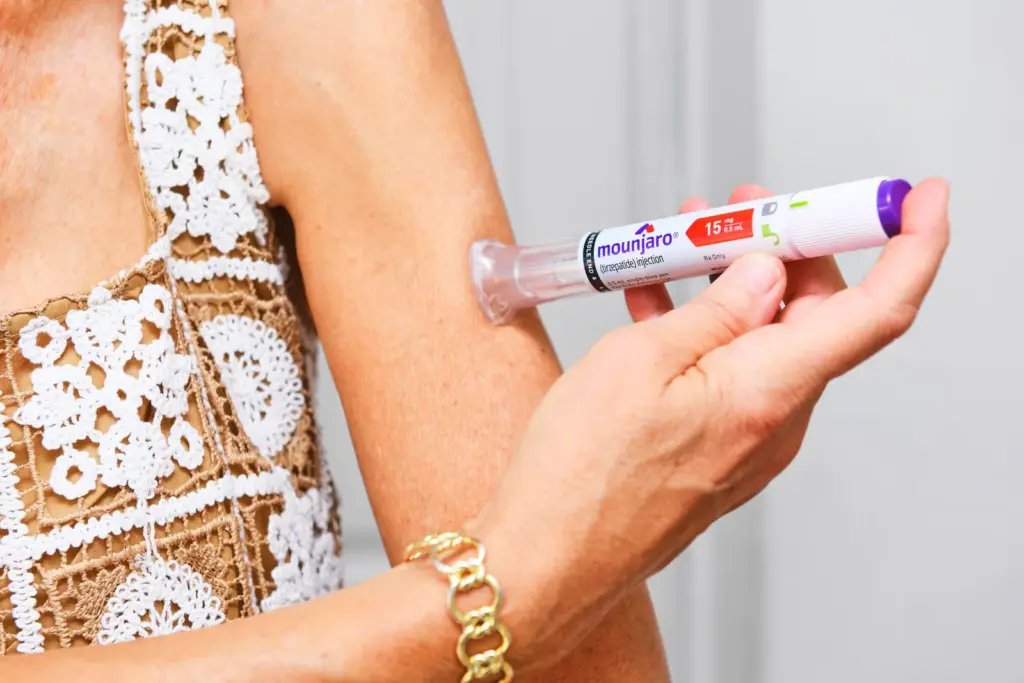
Let’s say her name is Elena and she weighs 90 kilos. The imprecision of these data does not change the value of her story. This woman, who does not want to give her real name, had not stepped on a scale for 20 of her 50 years. She knew, no number was needed to know, that she was clinically obese, but she had accepted it. One day, while browsing Instagram, she saw an ad for a platform selling Mounjaro. “I could do it again without turning off the light,” it said. She ignored it. “I could get on a plane without asking for a seatbelt extender,” a second ad insisted. Okay. “I could tie my shoes again,” read a third. She clicked. The post led her to a website, she filled out a form, sent some photos, and paid about 30 euros. A few days later, she obtained a medical prescription authorizing her to buy this weight-loss drug. It was her passport to a new life. “The change has been radical,” she says on the other end of the phone. “I’m happy.” In four months, she has lost what she couldn’t lose in years. She doesn’t know exactly how much, but estimates more than 10 kilos. She has hired a personal trainer and has already returned to the doctor. She also plans the most difficult challenge: getting back on the scale.
Read more And Clint Eastwood hung up his guns
Elena’s case very well represents the paradigm shift that has occurred in recent months with weight-loss drugs. We have gone from widespread scarcity to total abundance. It’s no longer just Hollywood actors who seem to shrink with each new appearance. It’s colleagues, friends, and family. The drugs are advertised on bus shelters, flooding social media. Getting a prescription is no longer complicated. Anyone overweight can obtain one with a couple of clicks and a video consultation. Follow-up is done through periodic emails with the supplying company.
“I think it’s irresponsible,” laments Andreea Ciudin, an endocrinologist at Vall d’Hebron Hospital who has participated in several clinical trials with this type of drug. She positively values that people like Elena can access increasingly common medications, but regrets that abundance turns into lack of control. “It’s not just about writing the prescription, but about following up with the person, knowing what dose they can have and adjusting it,” she states. In any case, it’s a reality that is already here and seems unstoppable.
In 2024, more than 4.8 million packages of Ozempic, Wegovy, and Mounjaro (the three available brands) were dispensed in Spain, according to data from the IQVIA consultancy. This would be equivalent to just under 400,000 people undergoing treatment. Current figures must be much higher, but we are still far from the United States, the main market for these medications. There, 12% of the population is undergoing treatment, a figure that has doubled in the last year. We are heading towards that situation, and the questions it raises are numerous. How will this change our relationship with food? How is the food industry adapting? And healthcare systems?
To understand how these medications work, one must start by focusing on the gut. “Every time we eat, when food touches the mucosa of the digestive tract, a healthy body releases hormones that act at the brain level to regulate appetite,” explains Ciudin. The best known is GLP-1, but there are also GIP, glucagon, amylin, and peptide YY. People with obesity do not generate these hormones, or not in sufficient quantity. Therefore, their brain does not process that they are full and they continue to eat. Weight-loss drugs act as an injectable substitute, artificially mimicking the effect of some of these natural molecules.
The industry has embarked on a crazy (and lucrative) race to create pharmacological copies of these molecules. The first to achieve this was semaglutide (with trade names like Ozempic), which mimicked a single molecule: GLP-1. Tirzepatide (the best-known brand is Mounjaro) is a dual agonist, copying GLP-1 and GIP. Currently, retatrutide is being investigated, a triple agonist that, in addition to these two particles, also mimics the action of glucagon. The results are surprising. Ozempic led to a 15% loss of body weight. This new compound reaches rates of up to 30%.
This is leading more and more people to respond to the medications. According to some studies, about 13% of users did not manage to lose weight with semaglutide, but this percentage is decreasing as new compositions are commercialized. “Perhaps that person didn’t respond because they didn’t have any problem with the GLP-1 hormone specifically,” Ciudin points out. “They might have had an alteration in peptide YY, GIP, or amylin.”
Another of the most interesting pharmacological novelties is the appearance of pills. Rybelsus is already marketed in Spain, but it has a small problem. “Only 2% is absorbed and passes into the blood, which is very little,” Ciudin points out. But this is the first generation of pills. More are coming. In a few months, Orforglipron will be commercialized. “They are still not as potent as injectables, but you don’t always need high potency. They can be used for maintenance, or to start,” the expert warns.
Elena tells it from the other side, that of personal experience. It was difficult for her to take the step to use these medications due to fear of needles. “I think that holds a lot of people back,” she adds. That fear helps explain why the arrival of pills on the market generates so much attention.
In recent months, there’s a growing feeling that people around are shrinking. Obese individuals are sporting slender figures, people prone to overweight are starting an irreversible reverse path. The big question is whether these individual changes will eventually translate into a shift in population trends. For years, the most reputable epidemiologists have pointed out that the massive use of Ozempic and similar drugs could curb the obesity pandemic. After several years of use, this phenomenon can begin to be studied.
According to the World Health Organization, 2.5 billion adults (43% of the global adult population) are overweight, and of these, 890 million (16% of all adults) live with obesity. The data has tripled since 1975.
But this trend seems to be slowing down; it has even slightly decreased in the United States. According to pollster Gallup, after reaching a peak of 39.9% adult obesity in 2022, the rate dropped to 37.0% in 2025. “It is too early to determine if these data represent a new trend or simply an isolated event,” concluded a scientific analysis published in the journal JAMA Network.
Its author, University of Michigan epidemiologist Anand Parekh, qualifies that caution in an exchange of messages. “It is likely that GLP-1s are causing many people to lose weight, but they are still considered obese according to the body mass index, which is how we measure obesity,” he points out. It could also be that money (it’s not cheap, Elena pays 230 euros a month) is acting as a class barrier. The question is what will happen in the long term.
Parekh is optimistic, but reminds us that we cannot rely entirely on a medical patch when the problem is environmental. “I firmly believe that adequate nutrition will be as important for obesity as pharmacological interventions. In that aspect, Spain is far ahead of the United States,” he notes.
Read more The television heartthrob Luis Lorenzo and his partner, seen for sentencing
We live in an obesogenic world, but it is also mutating, adapting to the Ozempic effect. Taking these medications can make a person eat up to 40% less and reduce their food expenditure by 3% to 5%. Millions of people with a tendency towards expansive eating are becoming, overnight, frugal and moderate. And this has a certain impact. Bodies lose weight, but so do the profits of multinationals.
In the sector, they talk about the fight for “stomach share”: if the consumer is less hungry, each food in their shrinking diet becomes more valuable. Nestlé has launched a line of dishes in the United States designed for users of these drugs. The frozen food company Conagra already labels meals “GLP‑1 friendly“. Just as fast-food chains launched their XL menus in the nineties, they are now introducing XS menus, as Subway has already done.
“People undergoing treatment with GLP-1 agonists are already considered a new market niche,” explains Beatriz Robles, food technologist and author, along with Laura Caorsi, of the podcast A la guerra con una cuchara. What might seem like a threat to the food industry is being transformed into a new business opportunity. When a person is being treated with Ozempic or similar drugs, “they not only have less hunger, but also feel less pleasure from food, especially from more caloric ones,” the expert points out.
This poses a direct threat to the food products on which a powerful industry has been built. It doesn’t affect the fishmonger or the greengrocer as much as the large corporate conglomerates that create ultra-processed foods. But these have taken note and are adapting. “There isn’t a reduction in consumption, but a shift in focus,” Robles points out. “And we need to reflect, because these types of specific products are not necessary for people undergoing treatment with GLP-1 agonists: their appearance responds more to a commercial than a clinical need.”
But the most revolutionary changes are not happening in the market. They are happening in our heads. American psychiatrist Nora Volkow was one of the first researchers to compare food addiction with addiction to certain drugs, almost 30 years ago. “We saw in neuroimaging that the same areas of the brain lit up, we verified that addicts had very similar behaviors,” she explains in a video call. “It seemed logical.” Her colleagues didn’t think so. For years, Volkow was labeled as exaggerated.
Today she is the director of the National Institute on Drug Abuse in the United States and one of the leading experts on the neural mechanisms of addictions. According to her research, these drugs are revealing something deeper than a simple loss of appetite. “They attenuate the response of the brain’s reward system,” she explains. “They reduce the activation of dopaminergic neurons in response to highly reinforcing stimuli, such as high-calorie food.”
That system, she emphasizes, is the same one activated by substances like cocaine, nicotine, or alcohol. “We don’t have one circuit for drugs and another for food: it’s the same.” That’s why these medications have opened the door to treating other addictions like alcoholism.
Dopamine doesn’t just produce pleasure; it also pushes us to act, to seek what the brain has learned to value as especially reinforcing. Hence, the new drugs have explained something that millions of people had intuitively described for years.

Many obese people talk about incessant thoughts about food: what they are going to eat, how much, when, what to avoid, how to compensate for it afterwards… That background hum has only now taken center stage, only when it has disappeared. It’s called food noise. Researchers developing anti-obesity drugs didn’t use that term, but those who started taking them did. Again and again, they repeated the same idea: ever since they could remember, that noise accompanied them, although they thought it was normal, that it happened to everyone. Only when it quieted down did they understand that it wasn’t so. “Wow, I totally remember the exact day I stopped feeling it,” Elena explains. “I started on a Sunday, and it was… maybe it was Thursday. I was eating and suddenly I didn’t feel like it. I stopped thinking about food, it was a liberation.”
Volkow offers a biological explanation for that experience. “When this system is overactive, you feel a constant motivation to seek food,” she says. “It’s an internal signal that pushes you to act.” The massive success of these medications is thus revealing things we didn’t know, not only about the biology of obesity, but also about how addictions work, to what extent the brain can sabotage willpower, and how an impulse can become a recurrent, insistent thought, difficult to silence.
Here, again, appears the limit of the pharmacological solution.
For Volkow, it would be a mistake to think that a set of injections alone will solve a problem that the environment also creates. “We are constantly exposed to highly attractive foods that activate desire even when we are not hungry,” she warns. The food industry, she says, has learned to maximize the pleasurable and addictive component of food by combining sugar, fat, salt, and texture to make some products extraordinarily reinforcing. “To think that we are going to solve obesity only with medication makes no sense. It’s treating with drugs something that we are simultaneously promoting as a society.”
No matter how much obese people are undergoing treatment, they move in an obesogenic world, in a sedentary society. The moment the pharmacological patch is removed, they will fall back. It’s like inviting a recovering alcoholic to an open bar party. Therefore, all consulted experts agree that these are useful tools, but that they alone will not change anything. The best example is offered by the United States, where their use is up to ten times more common than in Spain and the prevalence of obesity is 2.6 times higher.
These data demonstrate that such a complex problem does not have a simple solution. Anti-obesity drugs are sold as a miracle, but they have limitations. Side effects, discontinuations, frivolous uses, lax prescription, economic barriers, and the risk that their popularization will aggravate aesthetic pressure still exist. But they do mark a change of era. Not because they have defeated obesity, but because they have dismantled some seemingly unshakeable ideas about it, willpower, and moral failure. Elena summarizes it with a simple idea, which perhaps explains the dimension of the change better than any paper: “Suddenly I didn’t feel like eating. It’s the best thing that has ever happened to me.”