



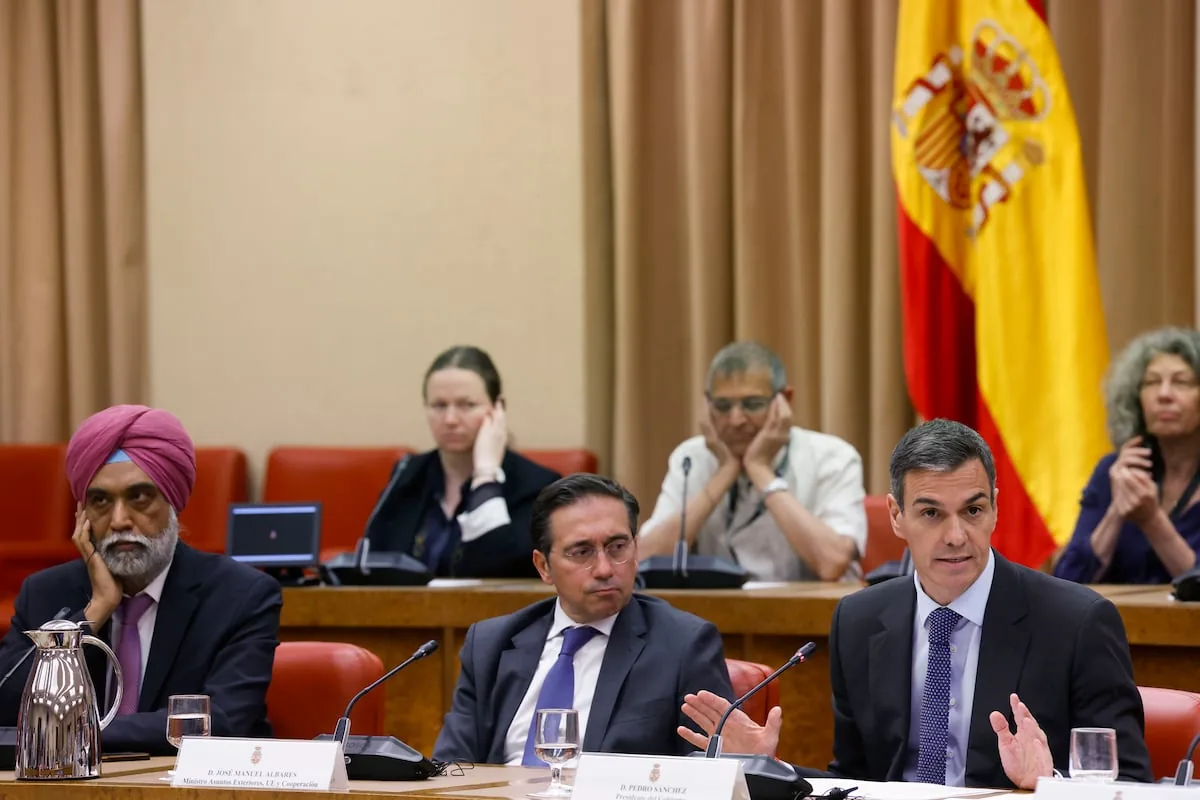
For the President of the Government, Pedro Sánchez, the concentration of power around artificial intelligence (AI) is a fact. The Executive he leads wants to place Spain at the forefront of the development of this technology, while warning of the risks involved in its uncontrolled deployment: it can widen social gaps, concentrate wealth, erode democracies, and influence climate change. Its regulation and those who guide its direction have become central to the challenge. “We advocate that AI governance should be in the hands of the people, and not in the hands of a small group of individuals,” he said this Wednesday at the first meeting of the UN Panel of Experts on Artificial Intelligence, held in the Congress of Deputies.
Read more The Prosecutor’s Office requests the dismissal of the investigation against Begoña Gómez
Sánchez highlighted that, right now, the direction of AI is not defined by society, nor by democratically elected governments, nor by the market, but by a small group of large companies: “Five of them concentrate almost 60% of the global market. All from the same country.” We are facing a “silent colonialism,” he warned.
During his speech, Sánchez said that it is not a “concentration of capacity; we are talking about a concentration of power, because technology is power.” “We need a global multilateral response, where there is an alliance between business, academia, scientists, legislative power, and executive power,” he emphasized.
In his opinion, the panel of experts he chaired today represents a “transcendental” step in Spain’s and the international community’s commitment to respond to the phenomenon. “Social networks promised a more open, connected, and democratic society. But today they are a failed state. Increasingly with more resources, more economic capacities to harm and undermine coexistence and our democratic systems,” he stated.
The panel, approved by the UN General Assembly in August 2025, brings together 40 experts —19 women and 21 men— from academia, the private sector, civil society, and international organizations. It is co-chaired by scientist Yoshua Bengio, a pioneer of deep learning and Turing Award winner, and journalist Maria Ressa, Nobel Peace Prize laureate in 2021 and one of the most critical voices against digital disinformation.
Read more A witness claims that the Generalitat had data to send the Es alert three hours earlier
During his speech, Yoshua Bengio, a pioneer of neural networks, insisted that the speed of technological development does not allow for slow responses. “We have to provide a rigorous scientific basis now,” he stated. “I changed my entire research agenda three years ago, when ChatGPT came out. And I realized that we could be on a very dangerous path. One that could be extremely beneficial if handled well, but also one that could create a lot of uncertainty,” he said, specifically warning about cybersecurity. “The way we are going to protect our infrastructure around the world becomes really important. And I don’t think these risks are being managed right now. There are a few people in the world, a couple of countries, who are basically going to decide our future,” he warned.
Bengio stressed that the success of this initiative will depend on cooperation and trust among its members. “The only way to build something so important is by developing human connection,” he stated.
For her part, Maria Ressa placed the debate in the democratic sphere. The journalist, who has documented the deterioration of democracies for over a decade, described a three-phase process that begins with a “narrative war,” where “lies repeated a million times become facts.” AI, she states, not only spreads disinformation but manufactures it on a large scale and customizes it, generating what she called “synthetic consensus.”
Ressa, a Filipino journalist and 2021 Nobel Peace Prize laureate, warned that this phenomenon leads to the weakening of institutions —such as the press or the courts— and results in scenarios of corruption and loss of accountability. “Without facts there is no truth, without truth there is no trust, and without these three, we do not have a shared reality,” she summarized.