






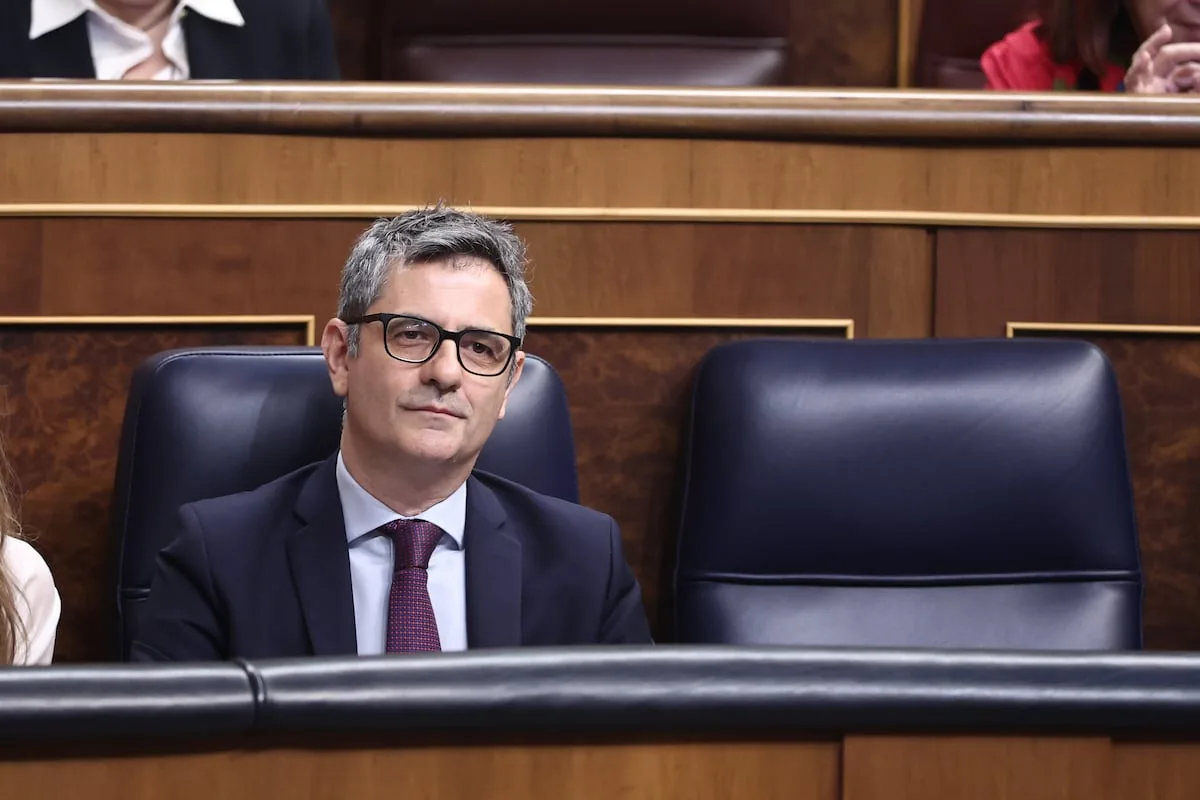
What is the limit of criticism of judicial actions? The Minister of the Presidency, Justice and Relations with the Courts, Félix Bolaños, has positioned himself on the shame that, according to him, the investigation by magistrate Juan Carlos Peinado in the case of the wife of the Prime Minister, Begoña Gómez, arouses. “It has embarrassed many citizens, judges and magistrates in Spain,” Bolaños declared this week in a press conference. For the two major judges’ associations, the conservative Professional Association of the Judiciary and the cross-sectional Francisco de Vitoria Judicial Association, however, the limit crossed by these statements is that of respect for judicial independence. The third, the progressive Judges for Democracy, assumes that it is “unusual” for such criticism to come from the Executive, but considers that it is not the criticism of others — whether politicians, journalists or any citizen — that puts the independence of judges at risk, but their own decisions.
Read more The opening of the Círculo de Bellas Artes, an explosion of irreverence and creativity
Judicial independence is a principle protected by the Constitution, although it is not enough for the judge to feel attacked. “It must be possible to objectify that certain acts may have impeded the independence of a judge, that is what is prohibited. But a judge must also have a bit of courage, of strength, because statements against their actions are covered by the right to freedom of expression,” defends Antonio Rovira, professor of Constitutional Law at the Autonomous University of Madrid. “A minister, no matter how much of a Minister of Justice he is, who says this: how can it affect the independence of the judge? Can it outrage him? Yes. Can it bother him? Yes, but that does not affect his independence,” adds Rovira: “Another thing is whether those statements are convenient or timely.”
Legal limits are not absolute, because fundamental principles of democracy come into conflict: in this case, freedom of expression and judicial independence. The Constitutional Court has “very rarely” ruled on this conflict, according to a 2015 ruling in which it did confirm the conviction of the two authors of a letter to the editor published by a newspaper accusing a judge of lack of impartiality. “Judicial impartiality is a structural support of the process,”: “Openly denying it in public, outside procedural channels, regarding a specific judge and a particular process and doing so without providing relevant reason […] entails a serious contempt for the professional honor” of judges. The ruling was issued with the disagreement of the prosecution and two dissenting votes, who considered that, even considering the alleged crime of public slander against the judge, the criticisms were protected by freedom of expression, precisely because the “public figure” status of judges advised lightening protection against criticism, not strengthening it.
No one here suggests that the minister’s statements can be considered defamatory or slanderous. So, are Bolaños’ statements reasonable? And, above all, are they reasonable given his status as a member of the Government? “Those who are in a position to represent, whether ministers or deputies, can criticize a judicial ruling, but any ad hominem argument, any personal attack should be institutionally banned,” says Natalia Velilla, judge and member of the Hay Derecho Foundation. For the professor of Procedural Law, Nicolás González-Cuéllar, these statements are “unacceptable” precisely because of who they come from “I don’t care about the substance of the matter. But for a minister to criticize a judge who is investigating the wife of the person who appointed that minister is banana republic stuff,” he says referring to Bolaños and the Prime Minister and husband of Gómez, Pedro Sánchez.
For Mercedes García Arán, professor of Criminal Law at the University of Barcelona, the fact that the criticisms focus on a specific matter, and are not a total amendment of one branch of the State against another, makes them more tolerable. Also, “what has been criticized are the rulings, not the person,” she states. “His rulings contain accusations that are not supported anywhere, another thing is that this judge is also a curious character, who has even demanded a platform [to enhance his authority], and on that each one can then think what they want,” adds Arán.
Jordi Nieva-Fenoll, also a professor at UB, defends that “any criticism with prudence and moderation is acceptable.” “Expressing doubts about the actions of another branch of the State is part of everyone’s freedom of expression. Of citizens, of course, but also of their representatives,” assures Nieva. Are Bolaños’ criticisms moderate? “I find it hard to evaluate them, honestly, in the sense that I don’t think one should opine on what another should opine. That is freedom of expression and that is democracy,” he says.
“It cannot be expected that any opinion that contradicts the action of a court becomes contempt,” says Edmundo Rodríguez, spokesperson for Judges for Democracy. The crime of contempt, in fact, disappeared from the penal code in 1995. Rodríguez does not believe that the minister’s words, or the social debate that may have arisen around Judge Peinado’s investigation, about which neither Rodríguez nor his association comment, affect the independence of Justice. “It is much more serious that a president of the Contentious-Administrative Chamber of Galicia has removed, as just happened, some magistrates from their jurisdictional function. That is much more serious than criticism. Criticism is a guarantee of democracy,” Rodríguez believes.
Read more The Marriott in Caracas, the hotel where Venezuela’s future is decided
Beyond the legal limits to judicial independence and freedom of expression, there are those of trust in institutions. In its latest report on the Rule of Law, the European Commission echoed the Spanish tensions. “According to European standards, while criticism of judicial rulings is a normal aspect of democratic debate, the executive and legislative powers must avoid falling into criticism that undermines the independence of the judiciary or public confidence in it,” the report states.
“If we are in Europe, we are also here for this,” emphasizes Joaquim Bosch, magistrate, for whom the general rule — criticism is healthy in democracy — must have its exceptions, and one would be government attacks on judges, which should be restrained to respect European standards. “This government is not the only one that has done so. In the Gürtel case, there were very harsh attacks, for example, against magistrate Ricardo de Prada [one of the members of the court that judged it],” adds Bosch, author of Checkmate to Democracy (Ariel, 2024).
The Commission’s report recalled something that tends to be forgotten: that judges owe the same respect they demand for themselves to the other branches of the State. “There have been judges who, dressed in their robes, have protested in front of judicial buildings against decisions outside their scope of competence, such as the amnesty law or the pardons [to the Catalan independence leaders],” Bosch recalls. “All state bodies (whether legislative, executive or judicial) must be governed by the principle of mutual respect to ensure the proper functioning of constitutional institutions and protect citizens’ trust in them,” the report stated.
“Everything can be criticized, judges can also criticize legislation, but they cannot personally attack President Sánchez, for example, as I have seen some colleagues do on social networks,” insists Judge Velilla. For the spokesperson of the Francisco de Vitoria Judicial Association, María Emma Ortega, who emphasizes the ideological cross-section of its members, there is a limit and it operates in both directions: “Judges do not comment on ministers and ministers do not disqualify judges.”
In Ortega and her association AJFV’s opinion, Minister Bolaños crossed that red line this week: “Freedom of expression cannot be the excuse to disqualify a specific judge. He is a minister, not just any member of the Socialist Party, for example. It is one branch of the state attacking another branch of the State.” To Professor Rovira, Bolaños’ statements seem “unnecessary” and “untimely,” but also that judges sometimes have too thin a skin. “For powers to work well, it is necessary to criticize, it is necessary to contrast. We must overcome the principle that the judiciary is a neutral, perfect power that applies the law as if it were mathematics,” he concludes.
Read more The six books of the week