






The title of Leo XIV’s first encyclical, Magnificent Humanity (Magnifica humanitas, the first two words in Latin of the text, as is tradition), already constitutes his program regarding algorithms, artificial intelligence, and a new society marked by technology: it claims what makes us human. But beyond the spiritual, it is a powerful document with an evident political charge, which does not hide who the new adversary pointed out by the Church is: the emerging technofascism theorized by the posthuman and transhuman theories of Silicon Valley and much of the ideologues surrounding Donald Trump. The subtitle of the 110-page text is “On the custody of the human person in the time of artificial intelligence.”
Read more The men’s linen pants in three colors that stand out on Amazon for being comfortable and lightweight
For the Pontiff, a graduate in Mathematics, it is about a new global scheme in which “whoever controls AI will impose their own moral vision, which will become the invisible infrastructure of the systems.” “Small very influential groups can guide information and consumption, condition democratic processes, and influence economic dynamics for their own benefit, contradicting social justice and solidarity among peoples,” he warns. That is why he calls on states to intervene to establish rules, regulate technology, and data ownership.
Similarly, at the international level, he advocates multilateralism and the role of the UN and international organizations. He also dissects the dangers of AI for environmental impact, the labor world, and education, and of course in its use in war scenarios. Moreover, in one of the many clear allusions to the current White House administration, Leo XIV declares that “today more than ever it is important to reiterate the overcoming of the theory of ‘just war,’ invoked too often to justify any war, without prejudice to the right to legitimate defense, understood in the strictest sense.”
A staunch defender of dialogue and the weakest, he believes that “a more present politics is needed, capable of slowing down where everything accelerates and protecting the spaces in which communities can continue participating and questioning themselves.” Robert Prevost uses the simile of the Tower of Babel to describe current risks: “The idolatry of profit that sacrifices the weak, the uniformity that flattens differences, the claim of a single language capable of translating everything, even the mystery of the person, into data and yields. This is the risk of dehumanization.”
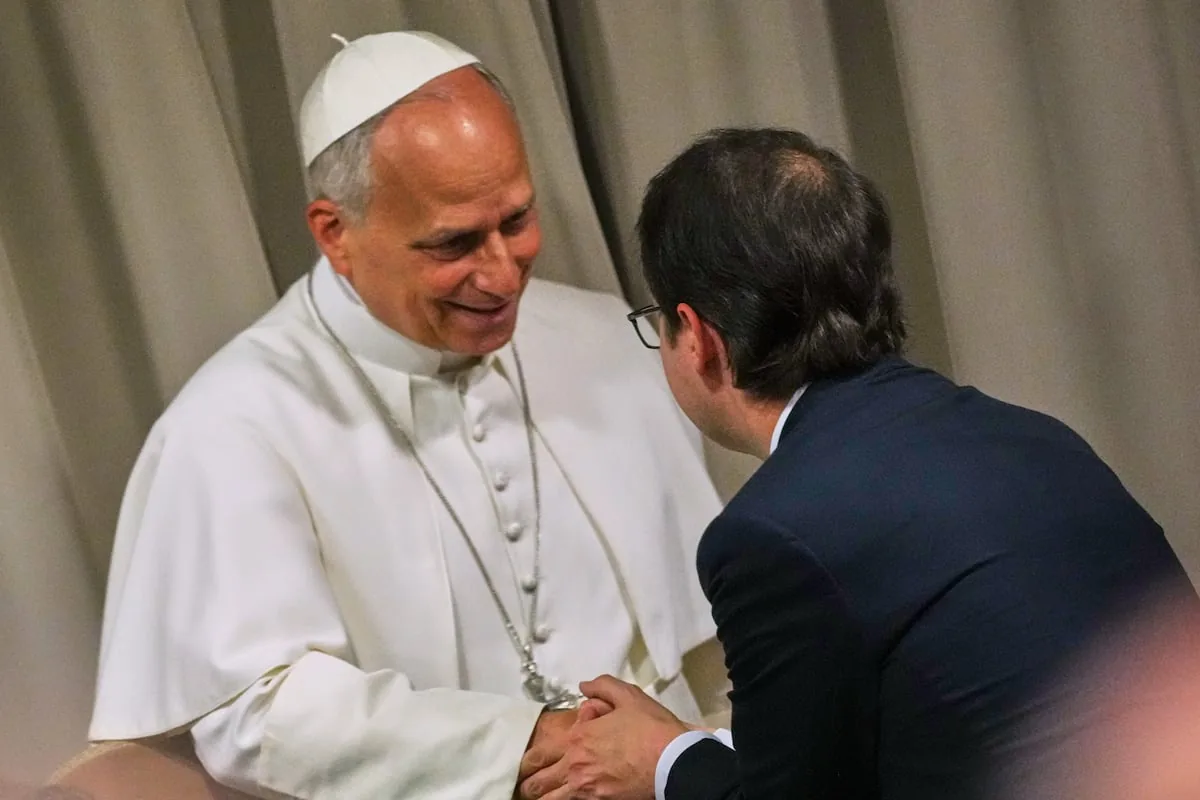
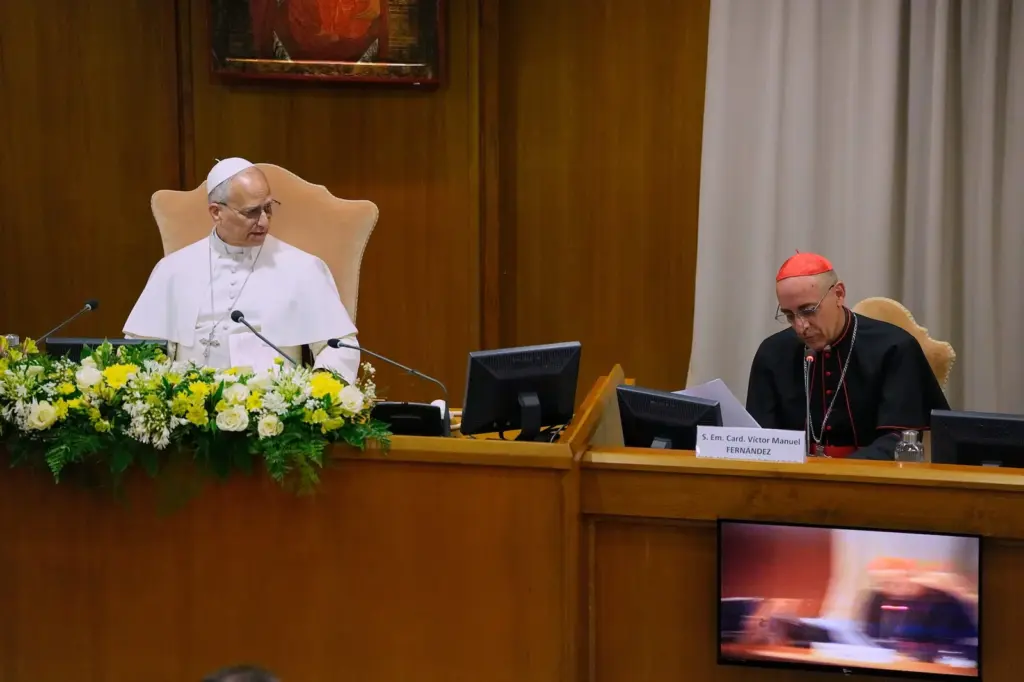
Leo XIV, elected a year ago, chose that name thinking of Leo XIII, the pope who initiated the social doctrine of the Church with the encyclical Rerum novarum (Of New Things), in 1891, in the face of the dehumanization of the industrial revolution and the rise of communism. The reference is so clear that he signed his first encyclical on the same day, May 15, because he believes the world is facing a similar epochal change. And certainly, Leo XIV takes a strong stance, following the line of Francis. Proof that he is aware of the ongoing challenge and his willingness to dialogue, Prevost personally attended the presentation of the document this Monday before an audience with academic and diplomatic representatives. It is the first time a pope has done so; until now, it was done by a prominent prelate at a press conference.
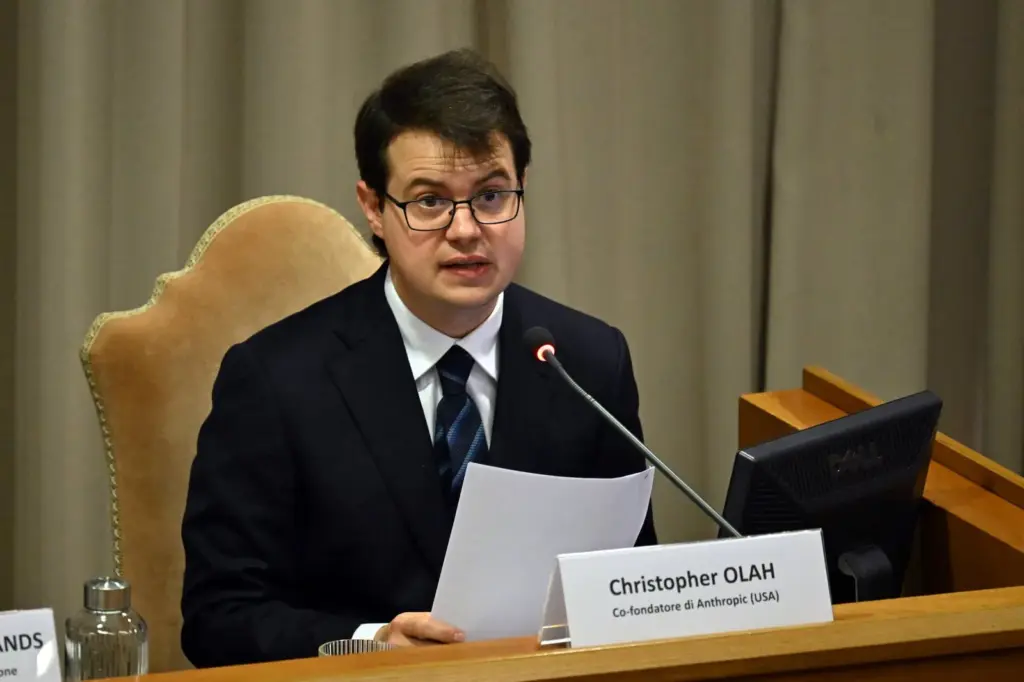
Moreover, among the speakers was Christopher Olah, 38 years old, atheist and co-founder of Anthropic, one of the main AI companies, but with a distinctive trait: he confronted Trump and opposed the use of his technology in the Pentagon. In his speech, he thanked the Pope and admitted that “moral voices that incentives cannot bend” are necessary.
The problem of forgetting historical memory
Robert Prevost, who kept a low profile for months and in recent months has emerged with his own personality by confronting Donald Trump, confirms with this document that he is a first-order antagonist figure against the White House policies and far-right populism. Because, he warns, without an “ethical and humanizing reflection, the growing power of digital systems risks leading us to new atrocities, no less shameful than those of the past that we deplore today, while we continue to present ourselves as ‘advanced’ and ‘civilized’ societies.”
The Pope considers that “we live in a time of remarkable spiritual and cultural blindness,” in which “a false pragmatism invites cutting the roots of memory (…), mistakenly believing that the atrocities of the 20th century can no longer be repeated.” “In reality, the same dynamics re-emerge in new forms,” he warns. Against this, he proclaims a “civilization of love” and never losing sight of humanity: “No calculation system, however sophisticated, generates a heart that gives itself, nor a conscience capable of discerning good.”
Leo XIV clearly diagnoses the poisonous effect of social networks and new modes of communication, and has no qualms about glimpsing a totalitarian drift: “Public opinion is progressively oriented and accustomed to polarized media narratives, often amplified by algorithms that value confrontation and opposition. We also witness a worrying loss of historical memory. The gradual disappearance of direct testimonies of the Holocaust and the two world wars facilitates the selective or distorted rewriting of the past, in a climate where fake news and narrative manipulations tarnish the lessons learned.”
Against “religious extremisms and identity fanaticism”
One of the ongoing phenomena he points out is an alliance of nihilism and pragmatism: “Religious extremisms and identity fanaticisms ally with irrational economicism, while politics easily resorts to disinformation, ridiculing the adversary, and systematically building fears and resentments. Thus, the diversity of the other is increasingly experienced as a threat.”
He is the first Augustinian pope, and the imprint of Saint Augustine, the construction of the city of God, is clear in the text. In a world where the central question is the struggle between good and evil, he calls to embrace the human, with all its problems and imperfections, and believes in a horizon of hope because he believes humanity is also capable of great things. He has never done so, he recalls, without “resistances, petty interests, and cultural inertias.” He points out that “history can change when at least one man or one woman truly takes the dignity of all seriously,” and the first example he cites, intentionally, is the civil rights movement in the United States, and Martin Luther King Jr. The Pope calls on everyone to work to “make technology grow without the heart retreating.”
“Disarm AI”
In this ideological battle, the Pope believes that artificial intelligence “is not morally neutral,” but is a weapon. That is why he calls to “disarm AI (…) remove it from the logic of the arms race, which today is no longer only military, but economic and cognitive.” “Disarming means breaking this equivalence between technological power and the right to govern. Disarming does not mean renouncing technology, but preventing it from dominating the human. It means removing it from monopolies, making it debatable, refutable, and therefore habitable. (…) AI is already an environment in which we are immersed and a power we must face. Therefore, it is not enough to regulate it; it is necessary to disarm it and make it welcoming.”
In the speech he read this Monday at the end of the presentation of the text, he emphasized this aspect even more. He even compared AI to the atomic bomb and said it must be “freed from the logics that turn it into an instrument of domination, exclusion, and death.” “Like nuclear energy, it must be at the service of all and the common good,” he concluded.
The Pontiff also shows his alarm in the document about the “normalization of war”: “When historical memory fades and ethical criteria that protect civilians and the most fragile weaken, it becomes easier to present violence as necessary, inevitable, or even ‘clean.’” In this sense, he points out that “the temptation to build collective identity against an enemy reappears, feeding narratives in which each one presents themselves as a victim legitimized for revenge.” “Simplification into schemes — ‘me first,’ ‘friend-enemy,’ ‘us-them’ — facilitates decisions, often irresponsible, that undermine mutual trust among nations. The strength of international law is thus replaced by the supposed ‘law of the strongest.’”
The danger of posthumanism and “second-class” people
At the center of the encyclical, the Pope directly refutes the theories of Elon Musk, Peter Thiel, and the visionary gurus of Silicon Valley, transhumanism, and posthumanism. “Even though these hypotheses remain largely speculative, they are gaining relevance because they modify the collective imagination and, consequently, guide social, economic, and political decisions,” he warns. “If the human being is treated as matter to be perfected or surpassed, then it becomes easier to accept that some are considered less useful, less desirable, less worthy. In the name of progress, one can come to think of ‘necessary sacrifices’ and make the most vulnerable pay the price of a supposed optimization of the species,” he asserts.
Prevost insists that some posthumanist currents even propose “the existence of ‘second-class’ human beings, serving the interests of elites who perceive themselves as superior: a disturbing perspective, even more serious if combined with technological instruments that exponentially expand the power of control and selection.”
But the Pope goes further and expands the analysis regarding global exploitation, not only because of the environmental impact demanded by new technologies but also due to “new forms of slavery” and a “new face” neocolonialism. It arises, he analyzes, from “structural debt logics that keep entire peoples in conditions of dependency.” “A significant part of the functioning of the digital economy relies on the silent work of millions of human beings, employed in little visible but essential activities: data labeling, content moderation — often poor — and model training. In many cases, these are young people, mostly women, who work hard in exchange for minimal wages. (…) It is not enough to invoke efficiency or praise the benefits of innovation if these are based on a chain of exploitation deliberately kept hidden.”
In these passages emerges the American pope who has lived half his life in Peru and knows the Global South. He explains that “injustices do not arise only from wrong decisions of individuals but also from structures, mechanisms, economic and cultural systems that almost automatically produce inequality.” That is why he asks to “recompose broken ties and reintegrate the excluded, taking into account the wounds caused by injustices: wars, colonialism, racial or gender discrimination, violence against entire peoples, and exploitation.”
Read more The wall charger for electric toothbrushes that eliminates cables from the bathroom
New colonialism and apology for slavery
Leo XIV accuses a new colonialism that “not only dominates bodies but appropriates data, transforming personal lives into exploitable information.” “Entire territories, especially those with less geopolitical relevance and greater structural fragility, are currently traversed by a new logic of extraction: that of health flows, epidemiological profiles, genetic maps, and demographic data.”
Here the Pontiff surprisingly slips in a historical mea culpa for the Catholic Church’s errors in allowing slavery: “We cannot deny or minimize the delay with which the Church and society condemned the scourge of slavery.” He specifies that it was not until the 19th century, again with Leo XIII. That is why, he explains, “the memory of complicity and blindness of the past before the injustice of slavery becomes for us a call to vigilance.”
The treatment of immigrants, the factor that defines a society
The Pope links all his reasoning to a kind of litmus test that determines whether a society is just or has gone astray: “A decisive test for social justice today is represented by the condition of migrants, refugees, and those forced to move due to poverty, violence, climate change, and natural disasters. The way a society treats them shows whether its idea of justice is guided by fear or fraternity.”
Here Prevost introduces a double reasoning, which he has already pointed out in the last year: recognizing the right to leave, but also working to make the right to stay effective. “Social justice, in this field, implies at least two complementary commitments. On the one hand, protecting the right to hope of those forced to leave, guaranteeing safe and legal routes, dignified reception conditions, and real integration processes. On the other, also promoting the right to remain in one’s own land in peace and security, addressing the root causes that force migration, including causes linked to economic injustices and the climate crisis.”
He means that in the migration issue there are two failures, at origin and destination, and both must be resolved if a solution is truly wanted. That is why he points out that “development that increases the consumption of some at the expense of costs and wounds in others, or relegates entire regions to subordinate roles, preventing them from expressing their own potential, is not humane.” He insists: “True progress is not that which increases the well-being of some by degrading ecosystems, shifting costs onto the most vulnerable communities, or compromising the living conditions of those who will come after us.”
There are numerous warnings against savage capitalism: “It is necessary to remember that economic freedom is not absolute and must always be measured according to the common good and the dignity of each person.” He demands that “decent and valuable employment” is an essential part of society, and not “a variable dependent solely on profit.” “A just society requires a present State and civil institutions capable of overcoming the mere logic of efficiency, explicitly directing resources, creativity, and norms in favor of the most vulnerable,” he concludes.
The encyclical even makes proposals regarding fiscal policy, as it points out the worrying increase in inequalities worldwide: “Just laws and redistribution instruments are needed to correct imbalances, including tax systems that relieve the burden on the weakest and demand more from those with greater resources.” And adds: “Taxation, social protections, and industrial policies must correct the imbalances created by the concentration of wealth and power.”
“The real alternative is not between enthusiasm and fear, but between two ways of building: progress that serves the person and peoples, or progress that bends them to logics of power,” concludes the Pope. He is categorical in denouncing that “those with powerful technical and economic resources (…) have a great capacity to provoke cultural changes and, ultimately, to convince a significant number of people about what the truth is about the human being, the world, the meaning of existence, the family, and even God.” It is a clear reference to the messianic drift underway in the United States, which tries to appropriate the Christian message.
Thanks to the press for exposing cases of pedophilia
The text gives great importance to the degeneration of public information, which it considers deliberate and with a deep political interest: “When the question about what is true loses interest and a pragmatism that settles for what seems useful or effective prevails, democratic life weakens.” It calls for an “ecology of information” and the need for “serious journalism.”
At this point, the Pope has an unprecedented detail in an encyclical, the most important pontifical document, by thanking the press for its work in denouncing pedophilia in the Church: “Some journalists committed to the truth have played a fundamental role in bringing injustices and abuses to light. To them, I would like to reiterate the words of Pope Francis when addressing the Vaticanists: ‘I also thank you for what you reveal about what does not work in the Church, for what helps us not to hide under the carpet, and for the voice you have given to the victims of abuse.’”
Arendt, ‘The Lord of the Rings’ and ‘Guernica’
The Pope, ultimately, also joins the legion of citations of Hannah Arendt, increasingly relevant, and alludes to The Origins of Totalitarianism: “Disinterest in the truth slowly but inexorably leads to totalitarianism, for which, as philosopher Hannah Arendt wrote, the ideal subjects are not so much those ideologically convinced, but ‘people for whom there is no longer a distinction between fact and fiction (that is, the reality of experience) and the distinction between true and false (that is, the norms of thought).’”
In another of the quotes, the Pope has his pop moment in a quote from The Lord of the Rings. In reality, he threads very finely, since this novel is a reference for far-right movements, starting with Giorgia Meloni herself, and Prevost emphasizes that a Tolkien character, “a Catholic writer,” described the responsibility of people this way (he does not quote it, but it is the wizard Gandalf, according to Italian media): “It is not for us to master all the tides of the world, but to do what is in our hands for the good of the days we have to live.”
There are other striking and very significant allusions, such as when he points out that culture and art, “when authentic, guard this spark, preventing the normalization of evil.” Then he cites three: “Beethoven’s Ninth Symphony as a desire for unity,” an obvious reference to Europe; Guernica “as a denunciation of dehumanization,” and the film Schindler’s List, “as an invitation not to consign the past to oblivion.”
Warning about mobile phone use in minors
There are other novel and surprising aspects for an encyclical: the Pope warns of the risk for children of “having a personal mobile phone too early and using it without adult control.” He sees overwhelmed families, “finding it difficult to resist alone the conditioning of business models that monetize attention and time,” and therefore calls for the intervention of authorities: “It is necessary to oppose, with far-reaching public decisions, the immediate interests of platforms — concentrated in few hands — when these conflict with the good of minors.”
Prevost also calls to defend public education. He points out as one of the most important challenges combating “strong inequalities in access to basic education and higher studies.” For this, he says states must invest the necessary resources “to guarantee quality education for all, either by adequately supporting the public school system or supporting private institutions,” but warns: “When a significant part of education, at various levels, is entrusted to private institutions, it may happen that, lacking adequate public support, access to school depends too much on the economic possibilities of families.”
In any case, the Pope offers a horizon of hope and trust in humanity. As a recipe, he proposes five paths “of daily and public responsibility,” and lists: “Disarm words, build peace in justice, assume the perspective of victims, cultivate healthy realism, and relaunch dialogue and multilateralism.”
Read more The showerhead with 6 spray modes that is a hit for just over 15 euros