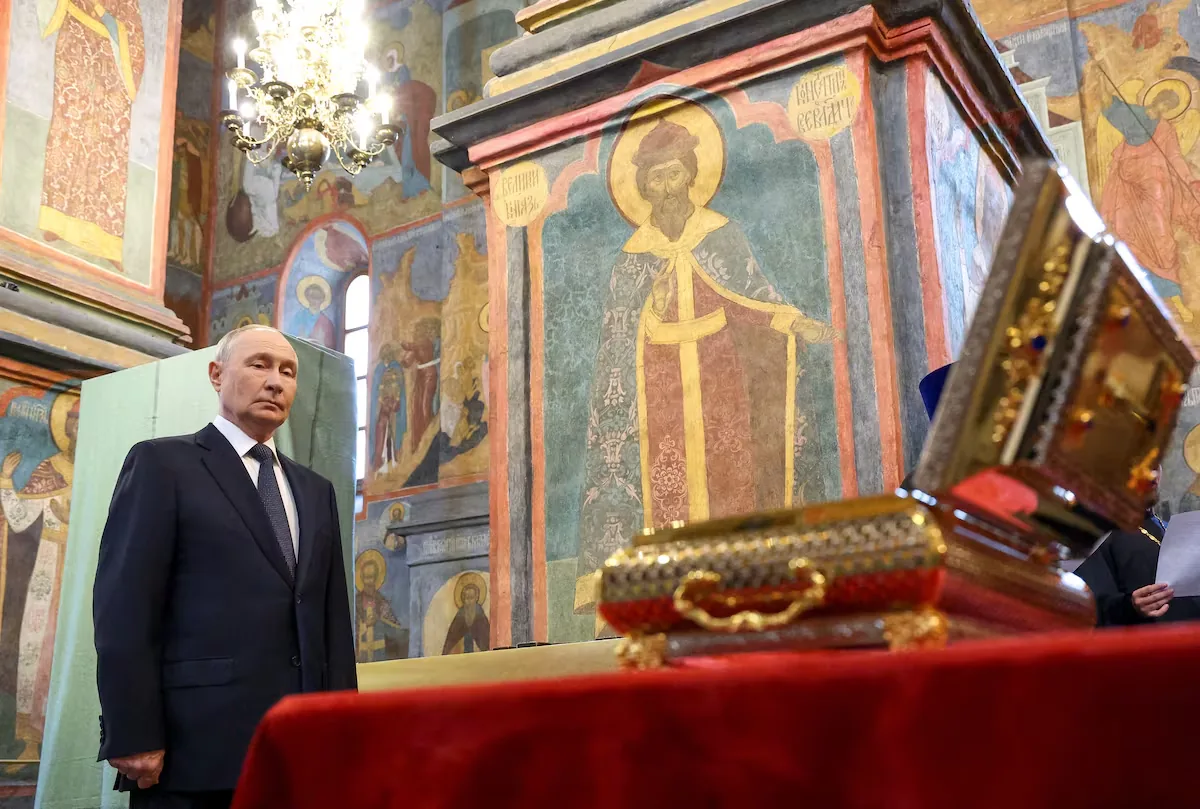
Every regime needs foundational myths to legitimize itself in its messianism. Stalin copied Ivan the Terrible and allowed the icon of Our Lady of Kazan, the Holy protector of Russia, to be carried in procession during the Nazi invasion; Franco made the left hand of Saint Teresa his guide in the Civil War, and Vladimir Putin has sent to the front in Ukraine another hand, the right one with which Prince Donskoy supposedly wielded the sword, so that the Russians link their current war with the Battle of Kulikovo of 1380. A battle that was not decisive, but to which Russian propaganda has once again elevated to legend to symbolize the unity of the Russians against the foreign enemy. Exactly what Putinism, eager for an eternal external threat to justify its repression, needs to represent today with the West.
The relics of the Slavic prince will rotate from one unit to another on the Donetsk front until they are displayed from October in the church of the Saur-Mogila memorial complex, in the same region occupied by Russia.
The procession has the blessing of the Patriarch of the Russian Orthodox Church, Kirill, who ordered at the beginning of the war that all masses pray for Russia’s victory. In fact, the primate has recommended not to be discouraged by a hypothetical nuclear war because “the Lord will come in his glory, destroy evil, and judge all nations.”
“There are forces that want to divide our Church and our society, depriving us of our historical memory and our unity. They act against the peoples of Rus as they did against Prince Dmitry Donskoy and Saint Sergius of Radonezh,” declared the Russian patriarch. “It is the same hand with which he wielded the sword on the battlefield of Kulikovo,” said Metropolitan Kirill of Stavropol, fascinated.
The Russian Orthodox Church has blessed this measure “in order to provide support and comprehensive spiritual guidance to the members of the army.” However, beneath the relic lies the Kremlin’s and the Russian Orthodox Church’s desire to present that medieval battle as a symbol of the war they claim to be waging today against a great enemy, the West, on the Ukrainian battlefield.
Russian authorities have known for two decades the whereabouts of the remains of the Grand Prince of Moscow Dmitry, nicknamed Donskoy several centuries after his death in 1389. Restoration work on the Archangel Cathedral, part of the Moscow Kremlin, revealed his tomb in 2007, as the complex itself states on its website. However, Russian propaganda has once again sold the discovery of their saint on August 20.
“It is an absolutely unique and miraculous discovery of relics,” Putin said during a visit to the tomb alongside Nikolai Makarov, director of the Institute of Archaeology of the Russian Academy of Sciences. “It is incredible, this strengthens the most important foundations of our history,” added the Russian leader.
Mythology presents the Battle of Kulikovo, fought on September 8, 1380, by the Don River, as the first time the Russians united against a common enemy, the Tatars and the Golden Horde, one of the parts into which the Mongol Empire was divided after the death of Genghis Khan.
A century and a half earlier, in 1237, the Mongol invasion had subdued other peoples of the current Russian territory and disintegrated the Rus of Kiev into several principalities, which the khanate subjected to vassalage. These principalities, including Vladimir, Suzdal, and Moscow, fought wars among themselves. The Russian Tsardom would be born centuries later, in 1547.
Read more Stop the clutter with the drawer organizer set that has over 10,000 reviews on Amazon
Taking advantage of the renewed eschatology around the grand prince, one of the Kremlin’s propaganda channels, Rossiya 1, has presented the Battle of Kulikovo as another chapter of the supposed eternal confrontation between the West and Russia.
“Donskoy was the first Russian ruler to consciously challenge a then-invincible power. In the 14th century, the West, as in the time of Alexander Nevsky, tried once again to crush the rebellious Russian rebels,” said the presenter. “Catholic Lithuania pressed from the northwest and the Genoese, with their armor, from the south. The Genoese merchants, along with the Pope, placed Khan Mamai at the head of a puppet army,” he added.
Scarce sources
There are few reliable sources on the Battle of Kulikovo. Russian historiography elevated the number of participants in that feat to hundreds of thousands centuries later, although other studies suggest it was a minor battle. Moreover, the clash was fought against a rebellious general of the Golden Horde, Mamai. The true leader of the Mongols, Tokhtamysh, maintained his dominance over the principalities and ravaged Moscow two years later.
Likewise, there is evidence that the druzhinas [bodyguard armies] of Lithuania fought on the rebel side against Mamai, and he had as an ally the principality of Ryazan, from which Moscow had taken the city of Kolomna years before. As for the Genoese, their only presence in the area was some mercenary strongholds in Crimea, something common in the Middle Ages, from the Great Catalan Company to the condottieri.
There have also been doubts in the historian community about Prince Donskoy’s participation in the battle, and his role if he actually fought in it. According to historians of the Russian government, there is no doubt about his involvement.
“From the 19th century, some reformist researchers questioned the prince’s personal heroism. Some even claimed that Dmitry never participated in the battle and that his generals won it,” said Doctor of Historical Sciences Roman Sokolov. “Now we have proof: a mark from a saber or spear blow that healed during the prince’s lifetime. It is the end of the falsehoods that unfortunately have reached our days,” added the historian from the Herzen State Pedagogical University.
The rewriting of history has a purpose. The veneration of Donskoy reinforces one of the slogans the Kremlin repeats to Russians from the first minute of the war: “God is with us.” And this phrase contrasts with an “they,” the West, its enemy.
At the end of its report, the Rossiya 1 channel insisted again on legitimizing its invasion of Ukraine with those pages of history. “The Battle of Borodino [against Napoleon] and the liberation of Donbas from the Nazis are linked to the Battle of Kulikovo. History is not over, Russia is writing new chapters, and the warrior prince Dmitry Donskoy is invisibly present in them.”
Read more The 5 dog strollers that are a hit on Amazon: foldable, durable, and for different sizes