There is no topic other than Ceuta in Spanish politics. Both the Government and the PP have decided to indefinitely delay announcements of measures or proposals they had prepared for this start of the political season, aware that everything quickly burns in the fire of a very deep crisis that, a month later, continues to wear down the Government and is still far from being resolved. On Tuesday, the Council of Ministers will approve an emergency plan with 165 million that will be added to the more medium-term recovery plan of 180 million promised in Ceuta by the First Vice President, Carlos Cuerpo.
Read more McLaren ties Lando Norris until beyond 2030
This coming week the Executive will redouble its efforts to try to appease it from a humanitarian, social, economic, and political point of view, and once again the Council of Ministers will be dominated by Ceuta. This time it will not only be political measures, like the single command last week, but a large package of economic emergency and basic services in which, according to Government sources, a very important amount will be approved for a city of 80,000 inhabitants: 165 million euros to revitalize the local economy and strengthen public services. The equivalent of that money in a city like Valencia would be 1,650 million, in Madrid, 7,200.
This money is for the emergency of the moment, and it is separate from the so-called Ceuta plan of 180 million, which the economic vice president, Carlos Cuerpo, announced will be expanded and is being negotiated with employers, unions, and representatives of the sectors in the city. That is a long-term plan, and these are emergency measures to provide a quick way out of the crisis and try to recover normality as soon as possible.
The package to be approved this Tuesday will mean a direct injection into Ceuta’s economy of 80 million euros in the next four months, an amount equivalent to 4.1% of its GDP, and therefore a considerable volume, while another 70 million are prepared to be spent in 2027. The direct economic injection, the most important, thus reaches 150 million euros in a year and a half.
These Government sources point out that in direct aid to SMEs and self-employed there will be 35 million euros and another 15 million to revitalize commerce and tourism, which have suffered a significant collapse this August, since the massive jump on July 30 and 31.
This Tuesday the Executive will also approve extra money to strengthen education, health, and justice in Ceuta, one of the most repeated issues in the neighbors’ protests, with 15 million euros.
At La Moncloa they insist that the Government is not sparing any type of resource to overcome the crisis, and they assure that the problem is not money nor political will, but the great logistical difficulty of finding places that can serve to host immigrants and get them off the streets, mountains, and beaches of Ceuta. The latter has also received a boost this week, when new spaces have been agreed upon that are already being enabled with the idea that in two weeks no one will be sleeping on the streets, and the return process is also accelerating with more agents, the help of Frontex, and the possibility that police officers conduct interviews online from outside Ceuta.
Sánchez has not gone to Ceuta since July 31, although half of his Government has been there, some of them many days and several times, like the Minister of Inclusion, Elma Saiz. The president’s image has enormous wear in the city, dominated by the PP for 25 years. However, the Government claims that Sánchez has been the president who has gone to the autonomous city the most times (four) on an official visit —Aznar only went once in 2000 during an electoral campaign, as a candidate, and Rajoy went as acting president in 2016— and above all the one who has invested the most money. La Moncloa maintains that in these eight years Ceuta has received double the resources than in Rajoy’s term. In direct transfers, the Executive assures, with Sánchez Ceuta has received 428 million, 50% more than with Rajoy.
Sánchez starts the political season this Monday with an interview on Cadena SER and has an important milestone on Thursday with an appearance in Congress about Ceuta. This issue, which the Government privately admits it has not managed well, despite efforts for weeks to redirect it, has blown up the political agenda and has the opposition convinced that it could be the final blow for Sánchez. “This could be his October 1, which was what finished off Rajoy after the corruption,” summarizes a PP leader recalling the procés, whose poor management devoured the former president’s image.
Several ministers and members of Sánchez’s circle consulted dismiss this idea and maintain that once again the PP is rushing and not measuring well. “The Ceuta crisis is serious, but we are going to resolve it. We have taken too long, that’s true,” admits a Government member. “We have lost a lot of time arguing with the city about where to shelter them, something that did not happen in 2021, and the truth is that after managing to have more than 90% return in a few hours, which was the hardest part, we did not properly dimension the remaining problem. But it will be resolved, we are putting everything in place to achieve it, and the PP will be left without a discourse again. Many things will still happen before voting,” he concludes.
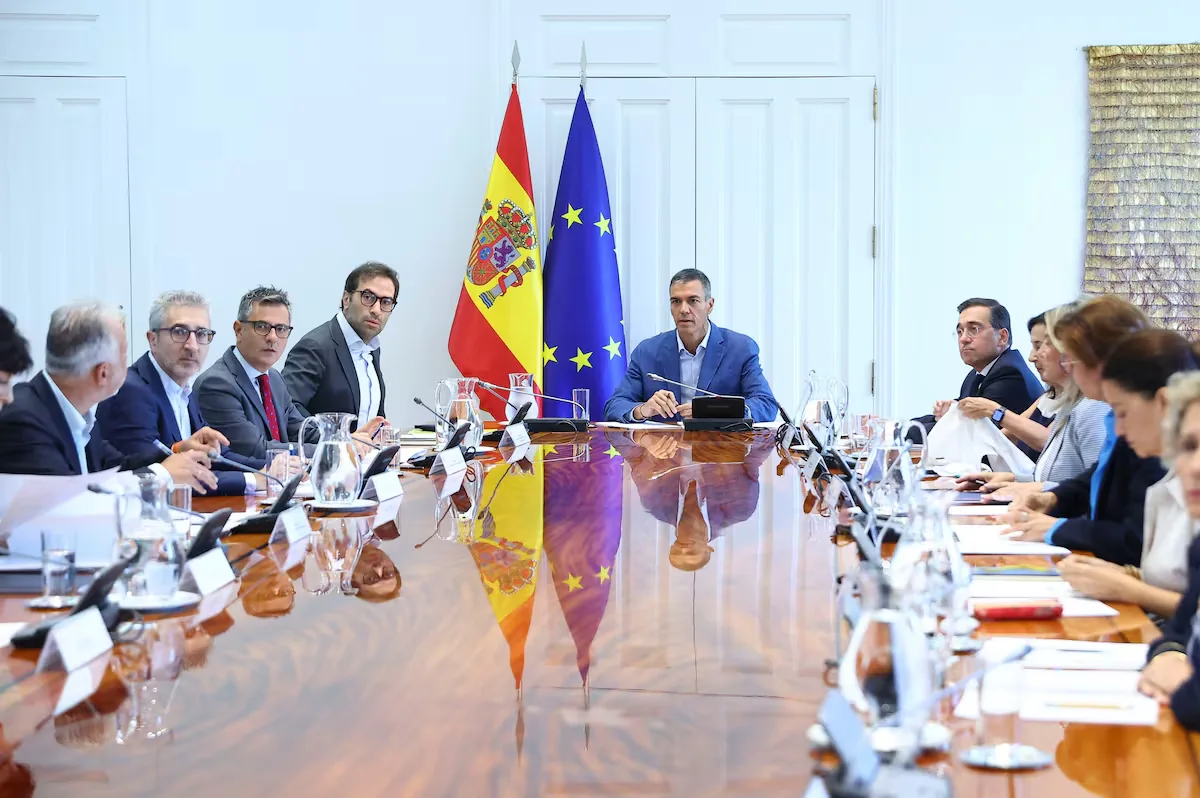
Sánchez and his team are preparing Thursday’s appearance —by then they expect to have the crisis more focused though not resolved— with the aim of demonstrating that far from being a problem, his good relationship with Morocco is what has allowed 90% of those who jumped to return in a few hours, something that has not happened in any other European migration crisis.
The Foreign Minister, José Manuel Albares, who has the most information, assured Congress that nothing indicates that Morocco encouraged this jump, and rather pointed to networks and the manipulation of thousands of people who were made to believe the border was open, even with videos of false speeches by Sánchez, generated by artificial intelligence. Albares spoke of the “reactionary international” that immediately launched against Spain, as if they were waiting for the news, and that is one of the lines Sánchez is working on for the appearance: that political alliance of far-right governments trying to end the last great European progressive resistance, which he leads with the Brazilian Lula in that attempt to stop the wave of far-right that runs through the two continents.
The Government needs to return to its political agenda as soon as possible, to the great ideological debate, to the economy, to announcements of progressive measures, and to the mobilization of the left. But for that, it has to close the Ceuta crisis. And it does not seem imminent, although Tuesday’s measures with those 165 million will try to accelerate normalization. Meanwhile, the opposition seems very comfortable in an issue that has its two focuses together: immigration and a worn-out Government.
The start has become very complicated for Sánchez, much more than last year, when the massacre in Gaza made him regain a lot of political strength while Feijóo got entangled in his ambiguous positions. The coming weeks will determine whether this crisis is deep and with electoral consequences or if it is another tough episode but with possibilities of solution. The big difference now with other holes from which the Government managed to emerge successfully is that the elections are really getting close.
Read more An accident involving three cars forces the closure of the AP-7 in El Papiol (Barcelona)