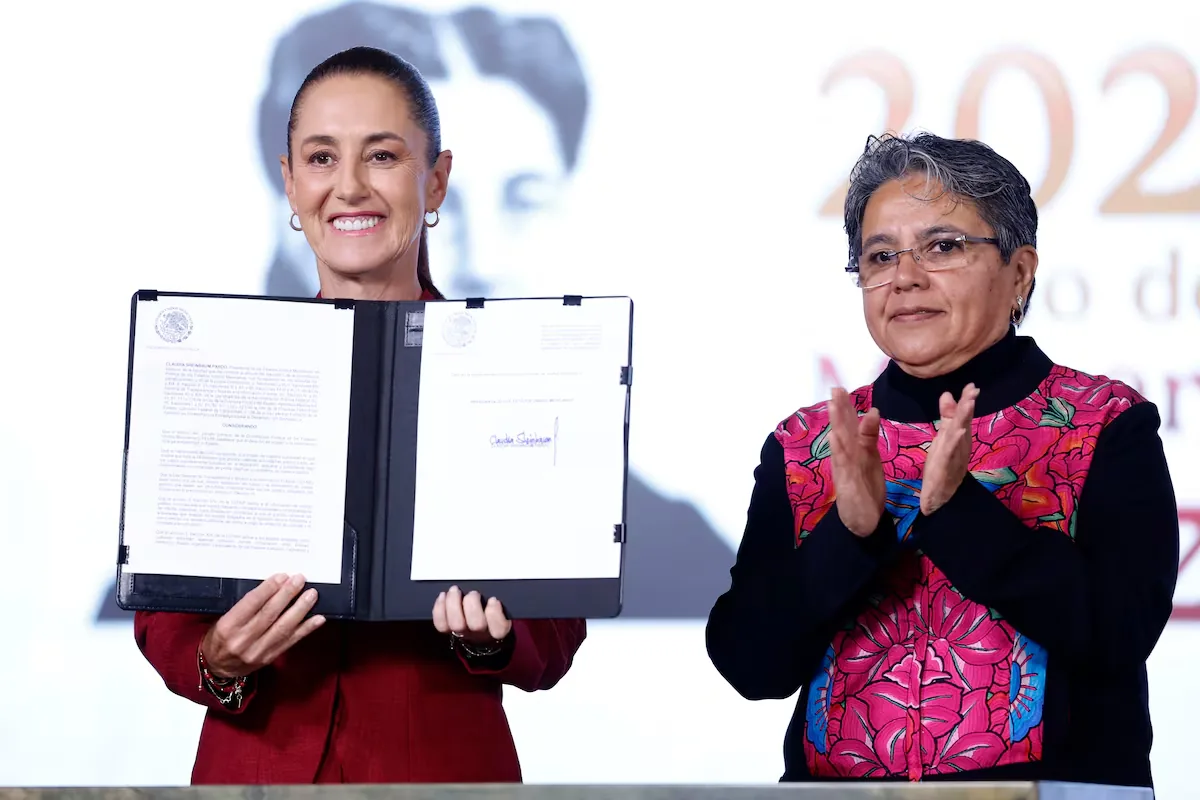
The Government of Claudia Sheinbaum has begun to move the first piece of a broader anti-corruption reform that will be discussed in the next session period of Congress, starting in September. The president signed a decree this Tuesday that tightens transparency rules for the entire public Administration and, more than an isolated measure, it functions as the cornerstone of the legislative package that her Administration is pushing to reconfigure the fight against corruption following the disappearance of the National Institute of Transparency (INAI).
Read more The entire Royal Family dresses in summer attire to welcome Balearic society in Marivent
EL PAÍS has revealed details about the reform package and the strategy the Government is pushing. With this, it aims to dismantle the current National Anti-Corruption System (SNA), rebuild the auditing and oversight framework, strengthen the State’s capacities to pursue the diversion of public resources, and establish mandatory coordination among the main institutions responsible for investigating corruption networks. The fight against fuel theft and false invoicing networks are shaping up as the most visible objectives of this new framework.
The decree signed by the president this Tuesday is part of this. The political and legal premise points to public information no longer depending on the discretion of the official who manages it. That is, the obligation to publish data will become a mandate for all federal agencies, with specific rules about what must be made public and under what strictly limited exceptions for reasons of public interest or national security.
The measure represents the Government’s first attempt to respond to one of the main criticisms that accompanied the disappearance of the INAI: that concentrating transparency functions within the State could translate into less access to public information.
The president again defended the extinction of the autonomous body by arguing that it represented an expense exceeding 1 billion pesos annually, accumulated corruption scandals, and left a National Transparency Platform that, she assured, frequently remained down. “So much bureaucracy is not needed for information to be transparent,” she said.
The Anti-Corruption and Good Governance Secretariat, headed by Raquel Buenrostro, is responsible, along with a group of experts and legislators, for implementing the reengineering that has been under construction for months. The official announced that the National Transparency Platform, created more than eight years ago, was technically stabilized and will receive new tools to facilitate the download and massive analysis of information.
The decree will require the publication of information considered of high public interest that until now was not part of the ordinary transparency obligations. The first front will be public procurement: all federal Government contracts will stop being published quarterly and will be updated monthly.
The second axis points directly to Petróleos Mexicanos and the Federal Electricity Commission, two areas under constant scrutiny for their opacity. The Executive will order the publication of financial statements, corporate governance structure, operating policies, reports sent to foreign authorities, and contracts of the subsidiaries of both public companies.
The third line incorporates information about audits and oversight. The Anti-Corruption Secretariat will publish annual audit programs, statistics, follow-up on observations, and the registry of external firms responsible for reviewing public spending. The Government will also invite states, municipalities, and other public powers to adopt the same “maximum publicity” standard, intending to build a homogeneous data openness system.
The decree also anticipates a fundamental change in how reserved information is classified. The current categories will be simplified to restrict exceptions practically to two cases: public interest and national security. Even in those cases, the instruction will be to prioritize the preparation of public versions rather than fully reserving the documents.
The decision does not come in isolation. It is part of the institutional framework that the Sheinbaum Administration began designing after taking office and that is intended to come as a reform package in September. Sheinbaum confirmed that the content of the decree will later be incorporated into the new General Transparency Law being prepared by the Legal Counsel together with the Anti-Corruption Secretariat. This adds to the legislative package; it will be one of the pillars of the anti-corruption offensive that also includes modifications to close spaces for fuel smuggling, combat invoicing companies, and strengthen the State’s oversight mechanisms.
The decree is the first trial of the new framework. The real dispute will begin in September, when Congress discusses the reform package with which the Government intends to redefine the rules of transparency and the fight against corruption for the coming years.