







The death of at least five British citizens in the dramatic fire in Los Gallardos (Almería) has highlighted a reality that often goes unnoticed: 408,000 UK citizens live in Spain, ten times the population of Gibraltar. And another 427,000 Spaniards reside in Great Britain, equivalent to the English city of Coventry. Additionally, 19 million subjects of King Charles III, mostly English, visited Spain last year, where they spent 23.54 billion euros, 1.44% of the Spanish GDP, while 2.6 million Spaniards travel to the UK each year, where they spent 1.4 billion pounds last year, 0.05% of their GDP. “In summer there are more flights between Spain and the UK than between any other countries in the world,” summarizes the British ambassador in Madrid, Alex Ellis. “The British like to come to Spain, Anthony Gordon too,” he adds, referring to the new star of the English national team who has signed for Barça.
Read more Imposing tolls on the Strait of Hormuz, Trump’s latest whim and backtrack
Despite this, relations between Spain and the United Kingdom have revolved for decades around the Gibraltar dispute, the last colonial territory in Europe, an “irritant” in the words of the Spanish Foreign Minister, José Manuel Albares, or a thorn in the side, according to a veteran diplomat, which forces walking on eggshells, measuring every step.
The entry into force of the agreement between the EU and the UK on Gibraltar, at 00:00 this Wednesday, opens a new scenario. The demolition of the Fence not only fosters “the creation of a space of shared prosperity between Gibraltar and the Campo, facilitating the flow of people and goods and completely changing human relations between both sides,” according to the British ambassador, but also facilitates “a much deeper and long-term relationship between the two countries.”
Gibraltar will not disappear overnight, warns Ignacio Molina, principal researcher at the Elcano Royal Institute. The Rock is too big to ignore and the implementation of the treaty will require hard work to develop all its chapters, from customs to labor, including police and environmental cooperation. But at least the border queues will disappear, allowing diplomats from both countries not to have to devote most of their efforts to resolving conflicts around the colony.
If social relations are very intense, economic ones are no less so. The UK is the first market for Spanish products outside the EU, with a trade balance favorable to Spain of about 14.5 billion annually; and the UK is the second destination of Spanish investment abroad after the United States, with an accumulated stock of 83 billion euros generating more than 140,000 jobs. This year, Indra won the contract to manage ticketing and access control for the London public transport network for nearly 1 billion euros; while Navantia is building three logistic ships for the Royal Navy for nearly 2 billion and has offered to build eight amphibious ships for the UK and the Netherlands at its shipyards in Belfast (Northern Ireland). This is added to an intense relationship in fields such as education (Spain is the second largest market worldwide for British private education, with 55,000 students) or justice (more than a hundred British fugitives arrested in Spain in the last two years).
The gap, highlights Ignacio Molina, occurs in political relations: Prime Minister Keir Starmer has not visited Spain during the two years he has been at 10 Downing Street, which he is about to leave. Added to this is that, after Brexit, the leaders of the two countries no longer meet regularly in European institutions. The British ambassador acknowledges that “the political relationship must be rebuilt and a new framework established. We are no longer partners in the EU, but we are in NATO, and European countries must cooperate much more because the global scenario has changed.”
Ellis emphasizes that he has worked intensively in the last two years to increase the flow of visits. The most important was Pedro Sánchez’s visit to London on September 3 last year, less than two months after the agreement on Gibraltar’s integration into the EU cleared the way.
That visit served to approve a strategic framework of 48 points to develop bilateral relations. The greatest progress has been made in the economic field. Rachel Reeves became last March the first British Minister of Economy to visit Spain in 11 years, on the occasion of the first Spain-UK Trade and Investment Forum. Her counterpart, Carlos Cuerpo, announced that Spain will exempt British citizens from the visa requirement for service provision stays under 90 days. Last Friday both signed in Brussels a roadmap to deepen collaboration.
There are fields, however, where progress is conditioned by relations between the UK and the EU. London’s incorporation into the Erasmus program, scheduled for 2027, could encourage a return of Spanish students to British universities, although it is unlikely to reach the figure of 13,000 that existed before Brexit and dropped drastically due to the inability to access the lower national tuition fees.
Residents of each country in the other have managed, after a laborious regularization process, to maintain the same rights they had before the UK left the EU on December 31, 2020, but those arriving afterward face a bureaucratic wall. Finally, cooperation in defense matters, theoretically outside Brussels’ competencies, stumbles on the failure of negotiations to incorporate London into the European SAFE program, endowed with 150 billion, “because they have set us a price of 1 billion euros, when Canada was only asked for ten,” explains Ellis.
The crowning achievement of the new stage in relations between Spain and the UK will be the State visit of King Charles III and his wife Camilla. Although the two Royal Houses have been discussing the matter for some time, there is no date yet for this trip, which is expected to take place in the second half of 2027, to avoid coinciding with the electoral process in Spain. It will be the first visit of a British Monarch to Spain in almost 40 years — Queen Elizabeth II was here in 1988 — and will serve as a return, a decade later, to the visit made by Kings Felipe VI and Letizia in July 2017. Ellis states that “it would be an honor as ambassador to receive His Majesty Charles III in Spain” and acknowledges that such visits have been very complicated in the past, “partly because of Gibraltar.”
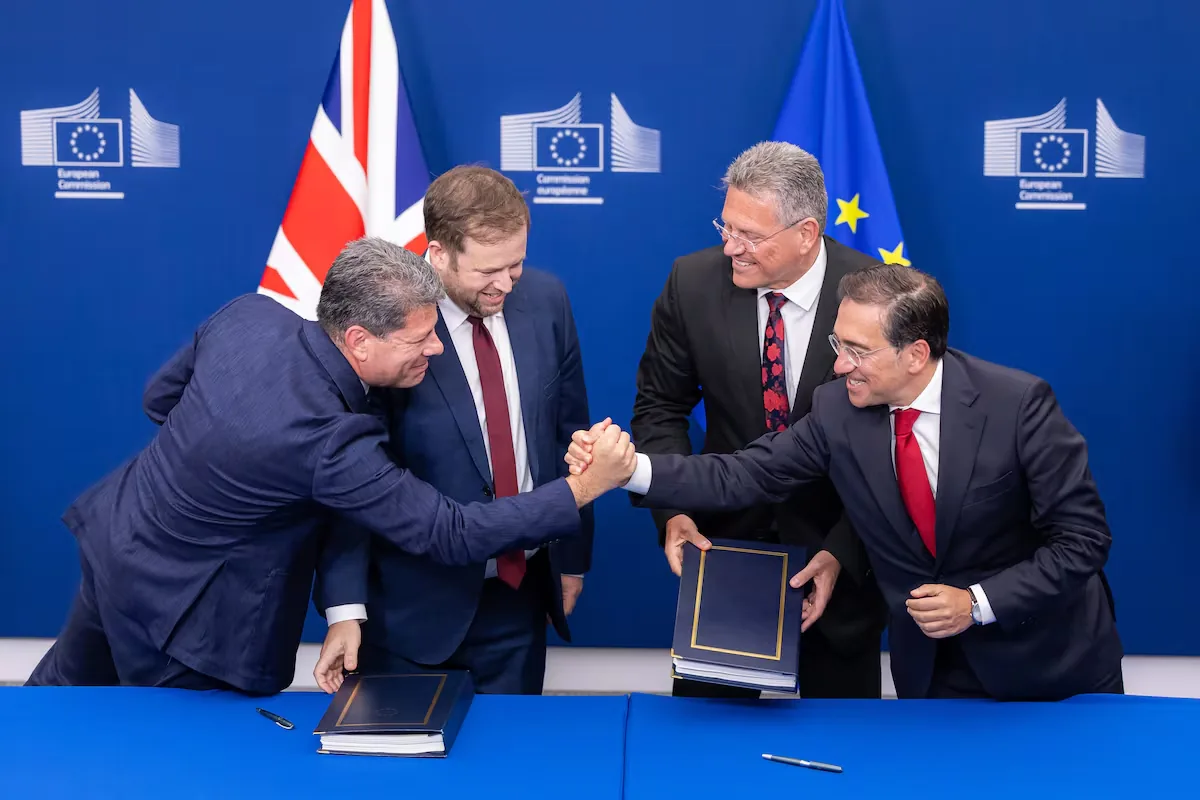
In statements to the press in Brussels, the head of Spanish diplomacy recalled that the agreement between the EU and the UK on Gibraltar was the “last missing piece to complete the Brexit puzzle.” Albares, who attended the signing of the treaty on Tuesday by European Commissioner Maroš Šefčovič and British Secretary of State for Europe Stephen Doughty, emphasized that now “a new stage opens in relations between Gibraltar and the Campo de Gibraltar and also in bilateral relations between Spain and the UK.” “We have achieved all of Spain’s objectives with this agreement,” said Albares, who stressed that “it guarantees forever the free movement of people and goods, avoids past fiscal and environmental distortions, and opens a path of opportunities to a promising future.” The Ministry of Foreign Affairs has not responded to the questions sent by EL PAÍS to prepare this information.