









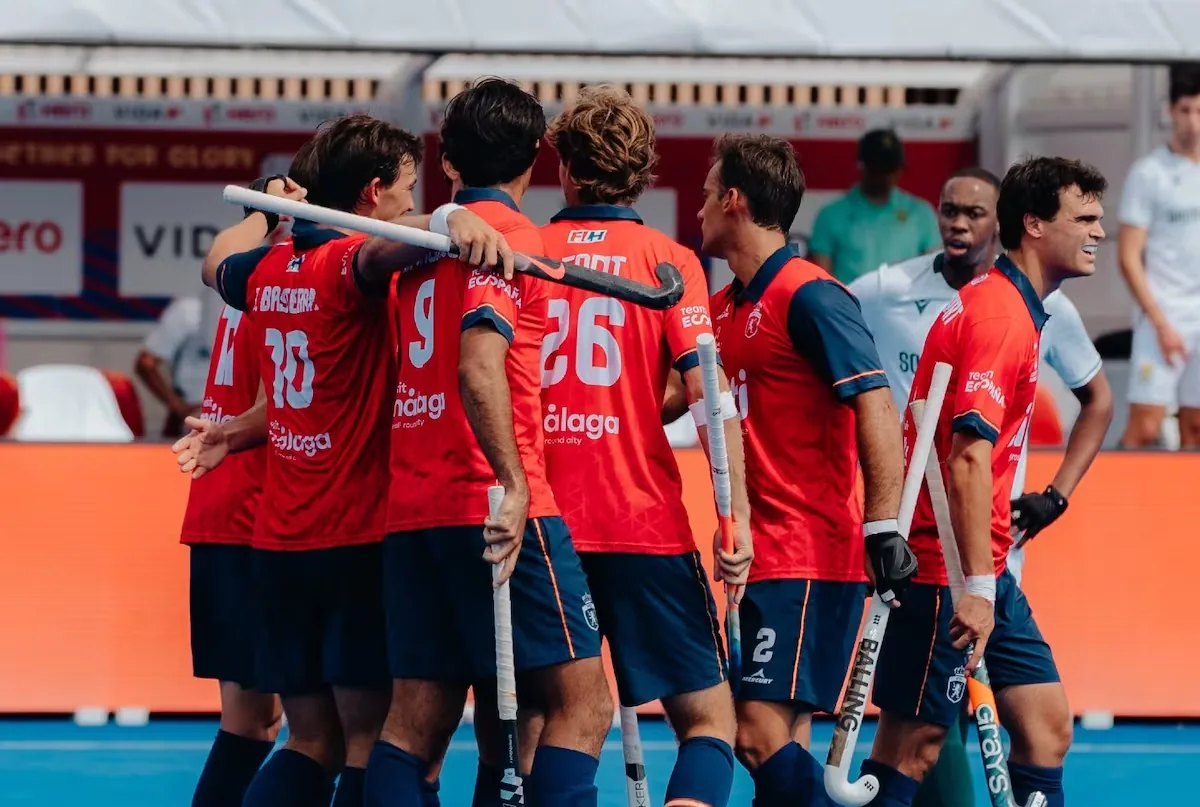
Spain once again fell just short of the field hockey world title. Max Caldas’ team lost this Sunday to Germany (0-1), the reigning champion, in a final with five penalty corners, intense, tight, and of enormous defensive demand. The Spaniards returned to a final after 28 years and were chasing, at the Belfius Hockey Arena in Wavre (Belgium), a title they have awaited since the first edition of the World Cup, held in Barcelona in 1971. Spain had managed to compete head-to-head and dominate several moments of the match, but Germany once again imposed itself as an elite field hockey team when Struthoff found the decisive goal. The German team thus crowns one of the best moments in the sport, after reaching their second consecutive world final and making it to the sixth final in their history.
Read more The Mexico City Marathon, between fashion and the risk of the crowd
With barely a minute and a half into the match, Germany caused the first scare with a penalty corner safely defended by Luis Calzado. The Spanish goalkeeper, one of the great pillars in the semifinal against the Netherlands, responded again when the match had just started. Spain withstood the initial German push and gradually loosened up as the minutes passed, moving the ball more securely, gaining space, and balancing the match against the reigning champion.
𝐓𝐰𝐨 𝐖𝐨𝐫𝐥𝐝 𝐂𝐮𝐩𝐬. 𝟓𝟓 𝐲𝐞𝐚𝐫𝐬 𝐚𝐩𝐚𝐫𝐭
📷 From Spain’s first World Cup final in 1971 to today. #OneStoryOneTeamOneWorldCup#RedSticks pic.twitter.com/Vg76FzJhIM
— Hockey España (@rfe_hockey) August 29, 2026
The intensity and speed of the plays were constant, and for several moments Max Caldas’ team dominated. The pressure increased, and the Spanish team ended up having slightly more possession (51%), but they failed to convert that dominance into a goal. They did not capitalize on any of the four penalty corners they had during the final. They also missed one of their clearest opportunities in the third quarter, when a shot from Cunill found Basterra in front of the goal, but the forward failed to finish. Germany needed much less. After spending much of the third quarter contained by Spanish pressure, they found the goal in the final minutes and broke a match that until then had been balanced.
In the second phase of the World Cup, Spain and Germany had already faced each other, and with two goals from José Basterra, the Spanish team turned the match around (2-1). The history, however, always weighed much more on the other side. Germany had already defeated Spain in two of their best tournaments this century. First in the 2006 World Cup, when they eliminated them in the semifinals; Spain ended with bronze. Two years later, the two teams met again in Beijing 2008, this time in the Olympic final: Germany won gold and Spain took silver.
Read more SER Catalunya expands its programming in Catalan and supports Barça
The Caldas Era
Spain arrived at this final after several years of regaining ground under the direction of Max Caldas. The Argentine coach, a great hope for Spanish field hockey, was chosen by the International Federation as the best male coach in the world in 2025 and is deeply linked to the Dutch school, where he developed much of his career also as a player.
Before taking command of the national team in 2021, he coached both Dutch teams: with the women’s team, he was Olympic champion in London 2012 and world champion in 2014; leading the men’s team, he won three European titles. His arrival in Spain was a bet to transform the working methodology, discipline, and above all, the competitive mentality of a team he has always described as very talented.
Caldas has insisted since his arrival on expanding that base and rejuvenating the team thinking in long cycles. “Same youth, more experience,” Caldas’ formula. The results took time to turn into medals: fourth place in Paris, two podiums in 2025, and the current silver have put Spain back at the top of the podium. Playing a final again against the Germans was a challenge at the level of the great stars. As reigning world champions, the German athletes have a structure and competitive tradition that has kept them among the main powers in hockey for decades.
In the first World Cup, in Barcelona 1971, the title slipped away against Pakistan due to a penalty corner. In Utrecht 1998, they again fell just short with a golden goal from the Netherlands in overtime. It took another 28 years for Spain to return to a World Cup final. And, in their third opportunity, the gold slipped away again. A bitter defeat despite having done almost everything right.
Read more The Notting Hill Carnival turns sixty and maintains the spirit of protest against racism