








A network of invisible threads connects the executives and directors of large Spanish companies. Having passed through certain elite business consultancies, business schools, or government positions opens more doors than any headhunting agency. State Lawyers on leave on the boards of directors of Ibex companies, former McKinsey executives in the most powerful offices of the financial sector, and former students of Icade or IESE occupying relevant positions in multinationals show this network of influences —as subtle as it is tenacious— that has been woven into the business elites.
Read more Ibai Llanos’ ‘Evening’ once again fills La Cartuja and attracts millions of viewers online
“Here, we all know each other, and when someone comes from McKinsey, we already know what’s going to happen,” notes an executive from one of Spain’s largest insurance companies. McKinsey & Company is an American strategic consulting firm founded 100 years ago. Its owners? Its own partners. Unlike other firms such as Accenture, PwC, Deloitte, or KPMG, which have a broader business spectrum, McKinsey is primarily dedicated to advising senior executives on launching significant projects within the organization: from mergers and acquisitions to entering new markets.
In the book The Consultant: How McKinsey Runs the World (Península), journalists Walt Bogdanich and Michael Fosythe explain one of the firm’s most common operating practices: the company is hired by a large corporation for specific tasks —efficiency improvements, process review, purchasing projects…—; consultants establish a very close relationship with management; and after a few years, some of these consultants end up being hired by the company, and they recruit other partners.
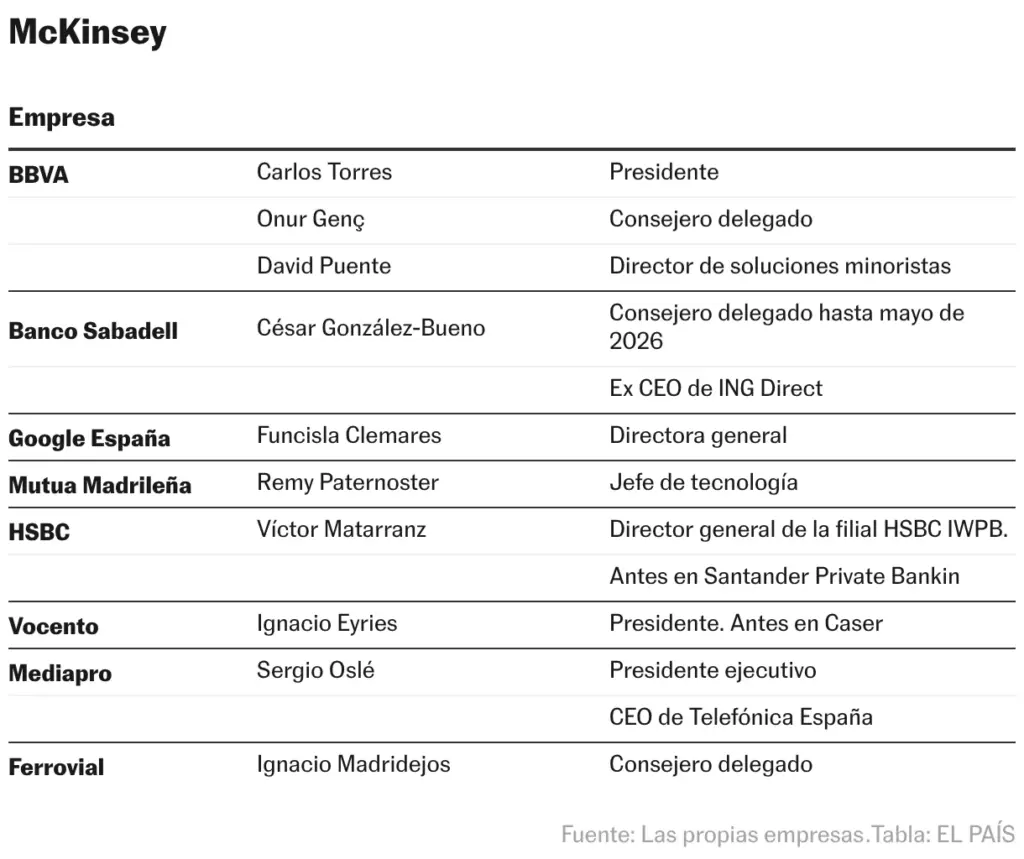
In Spain, McKinsey’s shadow is long. During BBVA’s attempt to acquire Banco Sabadell, three of the four main players had worked for the consultancy. Both BBVA’s chairman, Carlos Torres, and its CEO, Onur Genç, as well as the CEO of the Catalan bank, César González-Bueno, had been partners at the prestigious firm.
Throughout the failed takeover bid, many investors questioned Torres and Genç’s approach, attributing it to the ‘McKinsey pattern’. “They think they’re smarter than everyone else, but in the end, they lack street smarts, they lack knowing people better, and they dug in with a timid 10% improvement in the offer, which failed to tip the scales,” explains a veteran fund manager who manages assets worth over 100 million euros.
McKinsey has also had a significant presence at Santander. Víctor Matarránz was, until a few months ago, the right-hand man of the CEO, Héctor Grisi, and also headed the powerful insurance and asset management division. He now works for the British giant HSBC.
The network extends beyond the financial sector. Google’s head in Spain, Fuencisla Clemares, and the new presidents of media companies Vocento (publisher of ABC), Ignacio Eyries, and Mediapro, Sergio Oslé, were also McKinsey partners. The latter has started his tenure with an employment regulation file (ERE) for 20% of the workforce. Ferrovial’s CEO, Ignacio Madridejos, also belongs to the clan.
These circles of influence are not isolated. Sometimes, they overlap. This is the case with Madridejos. Before joining McKinsey, the executive studied Civil Engineering (Ingeniería de Caminos, Canales y Puertos) in Madrid, another of the most prolific breeding grounds for large Spanish companies. Especially in the construction sector. Florentino Pérez (chairman of ACS), Manuel Manrique and Juan del Rivero (Sacyr), Juan Miguel Villar Mir (who died in 2024 and founder of the Villar Mir group, now OHLA), and José María Entrecanales (founder of the Acciona group and who died in 2008) all studied this engineering.
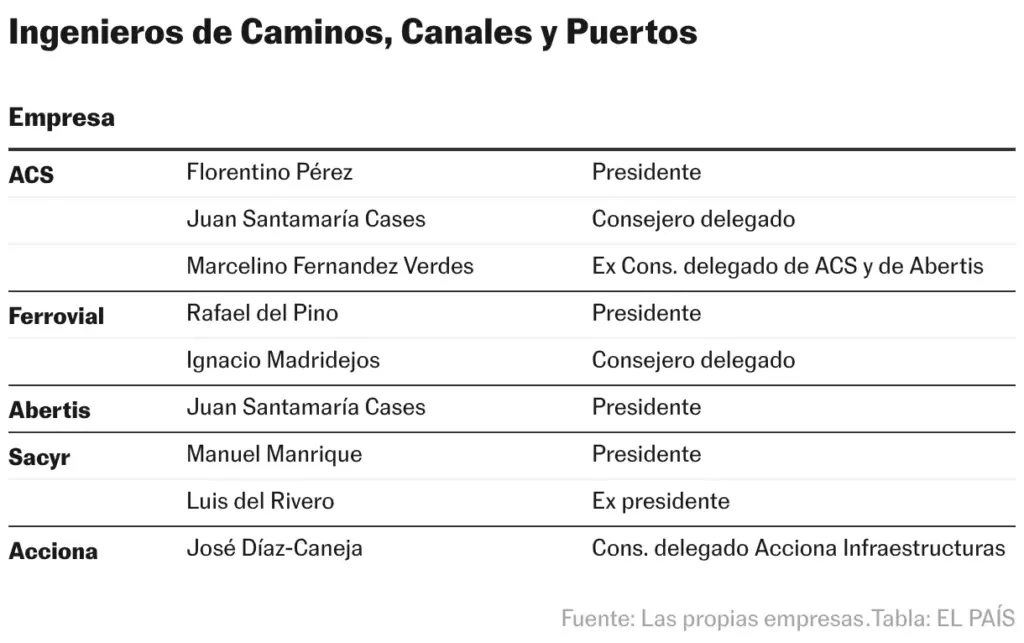
“Spain’s major infrastructures have been built by a handful of leading companies created by civil engineers who have also been very successful in their internationalization,” summarizes an octogenarian Madrid businessman who has worked with many of the engineers mentioned.
Another engineering breeding ground for Spanish executive elites is the Catholic Institute of Arts and Industries (ICAI), affiliated with the Pontifical University of Comillas. This private center is controlled by the Society of Jesus, the Catholic institution with the most influence in education in Spain, along with Opus Dei.
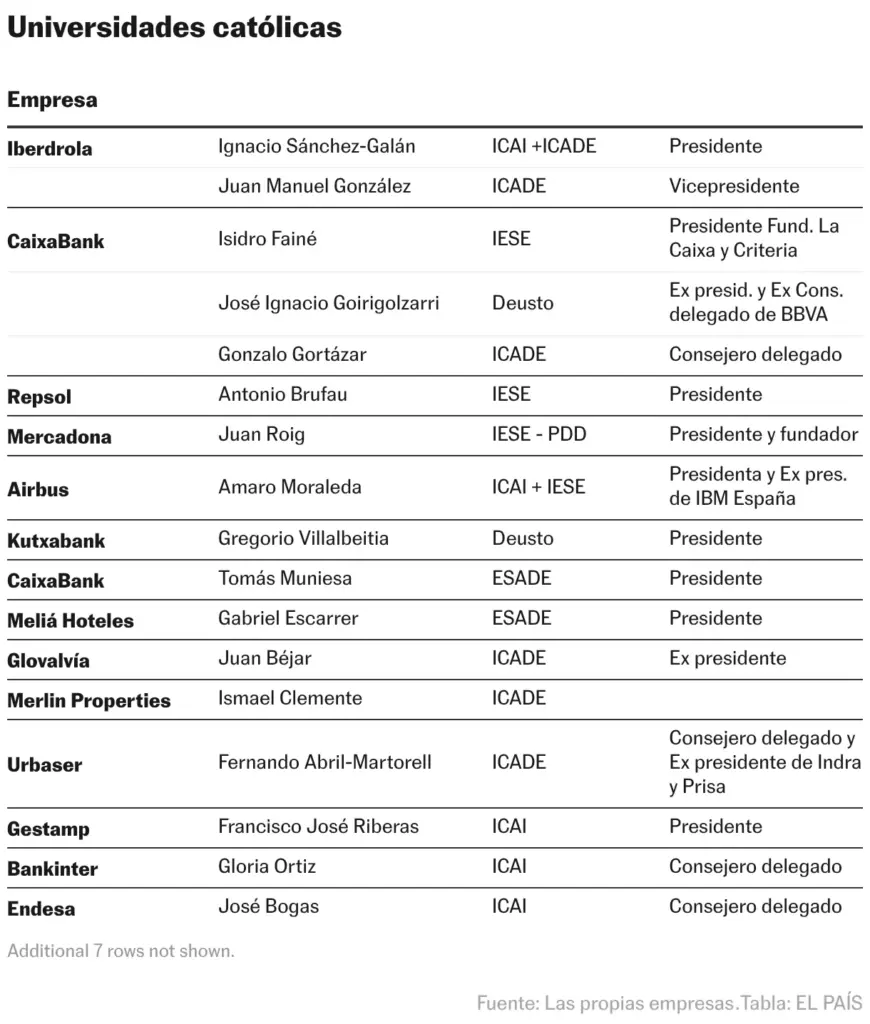
In the classrooms of ICAI, located on Alberto Aguilera street in Madrid, Ignacio Sánchez-Galán, the chairman of Iberdrola, studied Industrial Engineering. He also earned a degree in business management from the Catholic Institute of Business Administration (Icade) at the same university. Also trained at ICAI were Bankinter’s CEO, Gloria Ortiz; Endesa’s director and former chief executive, José Bogas; Francisco José Riberas, founder and chairman of Gestamp; and Amparo Moraleda, chairwoman of the European aviation multinational Airbus.
The network of alumni from both Jesuit centers —ICAI and Icade— is the most extensive and dense in the Spanish business landscape, with over 50,000 alumni registered. The list of famous executives is so vast that it has its own Wikipedia entry. This community seeks to “facilitate networking, mentoring, access to job boards, and exclusive events,” as explained on the Comillas University website.
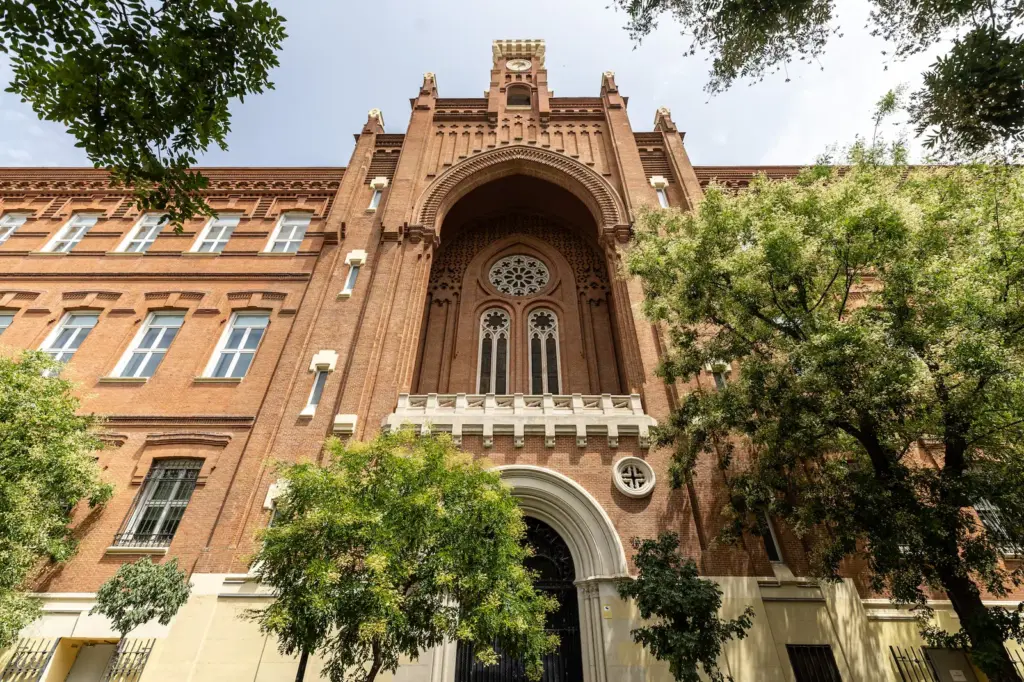
The Icade faculty was a pioneer in Spain in launching double degree programs. In 1960, it began offering its famous E3, which combines studies in Law and Business Administration. It later extended the formula to other combinations of university studies. The program was so successful that most Spanish universities ended up copying it.
A former Icade alumna, an executive at a marketing multinational, acknowledges that the quality of the education “is excellent,” but believes that if so many alumni reach executive positions, it is also due to other factors. “Networking influences it, of course, but it also influences that a good part of wealthy families from Madrid and its surroundings do everything possible to send their children there.” This executive recalls from her student days that “there were many classmates with hyphenated surnames, whose lives you would eventually learn about from the Society pages of ABC or Hola.”
Ignacio de la Torre, chief economist at the investment firm Arcano Partners, questions whether these contact networks have such influence. “In executive selection processes, profiles are sought that have certain skills, that have demonstrated their capacity throughout their career, and sometimes, they come from the field of engineering, or certain business schools, but if they have reached those positions, it is not because a university friend got them in,” reflects the economist. De la Torre argues that, furthermore, “HR departments look for varied profiles, because it has been shown that only in this way are more solid and successful teams built.”
The Jesuits are not only behind the Pontifical University of Comillas. They also control the University of Deusto, in Bilbao, a breeding ground for a good part of the Basque political and business elite, especially in the banking sector. The talent pool of “la Comercial de Deusto” —as this school is known, by its original name— is extensive in the financial sector. From José Ignacio Goirgolzarri (former CEO of BBVA and chairman of Bankia, and then of CaixaBank, after the merger); Emilio Botín (the historic chairman of Banco Santander, who died in 2014, and father of the current chairwoman, Ana Botín) to Gregorio Villalbeitia, chairman of Kutxabank, all passed through Deusto. Historical figures such as José Ángel Sánchez Asiaín (Banco de Bilbao), Emilio Ybarra (BBV), Pedro Luis Uriarte also belong to this talent pool.
In addition to Icade and ICAI in Madrid, and the Deusto faculty in Bilbao, the Jesuits also control Esade in Barcelona, the Higher School of Business Administration and Management. It is a postgraduate school for executives, created in 1958 with the impetus of a group of Catalan businessmen. Important executive figures have passed through its doors, such as Tomás Muniesa, current chairman of CaixaBank, and Gabriel Escarrer, chairman and CEO of Meliá Hotels International.
That same year, in the midst of Francoist developmentalism, the Opus Dei prelature founded, through the University of Navarra, the Institute of Higher Business Studies (IESE), another postgraduate school for executives. Its first headquarters was also in Barcelona, but it soon created a second campus in the pine forest of Cerro del Águila, in the Aravaca neighborhood of Madrid, next to the elitist Real Club de Campo.
The Jesuits and Opus Dei have competed for years to position their business schools among the most prestigious in the world. Both have agreements with Harvard University, and thousands of students pass through their classrooms each year. According to the latest ranking published by the Financial Times, IESE holds the third global position in open programs for executives, and Esade the fifth.
Both schools have programs for executives, but also for recent graduates. The famous MBAs (Master of Business Administration, in English). In the case of IESE, the program cost is 114,000 euros, although there are some scholarship programs.
An important supporter of IESE is Isidro Fainé, chairman of Fundación La Caixa, and one of the most powerful people in Spain. The long-serving banking executive —and member of Opus Dei— studied at Harvard and also completed a senior management program at IESE. CaixaBank, along with other companies such as Mango and the Basque engineering firm Sener, is one of the business school’s major sponsors. The budgetary control of IESE and the appointments of professors and members of its board of directors are supervised by the vice-chancellor of the University of Navarra, Father Ignacio Barrera Rodríguez, regional vicar of Opus Dei in Spain.
Andrés Villena Oliver, professor of applied economics at the Complutense University of Madrid, has been researching ruling classes for years. His latest book, The Elites That Dominate Spain (Libros del KO), reflects on these power networks. “Business schools, both Esade and IESE, are ultimately a creation of large industrial groups to train new business generations and continue to maintain power,” he reflects. In his opinion, these elite selection models “are a way of filtering candidates so that only similar people access executive positions.”
In addition to strategic consultancies, engineering schools, and Catholic universities, another breeding ground for executive elites is Public Administration. One of the clearest cases is that of the State Lawyers (Abogados del Estado), one of the most prestigious bodies of civil servants, responsible for exercising the legal defense and advice of the General State Administration. Of the 675 lawyers on staff, almost half are on leave, most working for large law firms and companies.
The leap to the private sector
One of the most frequent positions for State Lawyers who move to the private sector is that of company secretary on boards of directors. At Banco Santander, Mapfre, or Iberdrola, the person responsible for the functioning of the highest governing body is a State Lawyer. And not just as secretary. In the case of ACS, six of its directors have this background.
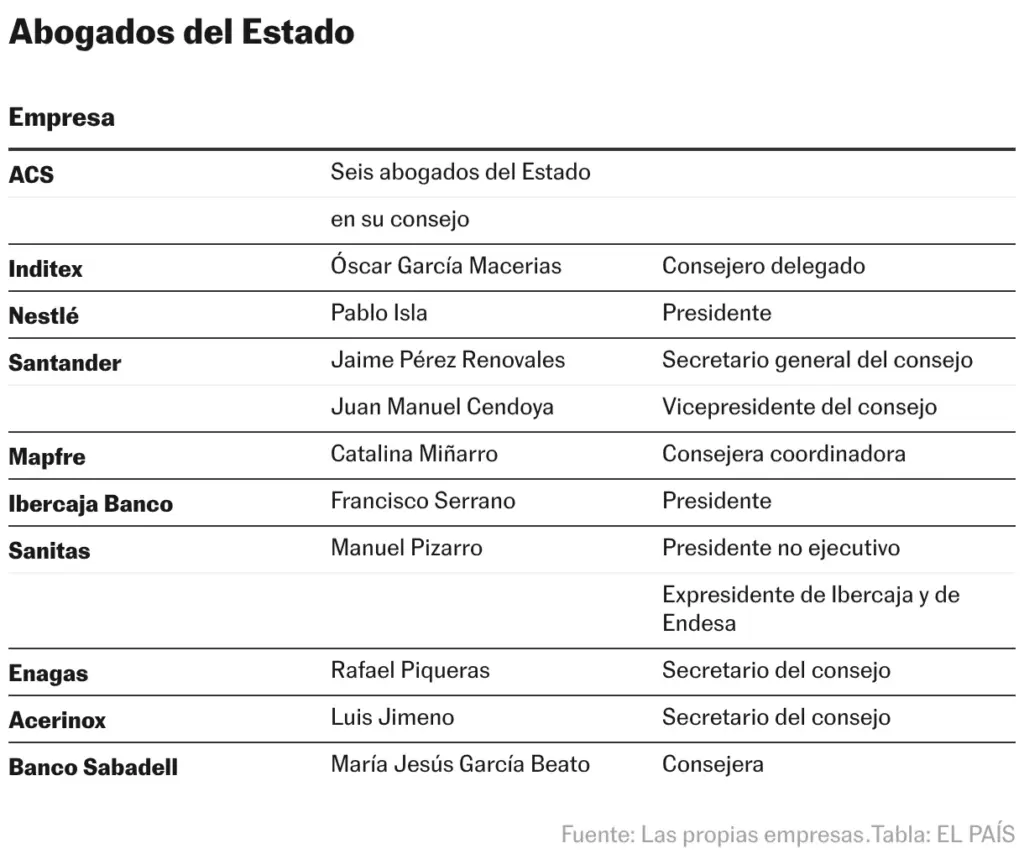
Their careers in the private sector are not always limited to legal advice. The person considered Spain’s most prestigious executive, Pablo Isla —former chairman of Inditex, Zara’s parent company, and current chairman of the Nestlé group— is a State Lawyer. His successor as Inditex’s chief executive, Óscar García Maceiras, also comes from this body of civil servants.
Professor Villena Oliver considers it “to a certain extent logical” that large companies want to have these profiles on their governing bodies, combining a vast knowledge of the State’s legal mechanisms with a very powerful network of relationships. “The 20 or 25 new State Lawyers who emerge each year know each other very well, and the company that later hires them not only recruits them but also their valuable contact list,” notes the economist.
Journalist Rafael Méndez, in his book The Owners of the State (Península), dissects the operating methods of this clan. “The entrance exams are extremely tough, and it’s not easy to pull strings for someone. But there are many hyphenated surnames and a certain degree of endogamy,” he explains.
Another body that has been a breeding ground for politicians and businessmen is that of State Commercial Technicians (Técnicos Comerciales del Estado). Those known as ‘tecos’ have filled many positions within the Ministry of Economy and the Bank of Spain. But many of them have also made the leap to private enterprise. José Manuel Campa, who was Secretary of State for Economy and director of the European Banking Authority, worked for four years as global director of regulatory affairs at Banco Santander and is now a professor at IESE Business School.
The financial sector probably concentrates the most clans among its executives. Being a highly regulated sector, banks tend to hire these high-ranking administrative officials. And almost all of their executives have passed through a business school. Another figure that once shaped the course of the Spanish stock market and still has a presence today is that of the former stockbrokers (agentes de cambio y Bolsa), a regulated figure, with similarities to notaries.
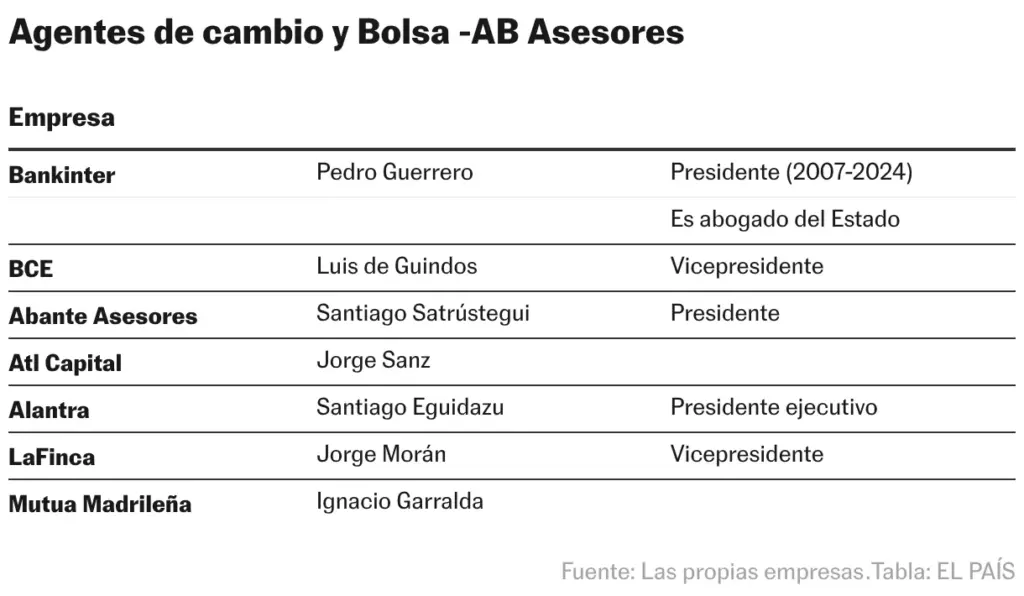
Some of them created their own companies. This was the case of Francisco González, who founded FG Valores Bursátiles and ended up as chairman of BBVA. Another firm created by former stockbrokers was AB Asesores. After selling the firm to the American bank Morgan Stanley, this clan dispersed and ended up in many large financial companies, from Bankinter to Mutua Madrileña. Who was their most famous partner? An unknown ‘teco’, named Luis de Guindos, who ended up chairing Lehman Brothers in Spain, becoming Minister of Economy, and then Vice-President of the European Central Bank. Another textbook case of power networks, overlapping circles, and privileged agendas that define economic power in Spain.
The formation of elites worldwide
The formation of economic and administrative elites follows different patterns depending on the country, but in all cases, there is a combination of academic merit, contact networks, and social selection mechanisms. France represents the most complete example of a system for reproducing elites through specific educational institutions. For decades, the École Nationale d’Administration (ENA), closed in 2022 and replaced by the Institut National du Service Public, and the École Polytechnique acted as true breeding grounds for high-ranking civil servants and business leaders. From their classrooms have emerged presidents of the Republic, ministers, senior officials, and leaders of some of the country’s largest companies. French uniqueness lies in the close connection between the State and large companies. Many graduates of these great écoles begin their careers in public administration and later move on to occupy positions of responsibility in industrial, energy, or financial groups. Groups such as AXA, Société Générale, BNP Paribas, Carrefour, Orange, or Vivendi have had top executives trained in these schools.
This phenomenon has led numerous sociologists and historians to describe these institutions as a kind of “state nobility” or “civil service nobility”: an elite legitimized by competitive exams and academic performance, but which at the same time concentrates a significant portion of power positions. Sociologist and Economics professor Andrés Villena considers it “natural” for each country to create specific systems for accessing power, “as a tool to guarantee the survival of the State.” As he explains, “the first to develop these methods of elite selection were the Chinese, with the figure of the mandarins 15 centuries ago.”
In the United Kingdom, the logic is different, although there is also a strong concentration. The universities of Oxford and Cambridge, collectively known as Oxbridge, continue to play a central role in the formation of political, legal, and business elites. Their influence is reinforced by the tradition of prestigious private schools, such as Eton or Winchester, which frequently serve as a prelude to the most selective universities. Unlike France, where the State occupies a central position, the British model is more linked to the weight of finance, liberal professions, and social networks built during education. In Germany, economic elites frequently come from technical universities, engineering schools, and a highly developed vocational training system. Access to business leadership is usually less concentrated in a small group of institutions.
The United States presents a more open and decentralized structure, though no less hierarchical. Universities such as Harvard, Stanford, Princeton, Yale, or MIT maintain considerable influence in Wall Street firms, Silicon Valley tech companies, and large corporations. However, entrepreneurship and geographical mobility allow for more diverse career paths than in Europe.
Read more Milei lashes out at Lula in Brazil and calls to «stop the socialist garbage»