







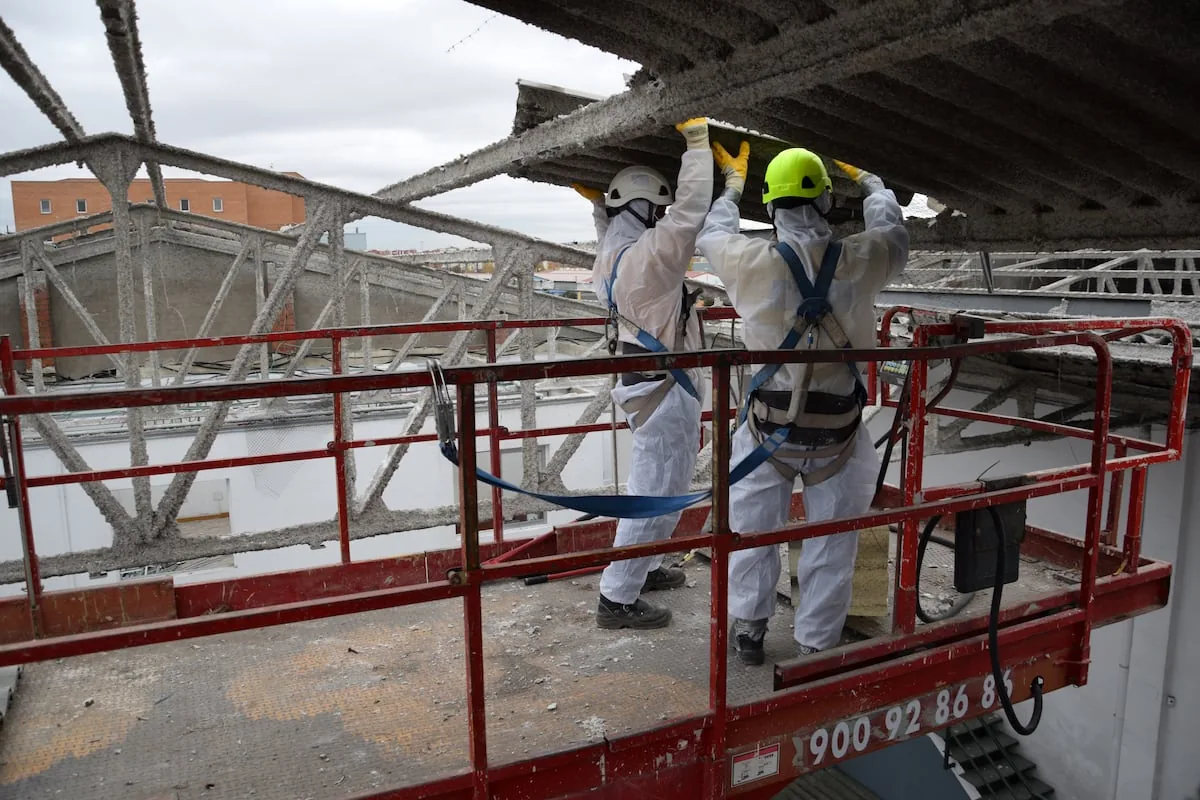
The compensation fund for asbestos victims is about to reach eight months since it started its activity in September 2025. During this time, 323 applications have been submitted, of which 82 compensations have been recognized, meaning that only one out of every four requests (25%) has been granted. This is indicated by the report provided by the fund’s management to the State Federation of Asbestos Victims Associations (Fedavica), which also states that just over five million euros have been allocated to pay these compensations, out of a total annual budget of 25 million euros endowed to the fund. The data therefore points to a low execution of compensations, which has led to repeated complaints from those affected and the unions.
According to the figures from the public body, whose management depends on the National Institute of Social Security (INSS), the autonomous community that has received the most applications is Valencia, with 100 claims. However, only 19 of these have been granted (19% of those requested). Meanwhile, the Basque Country is the most diligent community in this matter, having received 85 requests and granted 37, 43%, which doubles the national average recognition rate. Three communities —Catalonia, Asturias, and Cantabria— have received requests but have not yet granted any compensation.
Fedavica spokesperson Jon García has described the fund’s execution pace as “a scandal” due to its slowness and, above all, the low level of recognition that the affected parties’ requests are receiving. Additionally, there are two autonomous communities (Balearic Islands and La Rioja) that have not yet established the Evaluation Commission, set up in the royal decree that develops the fund’s operation, which must issue a mandatory report on the causal link between the diseases and their origin in asbestos exposure.
The formation of these commissions was precisely one of the main causes that delayed the fund’s launch. It was delayed almost four years since the law that determined its creation was approved in 2022. Since then, an annual budget of 25 million euros has been allocated to compensate the thousands affected by asbestos —most of whom are already deceased— but it was not until December 2025 that the first economic compensation was granted. And the total granted so far barely sums up to five million.
Considering that unspent funds do not roll over to the following year, those affected have repeatedly complained that about 100 million euros have already been lost, which have not reached the pockets of the sick nor the families of the deceased. Moreover, the latter cannot even apply for compensations, according to the fund’s regulations, despite the law that created it foreseeing that compensations could be received posthumously.
Both Fedavica and the unions CC OO and UGT, which support the complaints of this association, have denounced on several occasions the restrictive requirements to apply for compensations. These demands, specified in the regulatory development of the law, exclude many affected individuals. Besides the families of those who have already died from a disease contracted due to asbestos exposure, it also excludes those who have not obtained recognition of temporary disability for an occupational disease derived from asbestos, or relatives and close ones who have fallen ill from living with affected individuals.
For this reason, the three organizations met at the end of April with the Secretary of State for Social Security, Borja Suárez, to whom they demand a reform of the regulations. They seek to expand the cases that can be compensated, as well as increase the amounts being granted, which are much lower than those recognized by the courts, which usually triple those of the fund. They also denounce the exclusion from aid of cases of occupational disease due to asbestosis without respiratory restriction and those of fibrosing conditions of the pleura and pericardium that involve respiratory or cardiac restriction.
Both the association of affected individuals and the major unions also demand that the Government approve an exemption from IRPF taxation for these compensations, as happens with other groups such as victims of HIV, thalidomide, or the Adamuz train accident. At this point, they recall that the Foral Treasuries of the Basque Country and Navarre have indeed approved such an exemption, so currently there is discrimination between asbestos victims in these two communities and those in the rest of Spain.
After the meeting with the highest Social Security official, the representatives of Fedavica and the unions indicated that Suárez conveyed to them “that the Fund is being progressively launched and in a reasonably good manner.” However, they regretted that “although he took note of their demands,” they did not obtain any firm commitment to solve any of the issues raised, beyond that he would forward their proposals to the Minister of Inclusion, Social Security and Migrations, Elma Sáiz. That said, government sources consulted point out that, although the royal decree regulating this fund depends on Social Security and therefore so does its reform, the ball would be in the Ministry of Finance’s court, which practically determines the economic management of these compensations.