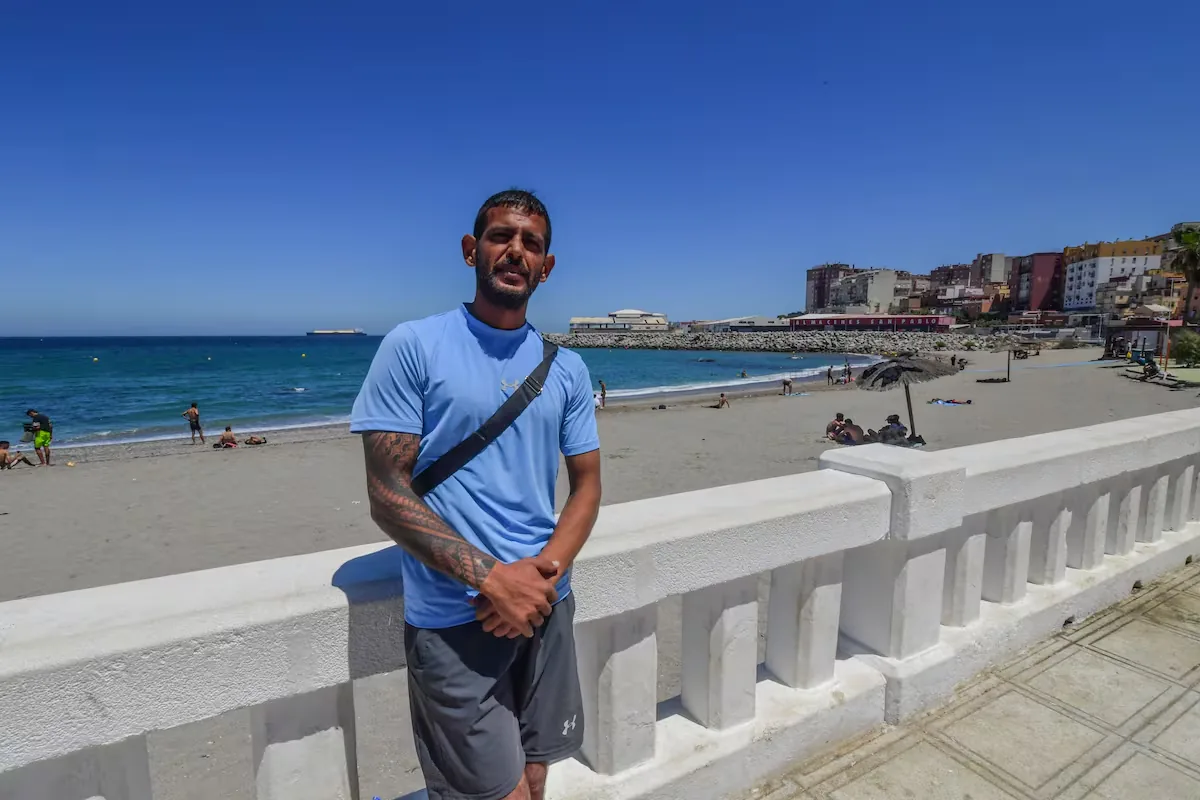
The hands of the Palestinian Saddam Yaser are tied to a small black bag that he carries across his chest. He holds it tightly as he walks along the promenade that surrounds Trampolín beach, where he has been killing time for thirteen nights now, since he swam to Ceuta. If these days could be defined with verbs, his would be to wait and protect. To wait for the authorities to process his asylum application and to protect the documents that prove he has already started the process. He is terrified of losing them, of having them stolen, of being left abandoned in limbo. “I know I am not my papers but also that without them I will be nothing,” he says, always conjugating in the future tense. About what he will do when it is decided whether or not he is eligible to claim the right to asylum in Spain.
He is according to the laws, because Saddam meets the requirements. They explained it to him right there, on the sand of the beach where thousands of migrants like him have written the word “asylum” on cardboard so that the eyes of the world understand what they were looking for when they took to the sea. Last week, volunteer lawyers from the neighborhood coordinator went to the coast and spoke with him. They reviewed his passport, his story, and processed a free application for international protection, which privately usually costs fees ranging from 400 to 700 euros. This is the option chosen by the also Palestinian Ahmed Awwad, 23 years old, from Ramallah. Saddam and he met in Ceuta, and the latter has chosen to pay a private lawyer 200 euros, most of what he brought with him in a waterproof bag.
Saddam feels uncomfortable receiving help, depending on it, and rejects compassionate offers of food or water. At 36 years old, he knows how to manage when he has to fend for himself, which in his case has been most of the time since he left his native Hebron. He has crossed half a dozen countries until he reached Morocco, always alone. He did not cross with the more than 70,000 people who entered on Thursday; he did so the day before. He took refuge in the hills of the city and, the next night, saw the tides of people entering, fearing a collapse that has been worse than he imagined. “As soon as I saw the beach overflowing, the sea full of people, I thought I would no longer have any option,” he says. He shrinks in his modesty and insists that he does not want “gifts” or “favors.” He considers himself privileged because, in addition to Arabic and Hebrew, he speaks excellent English and quickly understood how the complicated process to become a political refugee works. “It’s in your Constitution, right?” he asks. Specifically, in article 13, as well as in international treaties. But that knowledge is rare these days in Ceuta. Most sub-Saharan migrants at Trampolín tirelessly look for someone who speaks their language to unravel what step they have to take next. For now, they only have war, political persecution, or the risk their lives faced in their countries of origin, and they think that is not enough. They have the right to free legal assistance, but there are no hands. So they let the days pass, waiting on a heap of nothing.
The Police do not give appointments
There is no synonym left un-worn to describe what is happening: saturation, overflow, overload… Lawyers who come to help migrants start the procedures repeat it, and they do not waste time protesting because they are not given the means to process the applications. They have detected that the bottleneck is not there, but just after. The next step after submitting the application is the case evaluation, the triage carried out by the Police, where each person is assessed in a personal interview according to European regulations. And for now, there are no appointments. “We have offered to send reinforcements of lawyers, but the situation is paralyzed and we are pressing hard. But we will not send them if the files that have already been submitted are not started to be processed because it is useless,” denounces the director general of the Spanish Commission for Refugee Aid (CEAR), Mauricio Valiente. Without that, the asylum process does not advance, and migrants are unprotected against what they fear most: hot expulsions. Being returned to Morocco even though they have already submitted the international protection application, which is worthless if the process does not continue and the file of their case is not opened.
Read more Women who know they are going to be killed
The Ministry of the Interior is aware of the situation and insists that it has activated extraordinary mechanisms to speed up the files since last week. Internal sources explain that, so far, about 200 applications have been rejected, mainly from Moroccans who do not meet the conditions for international protection, and that there is “at least one” that is close to obtaining a positive response: a Senegalese woman whose life is at risk. New measures will be activated this week to relieve the situation, but to date several sources confirm that there is still no refugee close to being officially recognized. The procedures get stuck at the same point and migrants remain unprotected. The Government Delegate in Ceuta, Miguel Ángel Pérez Triano, announced that within a month the Government will put into operation a Temporary Foreigners Care Center (CATE) in a city warehouse to attend to these applications, but it has not materialized.
Meanwhile, Saddam remains entrenched in his two verbs, wait and protect. He speaks slowly, with a very subtle but sufficient hint of hope. He wants to study psychology when everything is over, he speaks Spanish haltingly. He manages not to lose patience and to go unnoticed on the beach, speaks little with people, mostly helps others as an improvised interpreter when they do not understand what is happening, which is almost all the time. He flees from tense situations, increasingly common after days without a horizon under suffocating heat. When they occur, he discreetly moves away from the powder keg, towards the hills, far from the El Tarajal border post. Because of his appearance, he is often mistaken for a Moroccan and knows it is not safe to approach there, because although rare, expulsions still occur. He is looking for where to buy a portable battery to turn on his phone and stay alert to what the lawyer tells him about asylum, but he collects failures. There is no news and no batteries he can buy. Most electronics stores are in the city center area, where the police patrol to prevent migrants from accessing their streets, and if he manages to slip past the control, many vendors also do not want to let him in. Near Plaza de África some lock their doors and open depending on the customer’s appearance. So for now, there is no news. Saddam returns to his limbo and waits. And protects the little he has. It fits in a black bag.