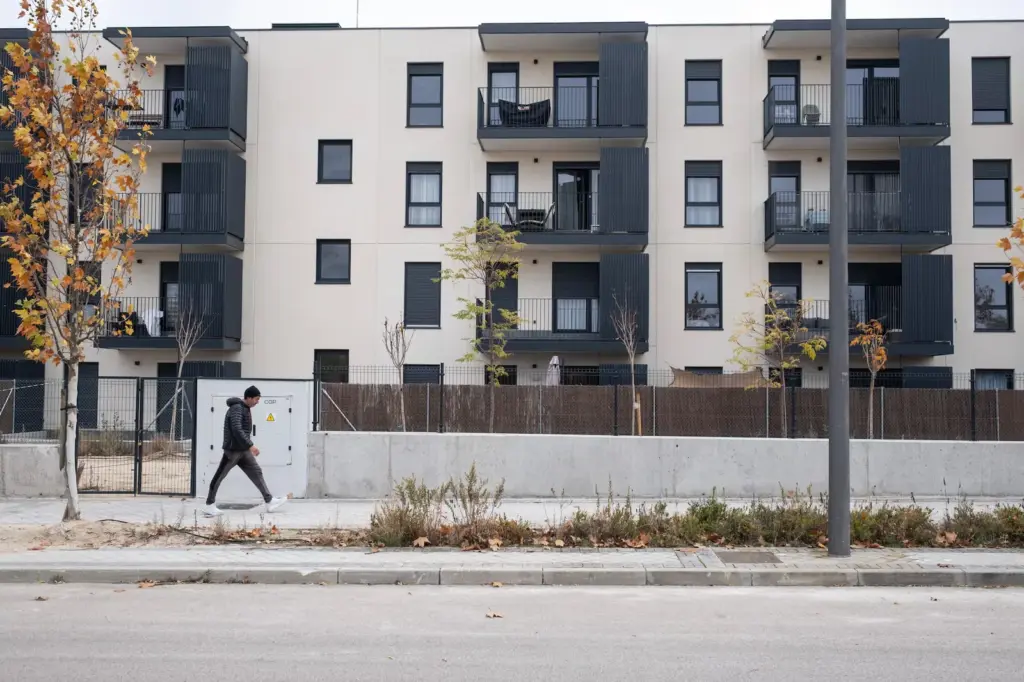
The Community of Madrid wants different companies to assume the cost of building more than half a thousand protected homes under an affordable rental regime in exchange for exploiting the collection of rents until the next century. This is stated in information published on the contracting portal, which reflects a forecast of accumulated gross income for the winning companies exceeding 350 million at constant 2026 prices, a figure that widely exceeds 800 million in nominal terms, among all concessions and during the 75 years of the concession. During that time, the chosen companies will not have to pay a fee to the Administration for exploiting the six capital plots affected by the three tenders, they will charge for the rents and services they provide, and the Community, in principle, will assume the payment of the IBI, unless the interested parties offer to do so. The built homes, which will cost the awardees around 100 million, will not return to public domain until the beginning of the 22nd century.
Read more A traveling circus for the horror of Gaza
“Unlike the previous surface rights established by IVIMA, in the legal business now intended, the awardee-surface holder will not only assume the obligation to build the protected housing building but also its subsequent management, maintenance, conservation, and exploitation,” is acknowledged in the documentation accompanying the three tenders, located in Hortaleza, San Blas-Canillejas, and Los Berrocales.
That is, the awardees will invest in construction and then recover that money by charging rents, with an estimated profitability close to 7% annually, which the Administration considers “in line with the cost of capital and far from representing an extraordinary profit.”
The specifications require that at least 5% of the apartments be reserved for families with incomes below about 29,000 euros per year (3.5 times the Public Indicator of Multiple Effect Income). That percentage may be doubled to 10% if the awardee offers it as an improvement in their proposal.
“Rents are limited by protected housing regulations and by the awardee’s economic offer,” argues a spokesperson for the Ministry of Housing, Transport, and Infrastructure, led by Jorge Rodrigo. “Additionally, this party assumes the risk of occupancy and delinquency,” they add, although in reality the specifications contemplate partial coverage by the Community. “At the end of the surface right, the homes revert to the Administration without compensation,” they recall. “It has been decided not to require a fee so that this cost does not end up affecting tenants’ rents. The goal is precisely to maximize rent reduction and facilitate access to affordable housing.”
This bet replicates the model of public land transfer to build buildings exploited by a private entity in subsidized education; the Plan Vive of rental housing; and the 40 new residences that the Community wants to build throughout the region on municipal plots. In total, the transfers decided since Isabel Díaz Ayuso (PP) came to power (2019) affect more than a hundred public lands, whose exploitation will depend on private entities for decades, guaranteeing enough time for the awardees to recover the investment and limiting the options of future governments. A strategy that benefits from the multiplier effect of the immense municipal power amassed by the PP in the 2023 elections.
In contrast, the left-wing opposition is very critical of the model, supported by state and regional legislation, and used, Madrid points out, by other regions such as Navarra or Castilla-La Mancha, both governed by the PSOE.
“The PP model has placed Madrid at the top in housing prices, whether for purchase or rent. A model that expels people and attracts funds because it is focused on guaranteeing the real estate business,” laments Jorge Moruno, deputy of Más Madrid in the regional Assembly. “The goal will be to inflate the services offered [cleaning, maintenance, garage…], regardless of whether tenants want to use them or whether those services serve any purpose, so that, as happens in the Plan Vive, the final rent paid by the tenant is inflated,” he adds. “The AVS [Social Housing Agency, promoter of the tender] has been unable to execute European funds and build 900 homes in five years, it has not even reached 350 new homes since 2019, and during the same period, it has disposed of more homes than it has inaugurated,” he points out.
And he recalls: “He announced the purchase of 175 homes years ago and has only bought 5. If it were not for the justice forcing him to recover 1,721 homes he sold to a vulture fund, today the public housing stock would be smaller than in 2005.”
Plan Vive
This is how they see it in the PSOE of Madrid, led by Minister Óscar López. “The Community of Madrid assumes it is incapable of managing social housing,” says deputy Javier Guardiola. “They can neither manage housing nor are they capable of building public housing on their own,” he continues. “Our model is clear: construction of permanent protected public housing and not the failed Plan Vive model for the people who need it.”
The business is perfect for the private companies that win the tenders, according to the opposition. For example, in the case of the new homes now being tendered, they will be able to charge for common expenses (with the limit that they represent 15% of the maximum rent); the rental of commercial premises (without limit); or parking spaces not linked to homes. In some cases, there is even the possibility that the AVS assumes part of the delinquency they suffer.
For their part, subsidized schools have historically been able to mortgage the public land itself to finance the work they have committed to. In exchange for offering subsidized places in compulsory education, they can offer fully paid places in levels such as Early Childhood or Baccalaureate, where the Administration has promoted the retention of students captured in the stage paid by the public budget with scholarships.
In the case of the 40 residences and day centers that the Community of Madrid has just begun to tender, with the goal of launching the first in summer 2028, managers will be able to charge for parking, the cafeteria, and hundreds of private residence places.
Finally, on the lands transferred for the Plan Vive, focused on building homes to market them under a theoretically affordable rental modality, the slice for the private party is even juicier: hundreds of millions of euros of net profit in each promotion, as this newspaper verified in the documentation of each of the tenders.
Read more Dozens of young Moroccans embark on the journey back home: «I have no other choice»