









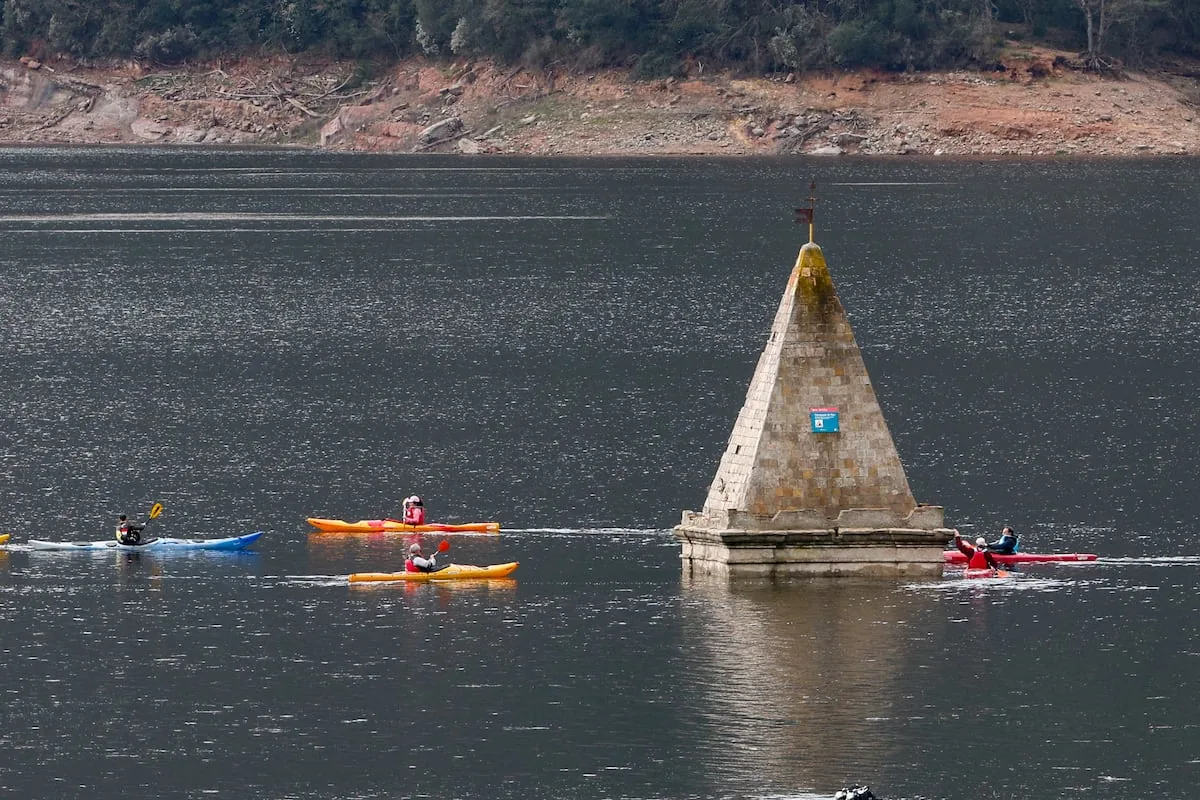
One learns from mistakes, but one must be vigilant not to stumble upon the same stone again. The first lesson that the Government of Salvador Illa learned from the drought that was hitting Catalonia when the president took office in August 2024 was that the mistake of the previous drought, that of 2008, could not be repeated. At that time, investments in water infrastructure were put on the calendar to avoid having a similar emergency again, but the crisis caused priorities to change. The last drought highlighted this deficiency, and although it ended with the spring rains of 2025, the Government committed to carrying out a water transition to face the next drought in better conditions. Despite this commitment, the Barcelona Chamber of Commerce stated this Monday that vigilance must continue, and has urged the Government not to forget the investments it has planned. The institution has asked the Executive to shield these investments, ensuring the execution of the 2.500 million euros that the Catalan Water Agency (ACA) plans to execute before 2032.
The shielding would imply that these investments would not be subject to political fluctuations, to the approval or non-approval of budgets, or to other unforeseen events. On paper, this is already the case, since, as explained last week by the Minister of Territory and spokesperson, Sílvia Paneque, these investments planned by the ACA do not depend on the budgets, but are financed by the European Investment Bank, loans that will be repaid through the tariffs that the public company Aigües Ter Llobregat applies to the water that then reaches homes through suppliers.
Last week, the Government approved the preliminary report of the bill for the water transition, a first step to enshrine in law all the objectives and regulations that will be necessary in this fight against drought. In parallel to this legislative effort, the Generalitat has launched a series of actions in an investment plan of 2.500 million euros, with major works such as the installation of two new desalination plants and the expansion of a third, the construction of water purification plants on the Besòs river, and a series of works in municipalities to repair pipes and connections and prevent leaks. It is in this last section where most delays are recorded, and also in that of desalination plants, which depend on the Government’s approval. The objective of the entire action plan is to increase the available water capacity, so that, if necessary, 70% of the water can come from unconventional resources: that is, not depending on rain and reservoirs, and having more regenerated or desalinated water.
Read more Morante de la Puebla, gored by the fourth bull of the bullfight in La Maestranza
Given these pending tasks, the Chamber has requested progress. Of the 2.500 million euros planned, at least 1.700 must be executed between 2029 and 2030. And according to an analysis prepared by the Chamber’s Water Transition Observatory based on information provided by the ACA, actions worth 12 million euros have been completed so far. In addition, there are at least 1.146 million euros of investment corresponding to actions that are still under study and are expected to have delays of up to one year, while others worth 195 million euros may exceed delays beyond that period.
Where the Chamber identifies the most “slowness” is in the processing of some projects such as the expansion of the Tordera desalination plant in Blanes (Girona) and the new Foix desalination plant, between Cubelles (Barcelona) and Cunit (Tarragona). These are precisely the ones that depend on the Government, but the Govern is confident that they will soon obtain permission. Despite the warnings, the Chamber does not consider the 2030 objective to be compromised, as “practically all planned actions are currently underway,” whether in the study, project, or execution phase. The Chamber believes that the Govern has a firm “commitment” in its policy to depend less on rainwater, but warns that the period for executing investments is “very short.” To meet the objectives, the Chamber believes it is “fundamental” to ensure “solid and stable financing” formulas, including direct budgetary sources.
Read more Eurodreams: Check Monday, April 20 draw