
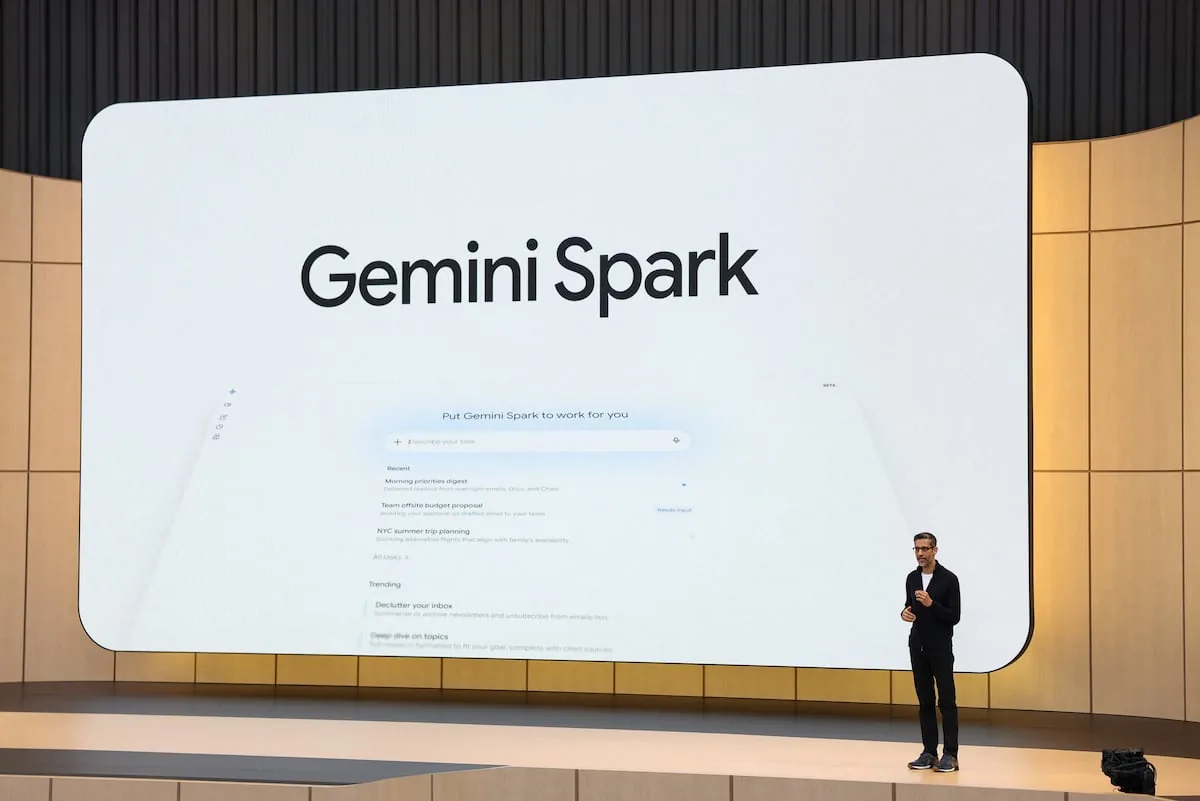
Google’s search bar undergoes its biggest transformation in 25 years. The tech giant announced yesterday at its I/O developer event that generative artificial intelligence (AI) will be fully integrated into its flagship product, the search engine, whose appearance is also changing: instead of a thin box, there is now a space that can fit an entire paragraph. The goal is to no longer enter just a couple of words, like “Zapatero Congress,” but to be able to elaborate more on the questions: “What do the different parliamentary forces think about the recent indictment of Zapatero? Detail the evidence on which the indictment is based.”
Read more The king of OnlyFans leaves Andorra for fear of ending up in jail for pimping
AI is now omnipresent at Google. The company had offered since last October the option to perform searches with its help. The experience has been so positive that it has been decided to make that technology dominate the experience. Search results can be texts, tables, or diagrams.
There are more new features. YouTube will incorporate a window to ask the AI questions about the video, so it shows us only the parts we want. It will be possible to create and edit documents or emails by voice in Gmail or Google Docs. Gemini Omni allows creating hyper-realistic videos with a finish similar to Nano Banana in photos. And all its products will be integrated into its AI detector, SynthID: images and audios generated with this technology will have an imperceptible watermark that will be revealed when the user wants to know if they are viewing a real or synthetic image. OpenAI, by the way, is joining this initiative. The launch of audio glasses developed together with Samsung, to be released in the fall, was also announced.
Some of the changes announced yesterday are global; others, for now, only for the US. Some will only be available by subscription, like Google Omni. But the revolution is in the new searches, which will progressively reach all countries. It is important for at least three reasons.
1. Goodbye to blue links
Until now, each search ended with a list of blue links, ordered from most to least relevant, according to the algorithm cooked up by the company. Google searched all the web pages it has indexed and selected those it judged to be the most important. And its judgment was not bad. Or at least it was not worse than that of other competitors, which has established it as the reference search engine of the internet era.
The experience will change completely. Now it will be more dynamic. The answers will no longer be links, but elaborated texts, tables, or graphics, or even animations, depending on what is asked or required. It will be possible to dialogue with the search engine to refine its results or better adapt them to what the user wants.
Gemini 3.5 Flash, the model that will guide the search engine, will also use agents working in the background to update information if there are news (like the old Google alerts, but integrated into the response).
2. Different answers for each user
This has deeper implications than it seems. Until now, Google’s search engine had a simple operation: the machine used its own algorithm that weighted which results were the most interesting for a specific search. Google’s magic, what made it more effective than others, was the configuration of its algorithm. Trying to unravel that magic formula, as secret as Coca-Cola’s, gave rise to a profession: SEO specialists (search engine optimization), who work on improving the web positioning of pages.
That model has officially come to an end. From now on, search results will no longer be the same for everyone. Google’s algorithm is no longer applied; instead, the question (or search) is sent to the generative AI engine. And this, by definition, will have a different reply for each user. This is one of the criticisms made of this technology from academia: one of the bases of the scientific system is that, given the same conditions, if we develop an exercise, the results should be similar.
That does not happen with generative AI. Each individual will receive a different answer to their questions. That can be good because it will give each user what they are looking for. But it also has its downside: Google will no longer be a standard. The phrase “put this in Google and look at the second result” will lose its value.
3. Google tightens the AI race
For Google, as for Microsoft, Meta, or Amazon, the open launch of ChatGPT in November 2022 caught them off guard. OpenAI, a company until then unknown, had put the big tech companies in check. Google, which until that moment clearly led scientific development and applications related to AI, was forced to step on the accelerator. In 2023 it reorganized its research labs to make better use of its scientific muscle.
Three years later, the effort is bearing fruit. Gemini, Google’s family of generative AI models, already has 900 million users, according to the company’s CEO, Sundar Pichai, who highlighted this yesterday. That means it has doubled the number of people using its tool and is now on par with ChatGPT, until now the undisputed leader. With one difference: while the new operators (OpenAI with ChatGPT or Anthropic with Claude) have losses due to data center costs, Google, which already had a broad infrastructure, is already monetizing the application of AI in its products.
In its latest quarterly results, the company said its advertising revenue had increased by 16%, up to 77 billion dollars (about 66 billion euros) thanks to AI, which has helped gather deeper information about users’ interests, which in turn helps better refine ad personalization.
Also considering that Gemini will be the generative AI base applied on iPhones (Siri will be powered by Google’s model), there are reasons to think that the Mountain View company will soon become the reference in this technology.
Read more Isak Andic planned to leave part of his heritage to a foundation as a «legacy to the world»