









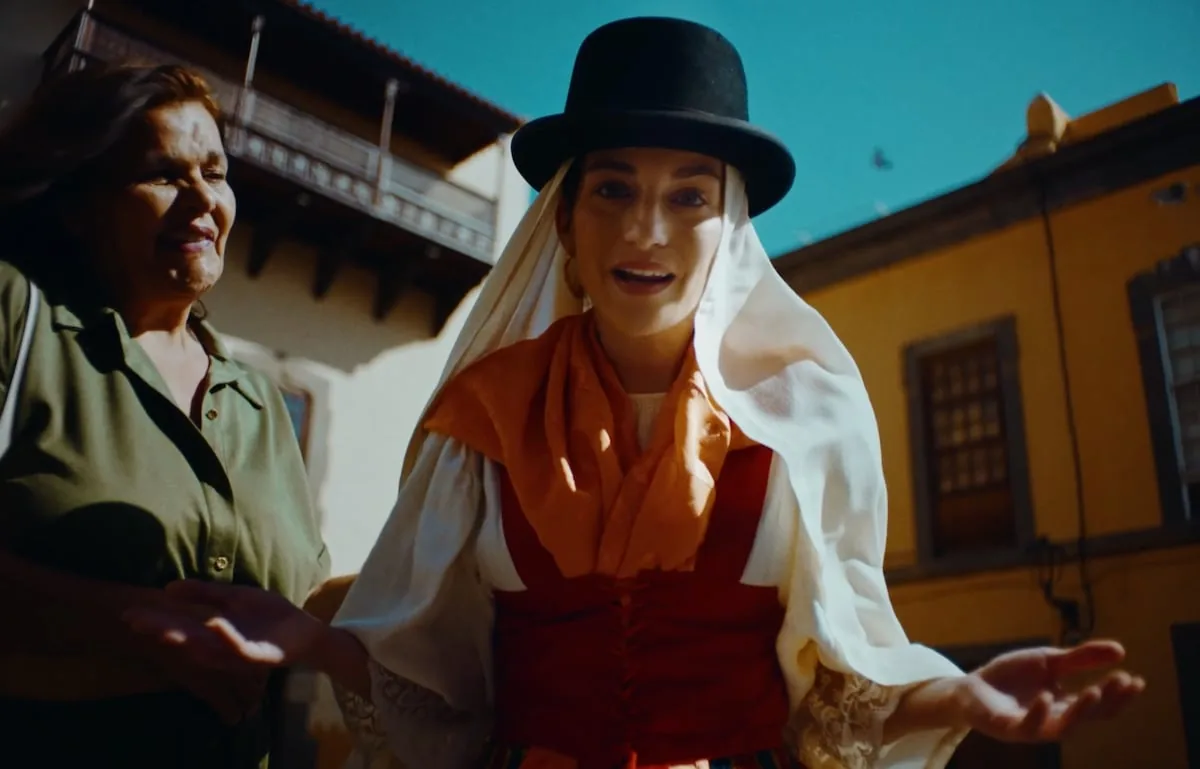
Canary Islands began using the pronoun ustedes to replace vosotros at the end of the 19th century, a usage that came from Western Andalusia and which also prevails in America. A little over 100 years later, authorities and linguists detect that this feature may be receding in favor of vosotros, used in northern Spanish. Gonzalo Armas, a secondary school teacher in Gran Canaria, notices this. “For a few years now, I suppose since social networks became popular, vosotros is increasingly present in classrooms. In fact, my little nephews, since they watch a lot of youtubers, experience the same.” For this reason, the Gran Canaria Council has mobilized with a social media campaign to defend ustedeo, aiming at Canary Islands Day, celebrated on May 30. “We cannot lose this. It is something that is part of the Canary identity,” says its president, Antonio Morales.
Read more Zapatero asks the judge to postpone his summons of June 2nd
“Ustedes, not vosotros. Vosotros is from outside. It doesn’t sound natural,” says the voiceover in the emotional video released by the island Corporation, which has accumulated more than 500,000 views in two days. “The ustedes marks the line of who we are. We use it out of respect, but also for identity and memory. And if we lose it, we don’t lose a simple word. If we lose it, we give up our island.”
Antonio Morales (Nueva Canarias) is concerned about the advance of this phenomenon. “We understand that there are elements that shape our values, our identity as a people. And speech, the dialect of the islands, is a way to distinguish ourselves, to bond, to identify.” He denounces the “external influences” to which the population is subjected, and fears that it is “becoming homogenized,” despite the fact that the variety of Spanish spoken in the Canary Islands is “the most spoken in the world.”
The Canary Language Academy, a public foundation dependent on the Government of the Canary Islands that started in 1999, acknowledges this phenomenon, although it recalls that even in the Canary Islands, vosotros has traditionally been preserved in areas of La Gomera and La Palma and in some municipalities in the midlands of Tenerife, especially in the south. In these latter areas, it clarifies, “it is mainly maintained among speakers from rural areas and older people.”
“It is true,” the institution assures in a response to a user, “that there are Canary speakers who, influenced by the prevailing norm in some peninsular areas, use the pronoun vosotros in situations where their parents or fellow countrymen would use, without hesitation, the form ustedes”. It explains that “this imitation of an external norm” is, “surely” a symptom “of the linguistic insecurity of some Canary speakers.”
The homogenization that Morales denounces goes beyond this pronoun. The leader points to a process that affects the Canary lexicon in general and gives examples such as the abandonment of the word balde in favor of cubo because it may be considered a “second-rate Spanish.”
Humberto Hernández, professor at the University of La Laguna and former president of the Canary Language Academy, sees it as “understandable” that many Canarians consider that “the use of vosotros represents a ‘loss of the grammatical feature that most characterizes us’ due to the recovery of the pronoun vosotros ‘considered more prestigious due to an unjustified castellanocentrism.’” In any case, he clarifies that he does not see it as a reason “to tear one’s clothes,” he explains. “Ustedeo is not a feature that has always characterized Canarians.” He also points out that languages evolve “and, for different reasons, changes occur that can affect their structure.”
At this point, the lexicographer from Tenerife and full member of the Royal Academy of Language, Dolores Corbella, agrees. “I continue using ustedes with the third person plural verbs, but it is the speakers who decide the changes: time must be allowed to pass.” Corbella also values that there are many other features that “define us and that we continue to use without realizing it,” highlighting among them the Atlantic pronunciation as opposed to the peninsular one.
Humberto Hernández does give importance to the reasons that may be causing this shift. “If it is due to normal evolution, or because the language demands it, fine. Now, the problem is if this happens due to some kind of imposition or because it is considered that that Spanish is the most correct, the most model, the most prestigious. And worse: that the peninsular Spanish pronominal system continues to be taught in schools in the Canary Islands. That, to me, seems serious.”
The communicator and classical philologist Elena Marrero addressed the issue in a video she posted in December on her Instagram account. “Ustedes is neither a trend nor incorrectness, it is identity,” she asserted. In the post, she broke down the possible causes of this substitution phenomenon. “The little representation of the Canary accent on television” is the first of them. “Unless it is for humor, because it seems we cannot be serious.” She highlights the effect of social networks, where streamers or influencers, “having fillers like hermano or chacho,” are “all day with bro on their lips.”
Marrero explains that this phenomenon can be combated from educational centers. “But what happens when there they are also made to believe that using vosotros is speaking well?” she asks. Even if it is “without bad intention,” by using teaching materials “made with the peninsular model” or by “teachers who come from outside and who have not received sufficient training to know how to integrate the linguistic identity of the Canary Islands” in the classroom. “Even though it is part of the curriculum,” she hints.
Humberto Hernández agrees at this point. “Spanish in the Canary Islands must be taught based on our dialectal variety, with all that this implies regarding materials and resources — including human ones — and not starting from the model of another dialect, which is not ours and which, mistakenly, is considered superior.”
A lifeline for ustedes, celebrates Morales, may come from music. The thriving urban music scene in the Canary Islands, which includes artists like Ptazeta, Cruz Cafuné, and especially Quevedo, who in his latest release, El Baifo, acts as a kind of identity shout. “There is a latent current of reaffirmation of Canarian identity,” concludes the president.