Amid a surge of Russian sabotage in Europe, the meeting last week between CIA Director John Ratcliffe and the heads of the Kremlin’s intelligence agencies has sparked all kinds of speculation, even pointing to a hypothetical Russian invasion. Washington, caught up in its own conflict with Iran, an ally of Moscow, just months before its elections, has not clarified the purpose of the visit and has encouraged theories to fly with a series of interested leaks. Intelligence experts wonder why Donald Trump would suddenly care about lending a hand to Europe.
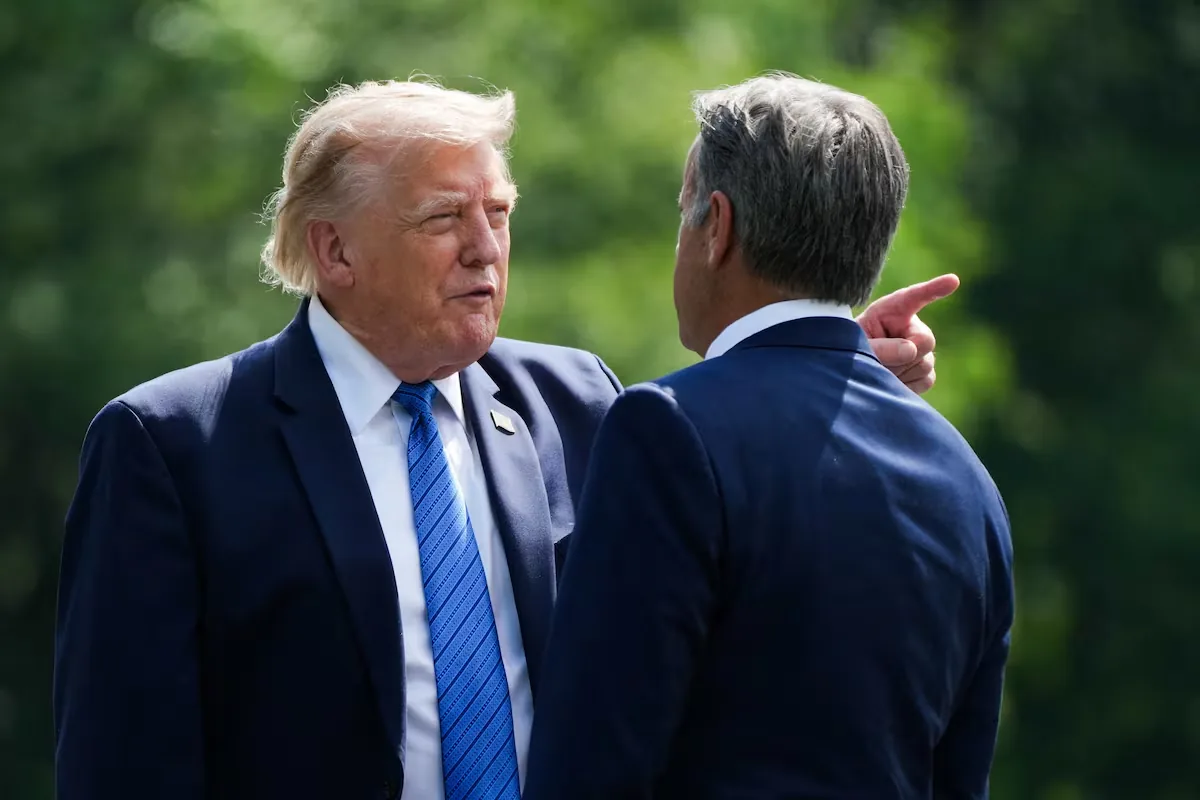
Since Ratcliffe’s arrival in Moscow on August 25, several theories supported by anonymous sources have emerged. The Wall Street Journal claimed that the CIA chief warned the Kremlin not to attack NATO because Washington knows it plans a “limited assault” against its eastern flank in the short term. The New York Times says Ratcliffe conveyed to his Russian intelligence counterparts a message for Vladimir Putin to convince him that Russia is doing poorly in the war. Axios noted that the CIA chief proposed a meeting between the Russian, American, and Ukrainian presidents, and Bloomberg published that European representatives were not informed of the content of the talks. The visit took place a couple of weeks after Moscow released former U.S. Marine Robert Gilman from prison, and there are still more Americans imprisoned in Russia. Donald Trump downplayed the event as a “routine” trip.
This was the first visit by a CIA chief to Moscow since November 2021, when William Burns went to the Russian capital to warn the Kremlin not to launch its invasion of Ukraine. At that time, Washington had evidence that thousands of Russian soldiers were being deployed for this assault despite Russian denials, as eventually happened in February 2022.
On this occasion, however, there is no evidence of any deployment to invade the eastern European Union. Preparations for a possible mobilization within Russia are aimed at sending more troops for the ongoing invasion of Ukraine, and after more than four exhausting years of war, opening another front and forced recruitment could have unpredictable consequences within Russian society.
However, Europe is today the battlefield of a broad shadow war. When an attack, an assassination, or a wave of remotely directed immigrants causes a government to short-circuit, the hostile country that provoked the crisis exploits that paralysis to extract concessions. Russian intelligence services, for example, try to destabilize the bloc to make it abandon Ukraine, but Iranian, Chinese, and Moroccan intelligence services also operate within the bloc, among other countries.
In just the last few weeks, German authorities have found three drones loaded with explosives near Leipzig airport, a hub also for military cargo destined for Ukraine, and several assassination attempts within the bloc have been identified, including the execution in Poland of Semion Skrepetski, a Russian artist critical of Putin. These operations are part of an escalation that includes cutting submarine cables, spying on military facilities with civilian drones, and testing European unity by sending hundreds of immigrants from the Belarusian border brought from the Middle East.
Spain is not exempt from this war even though it is at the other end of Europe. Spanish security services suspect that Ukrainian defector Maxim Kuzminov was assassinated in Alicante in 2024 by Russian intelligence, but they have not been able to prove it to date, and some companies have been targeted by cyberattacks to extract their internal information or cause them losses.
Only the CIA chief, John Ratcliffe, and the heads of the Russian Federal Security Service [FSB] and Foreign Intelligence Service [SVR], Aleksandr Bortnikov and Sergei Naryshkin, respectively, know what was discussed at the August 25 meeting. And the CIA is not a completely reliable source of information either, having allegedly spied on European leaders like Angela Merkel for years. According to European and Russian sources consulted by this newspaper, there was no ultimatum, although everything surrounding the meeting is like broken telephone claims.
“I don’t think it was a routine visit, as the SVR chief also said. He must have conveyed something very serious in person to the heads of the Russian intelligence services,” says Grigoriy Serscikov, an intelligence and political violence expert based in Amsterdam. “But without being part of the very small circle of people with access to reliable information, it is very difficult to speculate,” he warns.
“I think the conversation could have revolved around the United States’ stance on any provocation, rather than talking about an open Russian attack on a NATO country. This would imply communicating the position of the current U.S. Administration in case Article 5 of the Alliance came into effect, whereby an attack on any NATO country constitutes an aggression against the entire bloc,” adds Serscikov.
Journalist Andrei Soldatov, knowledgeable about the inner workings of Russian secret services, dismisses the ultimatum theory. “This kind of news does not withstand rigorous analysis. It is absurd to think he came to warn that Russia will attack a NATO country in a few years. What does ‘in a few years’ mean? This situation cannot be compared to that of 2021,” says the expert, founder of the Agentura portal.
“As for the sabotage version, it sounds a bit more plausible, but I am also quite skeptical, because we are talking about the Trump Administration, for whom their interests and those of the United States always come first. Why would the CIA director suddenly admonish Russia about actions that threaten its European partners, who precisely do not excite Trump? If that were the case, he would have exploited it publicly. He would have demanded something in return from the Europeans publicly and proclaimed himself their savior,” reflects the expert on Russian espionage.
In fact, the Trump administration published a major strategic plan last year that left Europe’s security in its own hands and even contemplated interfering in its internal politics. “The current U.S. administration has given up on Europe and no longer sees it necessary to inform them,” recalls Serscikov.
“This type of contact,” adds Soldatov, “occurs when U.S. intelligence agencies have relevant information for their national security. When there is a threat to U.S. citizens or facilities, such as military bases, or to free hostages.”
Read more The first US attack on Iran since July causes several dead and injured
In his opinion, the most plausible version would revolve around the United States’ conflict with Iran on the eve of the November U.S. legislative elections. “They obtained information that the Iranians planned some kind of attack and the CIA believed the Russians could prevent it, or would ask to stop supplying intelligence to the Iranian regime.”
“If it had to do with Iran, the Trump administration was not going to admit it publicly. That is why other theories have surfaced,” emphasizes Soldatov.
The secret services war
Russian experts consider the version that Ratcliffe traveled to Moscow to tell Putin “the truth” about the war that his inner circle does not tell him absurd. According to U.S. media, the CIA chief would have conveyed that “truth” to the heads of the SVR and FSB, who along with the military intelligence service [GRU] are precisely those who brief Putin every morning. “It makes no sense,” laughs Soldatov.
Moreover, from the Kremlin’s point of view, the war is not going badly. Its forces have brought the gray zone of the front to about ten kilometers from Sloviansk, where its paramilitaries ignited the Donbas war in 2014, and the Ministry of Defense has threatened to freeze the Ukrainian population this winter by launching thousands of missiles and drones against its already seriously damaged energy infrastructure last year. Therefore, Kiev urgently pleads with the West for more air defenses.
All Russian businessmen agree that the economy is terrible, and military spending and debt payments consume more than half the budget, so there will be social cuts. In addition, the independent outlet Mediazona has confirmed the names of 242,747 dead Russian soldiers and estimates a much higher real figure not counting the wounded. But none of this matters to Putin, who takes as a reference for his crusade the 27 million Soviet deaths of World War II.
Western support for Ukraine has prevented Putin from achieving his ambition to dominate Ukraine. Therefore, Russian sources believe the Kremlin would have considered some kind of escalation with Europe to intimidate it.
One option openly considered by Moscow is the capture of a European ship in response to the interception of one of its tankers under sanctions. The United States and the United Kingdom have already detained a couple of vessels. “It is possible, public pressure is increasing, and Russia could resort to such an operation as a public relations strategy,” says Serscikov.
The expert believes “a certain increase in sabotage by Russia is totally possible,” but maintains that a massive campaign “is extremely unlikely for the simple reason that Russian intelligence services lack the capacity for large-scale recruitment.”
Serscikov, a contributor to the Russian intelligence publication Nevídimoye Izmeréniye [Unknown Dimension], emphasizes that espionage has changed in recent decades and these acts “are no longer carried out by professional saboteurs, but by ordinary people, often with criminal records, recruited [by the secret services] in exchange for money” through Telegram and other social networks.
This covert war is also fought at another level within Russia and Ukraine, where sabotage and assassinations are commonplace and as complex as the explosion of a transport truck on the Crimea bridge or the sudden appearance of drones over several Russian air bases that had been hidden inside cargo vehicles without any of their drivers knowing.
Serscikov recalls in one of his articles that Western intelligence imposed red lines on Ukrainian secret services since the Donbas war of 2014 that have been gradually lifted since the full invasion of February 24, 2022. Thanks to Western information and technology, their operations have made a huge leap from traditional espionage to selective operations carried out with citizens remotely manipulated according to their psychological profiles.
“The real front is fought on the Internet, the media, and collective consciousness. Victory does not depend only on drone attacks or the assassination of generals, but on who better controls the perception of reality and raises the cost of an attack to an unsustainable level for the enemy,” reflects Serscikov.
Read more Terzic’s Athletic presents itself to the world at Balaídos with its first victory