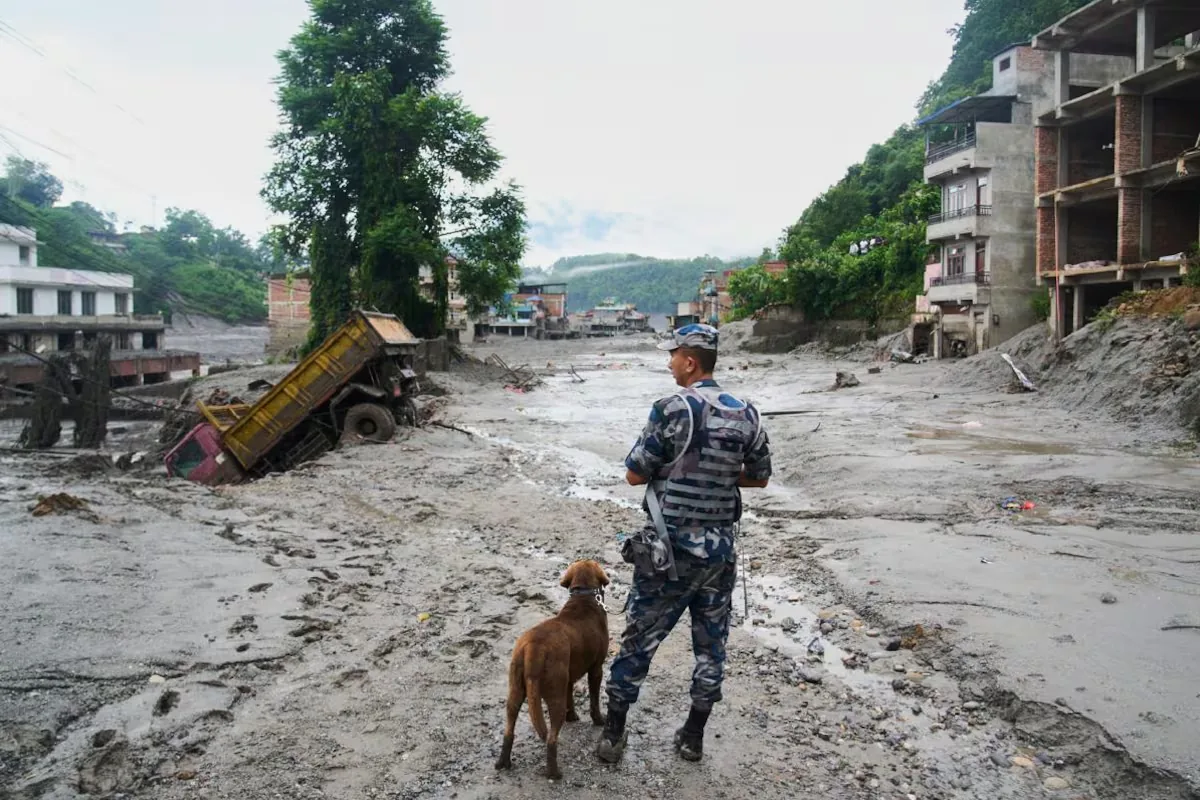
At 8:37 a.m. on Wednesday (4:52 a.m. in mainland Spain), seismographs detected a strong signal in the Himalayas, the highest mountain range on the planet. The United States Geological Survey initially identified it as a magnitude 4.4 earthquake, but later reclassified it as the seismic trace of a gigantic 5.2 landslide caused, according to preliminary investigations, by the collapse of a glacier. This phenomenon produced a monstrous flood in the Gyirong mountain corridor, on the border between Nepal and Tibet, which has already caused more than 165 deaths and hundreds missing — the Ministry of Foreign Affairs confirms that four Spaniards have not been located. We compile what is known and what is not about this natural disaster.
Did the catastrophe occur due to an earthquake?
The US Geological Survey (USGS) initially recorded a magnitude 4.4 seismic event that was interpreted as an earthquake that had caused the subsequent avalanche. Later, the USGS conducted additional analyses “of nearby seismic stations, long-period seismic waves, and satellite images” which led to the determination “that the seismic event was rather a glacier collapse and debris flow, and that no earthquake had occurred.” In other words, what the seismographs recorded was not tectonic in origin, but the tremor caused by the massive debris collapse.
What looked like an M4.4 earthquake was actually the vibration generated by an avalanche of rock and ice that fell on the #Nepal-Tibet border. When reviewing the signal in more detail, the USGS scientists noticed that it did not have the typical shape of an earthquake due to… https://t.co/TRTd8BUb9A
— Amilcar Carrera-Cevallos (Earthquake) (@amilcarcasper) August 26, 2026
The USGS also corrected the magnitude: it was 5.2, near the border between Nepal and China at 8:37 local time (10:52 China Standard Time). “The USGS determined that the seismic event was a glacial collapse and debris flow that caused subsequent catastrophic impacts downstream,” explains the US agency, a reference in this field.
How did the glacier collapse?
Satellite images from Planet Labs analyzed by experts cited by Reuters place the origin of the catastrophe on the Nepalese side of the border. A considerable part of the front of a glacier detached at about 5,200 meters altitude and fell around 1,200 meters down to the valley floor. The avalanche of ice and rocks entered the Lhende River and sent downstream a huge mass of water, mud, and sediments that first devastated the Tibetan border crossing of Gyirong and also descended through Nepal, where it destroyed numerous towns and infrastructures.
The scenes out of Nepal today are horrendous. Catastrophic doesn’t seem to do it justice.
It looks as though the flood emanated from the slopes of Langtang Lirung, a 7,234 m (23,734 ft) high peak. Satellite imagery (see post below) from@NDRRMA_Nepal shows a massive landslide on… pic.twitter.com/tjl4WHJ89N
Read more We test the best stationary bikes for exercising at home
— Iain Cameron (@theiaincameron) August 26, 2026
Were these risks known?
A study published in Nature Communications in 2023 already warned that glacier melting pours huge amounts of water into nearby lakes, putting at least 15 million people worldwide under the threat of sudden and likely deadly flooding. Of these, about 7.5 million live precisely in India, Pakistan, and China — which share the Himalayas — as well as in Peru. Another study from the same year compiled more than 150 glacier floods that have occurred throughout history. In March, Pakistan — another country sharing the mountain range — warned that glacier melting driven by climate change increasingly poses risks to lives and infrastructure.
Has climate change influenced it?
Scientists have demonstrated that global warming driven by anthropogenic climate change is melting glaciers worldwide; however, it is too early to determine precisely whether the glacier that caused this phenomenon played a key role. Attribution studies of climatic events usually take weeks to complete.
Are there Spaniards among the victims?
The Ministry of Foreign Affairs has confirmed that four Spaniards are missing after the flood. “At this time, we have no confirmed Spanish fatalities, but there are four people we cannot locate,” explained Minister José Manuel Albares in a statement. The Foreign Minister has called on Spaniards who are or have been in the area, as well as their families and friends, to contact the consular emergency phone numbers and those enabled for this situation. These phone numbers are the Ministry in Madrid (+34 91 000 1249), the Spanish Embassy in India (+91 9810174160), and the Honorary Consulate in Nepal (+977 1 4579488/4570770).
Have there been other similar catastrophes?
These types of events have not been very common in recent history, although there are some examples. Last year, the Birch glacier swallowed much of the village of Blatten (with 300 inhabitants) in the Swiss Alps in seconds, although scientists warned two days earlier and the village was evacuated, so there were no casualties. In December 1941, a piece of a glacier in Huascarán National Park, Peru, fell into a nearby lagoon, generating a wave that broke the dam, causing water to overflow into the Cojup valley. That enormous flood, carrying blocks of ice and large rocks, reached the Peruvian town of Huaraz in just 15 minutes, causing the death of more than 1,800 people (other estimates speak of up to 6,000). Much earlier, the Tête Rousse glacier in the French Alps overflowed in 1892 causing 175 deaths. In 2020, a glacial lake in British Columbia (Canada) caused a water tsunami about 100 meters high, although on that occasion there were no injuries.