






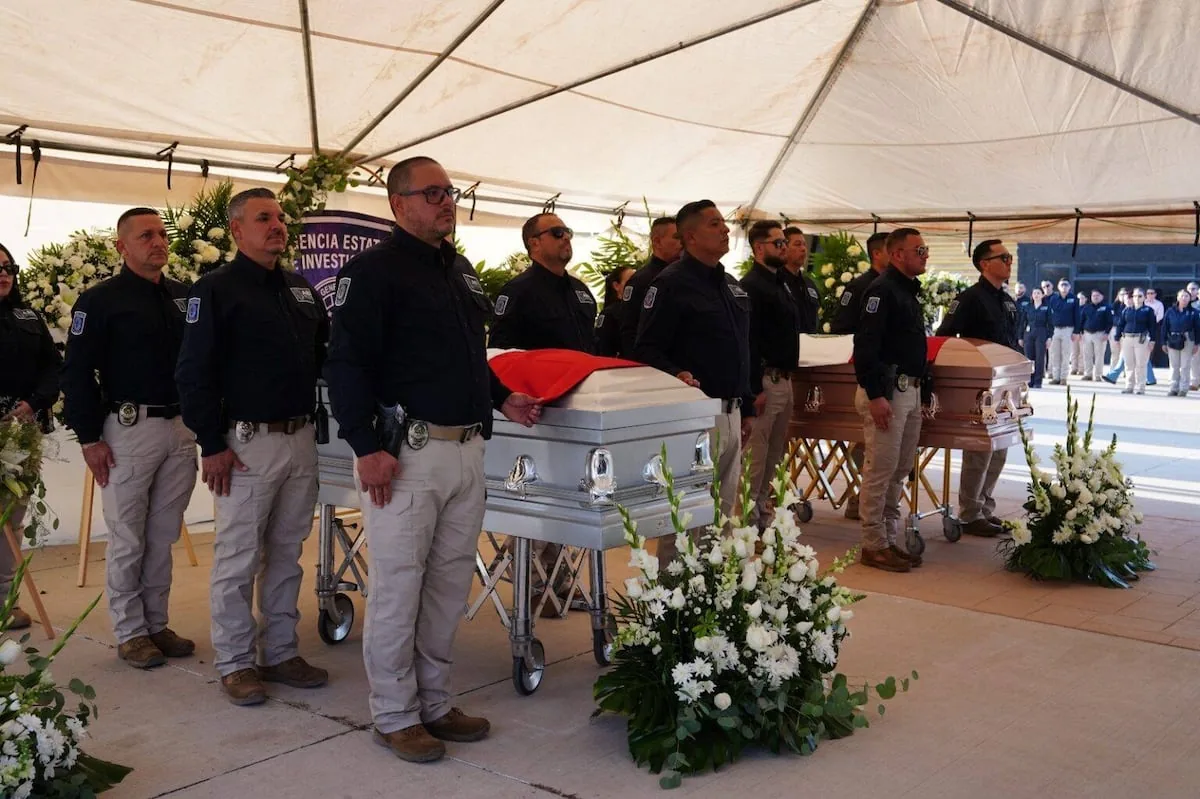
The death of two US officials in a road accident in a remote area of the Sierra Madre Occidental, in the State of Chihuahua, would have been nothing more than an unfortunate event that occurred in the early hours of Sunday in a place full of steep ravines where two Mexican agents also lost their lives. The dimension of the matter changed when it was learned that the Americans were agents of the CIA, the United States’ espionage agency. And above all, it has escalated in the last 48 hours, when President Claudia Sheinbaum stated that all four were “working jointly” on a mission of which the federal government was not informed. In addition to the State of Chihuahua, the president has requested explanations from the United States through a letter sent to the embassy.
The accident has become a crack through which citizens have glimpsed one of the most opaque aspects of the complex relationship with the northern neighbor, that of security, how much is cooperation with Washington and how much is subordination, in a debate where the threat of US interference is a constant, especially since Donald Trump returned to the presidency.
The rhetoric of intervention on Mexican soil has been even more intense since this January, when Trump, after taking Maduro from his bed in Caracas and bringing him to a New York prison, said that “[drug] cartels control Mexico” and offered the country military presence to combat them. Sheinbaum has always drawn a red line at that point in cooperation with Washington, and has developed a narrative of defense of sovereignty. This Wednesday she stated: “In our conversations, Trump has suggested giving us greater support, including the presence of members of the United States Army, to which we have said ‘it is not necessary, President Trump,’ our collaboration is very good and another case would violate our laws. We are very strict with our national sovereignty.”
What these two US officials were doing in Mexico is still an unknown for the Sheinbaum government, as she herself has admitted. That is why she has asked for explanations from the State of Chihuahua, an entity located on the border with the United States where security cooperation with Washington is fluid and which is one of the few governed by the opposition National Action Party (PAN). Sheinbaum wants to know what happened to see “if the Constitution was violated,” since Chihuahua itself would not have the capacity to authorize the entry of foreign agents or joint operations without the federal government’s knowledge. The president has raised her tone and stressed this Wednesday that “there cannot be US agents operating in the field,” as this issue affects “national security and sovereignty,” and therefore “it is not a minor issue.”
Hours later, White House spokeswoman Karoline Leavitt referred to the matter not to give explanations, but to say that Trump “always seeks more cooperation” and to demand “a little empathy” from Sheinbaum: “it would be very timely for the two American lives that have been lost,” she said on Fox News, “considering everything the United States is doing.”
Trump in recent months has been disseminating military presence throughout Latin America under the idea of the fight against drug trafficking and that the region is his area of influence or, in his words, his “backyard,” an allusion to the Monroe Doctrine that the US president has dusted off. While Ecuador and Argentina have opened their doors to him for joint operations and military presence, Mexico tries to resist the pressure with fluid collaboration in many areas, but with the clear limit that whatever is done in Mexico requires the collaboration of the Government of Mexico.
Read more The UN High Commissioner “recognizes the will” of Sheinbaum to resolve the crisis of disappearances
“For more than 100 years, there have been agents from the CIA, DEA, and other agencies in Mexico. It is a constant, not a variable, of the bilateral relationship,” explains Carlos Pérez Ricart, a research professor at the Center for Economic Research and Teaching and author of the book One Hundred Years of Spies and Drugs: The History of United States Anti-Narcotics Agents in Mexico. “They operate, move, and make contacts without the Mexican government’s knowledge, or they may agree with State governments, but it is irrelevant whether the federal government knew or not, since it lacks the ability to prevent or track them,” he indicates.
Pérez Ricart speaks of the “inevitability” of the presence of these agents, something that is difficult to reconcile with the idea of sovereignty in the face of a neighbor that has “few limits in foreign policy” and “specific objectives related to criminality in Mexico and pursues them, legally or illegally. That’s how it has always been,” the analyst indicates. For him, the bilateral relationship is “based on asymmetry, blackmail, pressure” and permeated by drug trafficking. In this framework, the president’s government’s narrative of sovereignty shows cracks. An internal one, which exposes the lack of communication on security matters with one of the States, Chihuahua, when that coordination “is one of the pillars of the security strategy presented by Omar García Harfuch [the Secretary of Security]” regardless of the political party in power there, notes Teresa Martínez Trujillo, a research professor at Tecnológico de Monterrey.
On the other hand, recognizing, as Sheinbaum has done, that she does not know what is happening in a State that is also a key location, on the border, implies that there is a blind spot and that US pressure seeps through there. “It’s myopia, in the sense that she has no information from either the United States or Chihuahua, and therefore a lack of control over what happens in that place,” explains Martínez, a politically unfavorable image for her.
The opacity and suspicion surrounding everything related to the CIA and its actions in Latin America is another key factor in this story, Martínez indicates. “If the car hadn’t gone off the cliff, we wouldn’t have known anything, and even so, a lot of information is still missing,” she states. And that darkness fuels suspicion along with logical questions. For example, what were the two US agents and two other Mexican agents assigned to the Chihuahua State Investigation Agency doing together? Morena, Sheinbaum’s party, has requested the appearance in the Senate of the governor of that State, María Eugenia Campos, and the prosecutor to clarify this point.
The Chihuahua prosecutor, César Jáuregui, has been changing his version of what kind of cooperation the four deceased had as the days passed. On Sunday, he assured that they “were returning from an operation to destroy clandestine drug laboratories.” On Monday, he said that the Americans were in a town six hours from the dismantled laboratory training Mexican agents in the use of drones and that they were not working on the same mission at the laboratory; the Mexicans would have simply picked them up by car after finishing their respective separate tasks. Sheinbaum contradicted the prosecutor and said that she has evidence that they were working jointly, which opens the door to a violation of the Constitution, as she has indicated in recent days, but the matter is still far from being clarified and is escalating. Now, the governor of Chihuahua has requested a meeting with Sheinbaum to discuss the issue, in which she celebrates “the dismantling of the largest laboratory known to date,” and in which it is still unknown what role the Americans played.
Read more Carlos Baute, María Corina Machado and Venezuelan racism