










On August 7, 1847, a major earthquake occurred in Egypt. With its epicenter in the Fayoum region, 100 kilometers south of Cairo, historical documents speak of dozens of deaths and hundreds of buildings destroyed. But the pyramids remained standing. Some, like the Great Pyramid of Giza, the Pyramid of Khufu, have been withstanding tremors for about 4,600 years. An analysis of the vibrations inside the tomb published this Thursday in Scientific Reports shows how its design dampens the external vibrational frequencies, preventing the amplification of the tremors’ impact.
“Historical accounts indicate that the earthquake loosened many of the remaining outer casing stones of the Giza pyramids, and some blocks fell off,” says Mohamed ElGabry, researcher at the National Research Institute of Astronomy and Geophysics (NRIAG) and lead author of the study. “However, the main body of the Great Pyramid (and the other pyramids) remained largely intact and structurally sound,” he adds.
Architects and engineers have always highlighted the stability of the Egyptian pyramids, the tallest buildings ever constructed by humans for thousands of years. Some reasons are obvious: a pyramidal structure, with the three sides of the base measuring 230.33 meters each, tapering as it rises to 146.59 meters (original height), and culminating in a small pyramidion (now lost, currently ending in a 9×9 meter summit), causes most of the mass to be concentrated at the bottom. Additionally, this design lowers the center of gravity. But that does not explain everything: the Pyramid of Khufu, built with 2.3 million blocks bonded (not always) with some plaster, behaves as a single unit.
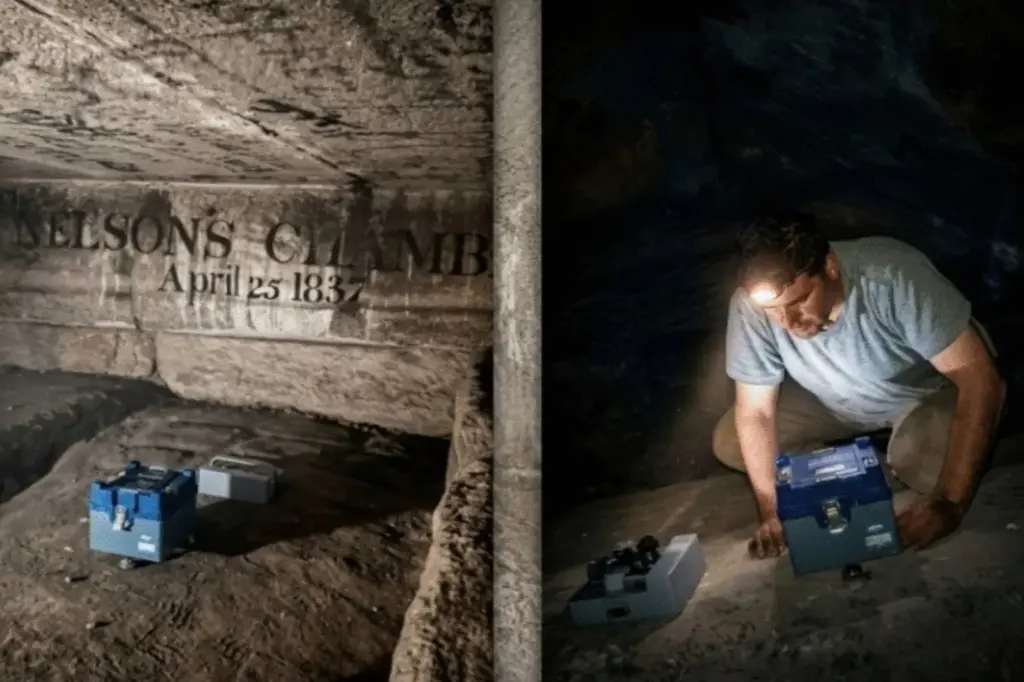
“Imagine it as a swing: every structure has a preferred rhythm at which it vibrates most easily,” says ElGabry. Using a system called the HVSR seismic method (Horizontal to Vertical Spectral Ratio) or Nakamura method, they measured natural vibrations at about thirty points in the Pyramid of Khufu, from the Queen’s chamber to the Pharaoh’s chamber, including ventilation shafts and debris areas. With very few variations, the vibration is always the same. “We found that most of the Great Pyramid naturally vibrates at about 2.3 vibrations per second (2.3 hertz, Hz). This indicates it is extremely well built and uniform throughout; it behaves as a single solid structure rather than many separate pieces,” he details.
This means the pyramid vibrates very uniformly and balanced from the base to the top and through its different internal parts (chambers, passages, shafts). “There are practically no weak zones that behave very differently from the rest,” says ElGabry. This homogeneity, adds the Egyptian researcher, “is excellent for stability, as it reduces the likelihood of dangerous internal stresses and cracks forming during an earthquake.”
Read more The National Court orders the blocking of 490,780 euros from Zapatero’s bank accounts
During their measurements, they observed something they consider very relevant. The vibrations recorded around the pyramid are different from those inside. The ground surrounding it vibrates at a much lower frequency, about 0.6 Hz, while the pyramid vibrates at 2.3 Hz. Because these two frequencies are quite different, the pyramid does not resonate with the ground during an earthquake, and that is key. “Resonance is like pushing a child on a swing at exactly the right rhythm: even small pushes make it go very high,” ElGabry compares again. Because if the frequencies match, the shaking becomes much stronger and more destructive. “The large difference in frequencies between the pyramid and the ground prevents this dangerous amplification, which helps keep the monument stable,” he concludes.
“The fundamental natural vibration period of the pyramid is far from the characteristic vibration period of the ground on which it rests,” explains Amadeo Benavent, principal investigator of the seismic engineering research group at the Polytechnic University of Madrid. “This prevents the horizontal movement of the ground and the pyramid from resonating when an earthquake occurs,” he adds. As happens with sound when several voices overlap, “the resonance phenomenon is potentially very damaging because it causes the horizontal displacements of the structure to grow significantly,” details Benavent, who has reviewed the research.
Besides the mass distribution, there are other factors that give seismic resistance to the Pyramid of Khufu. One is the millions of joints between the blocks, which help dissipate some of the energy introduced by the earthquake into the pyramid. Another is the base. “I recently visited the area, attending as an invited member a geology congress of the Eastern Mediterranean, and I was able to verify that the pyramid platform is made up of a strong layer of well-cemented limestone, which surely provides these buildings with a stable and rigid substrate,” recounts Juan Ignacio Soto, from the geodynamics department at the University of Granada and an expert in seismicity.
Egyptians believed in a life beyond this one. The construction of their pyramids, which are nothing more than large tombs, is justified by that belief system. And if the pharaoh is to have eternal life, his pyramid must be eternal as well. Everything indicates they built them with that idea of eternity. But the architectural rationality to achieve it is very different from today’s, at least regarding earthquakes. As Mohamed ElGabry concludes, “the pyramid is extremely rigid compared to many modern tall buildings.” In fact, its approach to facing an earthquake is the opposite: “A skyscraper is intentionally designed to be relatively flexible.”
Read more United States deploys its aircraft carrier USS Nimitz in the Caribbean amid campaign against Cuba