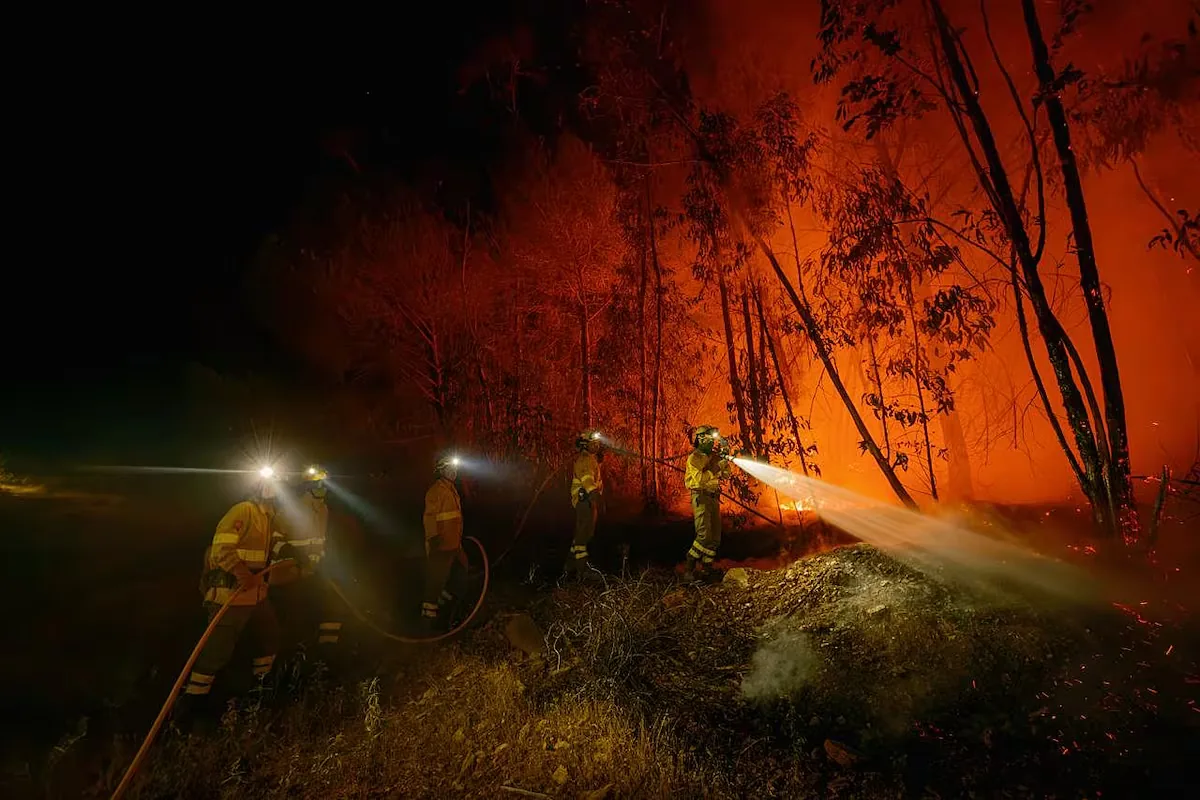
The Niebla (Huelva) fire remains active this Tuesday after affecting more than 20,000 hectares and keeping 700 people evacuated from the municipalities of Niebla, Berrocal, Villarasa, Zalamea la Real, and El Madroño. The Minister of the Presidency, Health, and Emergencies of the Junta de Andalucía, Antonio Sanz, emphasized this morning that the night allowed the flames to be contained in some areas, but there is still much to be done. “It is a fire that still has days of work left because the extent and perimeter are still very large. We have to act over many kilometers and work meter by meter to seal and prevent new reactivations,” Sanz reported from the advanced command post.
Ground forces have been working throughout the night against the flames, which have not yet reached the province of Seville. And when day broke, reinforcements arrived with three helicopters and two amphibious planes, aircraft to which more resources will be added throughout the day. Their work is more difficult than usual because the fire is still “beyond the capacity for extinguishing,” as Sanz highlighted, who pointed out that this is because the heat output and size of the flames make it impossible to stop their advance. “You can have all the resources you want, but the physical situation prevents action. Ground forces cannot fight it without risking their lives, and that is why we have even had to extract some of them by helicopter. And aerial resources are not effective because the water evaporates before reaching the flames,” the minister stressed. Up to 652 personnel — including members of the Infoca Plan, the Military Emergency Unit, firefighters from the provincial consortia of Huelva and Seville, and even a unit from Cáceres — are working on the ground, and 26 aerial resources are expected.
According to Sanz, the objectives for the day are several. On one hand, to maintain a control line in the northern area between the towns of Marigenta and Berrocal with technical fire and the support of a mechanized line. On the other hand, in the east, bulldozers — there are 14 in the entire operation — and ground personnel are working to close the perimeter area. Beyond that, in the west, the priority is to prevent the fire from crossing the firebreak established as a control measure. And finally, in the south, the perimeter will be consolidated while possible reactivations are controlled. “This is a terrible fire because the threats come from all sides. It spreads on all its flanks, with secondary spots that can appear anywhere,” warned the minister, who on Monday highlighted how one of those secondary spots developed 3.5 kilometers from the main focus, an area that the fire then ravaged in just 15 minutes.
That said, his words showed slight optimism on Tuesday morning because weather forecasts predict the arrival of east winds, which may allow safer action in risk areas and also keep the first belt of affected municipalities protected with Berrocal as the epicenter. “We have to wait for the day to see if those forecasts are confirmed,” Sanz indicated cautiously to warn later that “changes in the fire’s circumstances, its aggressiveness, its danger, and convective phenomena greatly disrupt plans.” “We have to be very cautious,” he said several times.
Smoke warnings
For now, nearly 700 people have been evacuated from their homes in the municipalities of Niebla, Berrocal, Villarasa, Zalamea la Real, and El Madroño. The first evacuations took place on Saturday night, after the Andalusian administration sent an Es-Alert message to evacuate several areas of Berrocal, Marigenta, El Membrillo, and El Pozuelo, all in the province of Huelva. On Monday, preventive evacuation was carried out in Las Delgadas — in Zalamea la Real (Huelva) — and the main nucleus of El Madroño (Seville), as well as its four hamlets: El Álamo, Juan Antón, Juan Gallego, and Villargordo. In total, about 700 people remain out of their homes, most in second homes or relatives’ houses, although some also spent the night in shelters attended by the Red Cross, Civil Protection, and the Andalusian Emergency Group (GREA). Sanz reminded that evacuations are not a recommendation. “It is a mandatory instruction,” he pointed out, because the risk level remains “very high” in all affected localities.
Read more The race for minerals and a justice perspective for Latin America
The Andalusian Emergency Agency has also warned that the intense smoke — visible from the cities of Seville and Huelva, where there is a strong smell of burning in the air — may affect the municipalities closest to the fire, so it has asked the population to close doors and windows and to especially protect the most vulnerable people, such as the elderly, children, or patients with respiratory conditions. “We ask for caution and recommend following the instructions of emergency services and the information disseminated through official channels,” requested the Huelva City Council from its social networks.
Road closures
The Directorate General of Traffic (DGT) has reported that, due to the fire, 11 roads remain closed in Andalusia, all secondary. In Huelva, traffic is not allowed on the A-493 and HU-4103 in La Palma del Condado, HU-3106 in Niebla, HU-5104 in Zalamea la Real, HU-6104 in Minas de Riotinto, HU-6106 in Nerva, HU-6107 in Berrocal, and HU-6108 in Paterna del Campo. In Seville, SE-538 and SE-6400 in El Álamo and SE-6402 in El Madroño are closed.
📢⚫️🔥Due to the fire, 13 secondary roads remain closed:
📍Huelva
➡️A-493, HU-4103 La Palma del Condado
➡️HU-3106 Niebla
➡️HU-5104 Zalamea la Real
➡️HU-6104, Minas de Riotinto
➡️HU-6106, Nerva
➡️HU-6107 Berrocal
➡️HU-6108 Paterna del CampoRead more Time of tragedy, time of solidarity
— Dir. Gral. Tráfico (@DGTes) August 11, 2026