









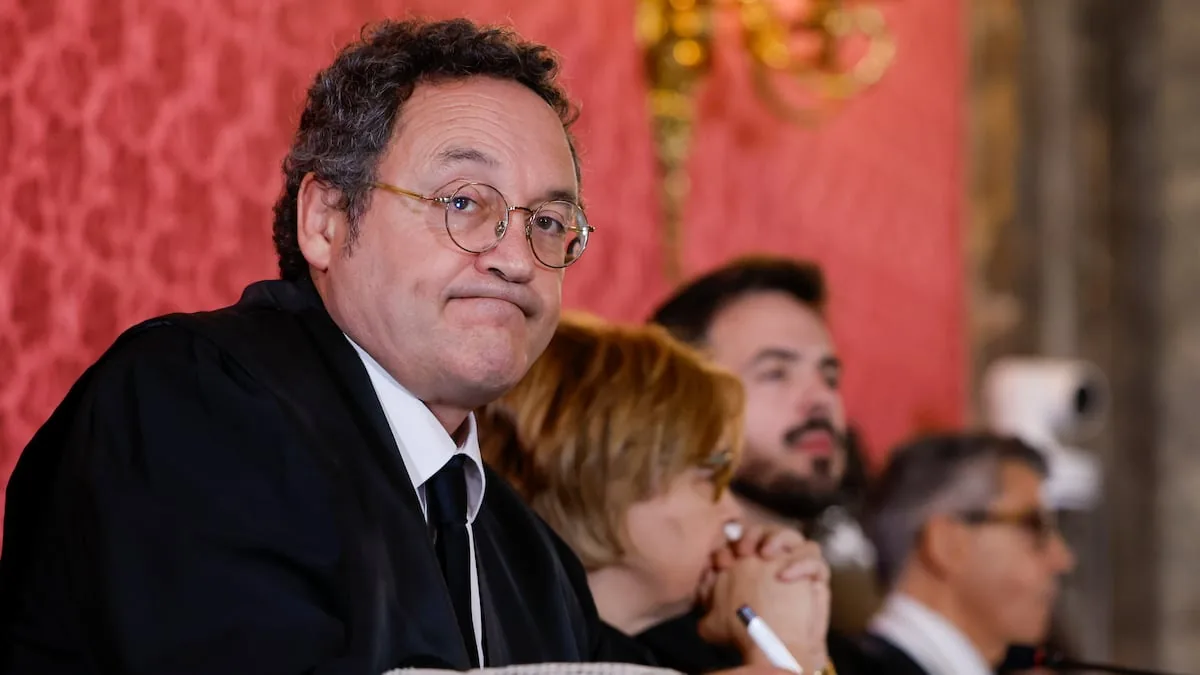
The appeal that the former Attorney General Álvaro García Ortiz has filed before the Constitutional Court for his conviction as the author of a crime of revealing secrets hits the sore spot, arguing his request for protection based on the inconsistencies of the Supreme Court’s ruling.
Read more The Fine Arts of Cádiz languish among scaffolding of works
Since the Criminal Chamber of the high court announced its conviction on November 21, it was evident that this matter would reach the plenary table of the guarantees body, due to the importance of the case and the precedent it represents. And, especially, because of the broad stroke used by the Supreme Court to attribute the leak of reserved data to García Ortiz without exactly proving it, since alternatively or subsidiarily the hypothesis was considered that this conduct was the work of “a person from his immediate environment and with his knowledge.”
It was then made clear that the interpretation of the criminal provision for which the former Attorney General was convicted was going to be very significant. Article 417 of the Penal Code states that the crime there typified will be committed by “the authority or public official who reveals secrets or information of which they have knowledge by reason of their office or position and which should not be disclosed.” This statement —“which should not be disclosed”— was going to be discussed, since from the perspective of the State Prosecutor’s Office it was necessary to deny a rumor, that there had been an order “from above” to redirect the course of the actions carried out against the businessman Alberto González Amador, partner of the president of the Community of Madrid, for alleged tax crimes.
Read more The vassal sovereignty
The former Attorney General has always denied being the author of the leak, and in his appeal he reiterates this, stating that there has never been proof to the contrary, nor that the revelation of data was the product of someone from his “environment.” From this it follows that the Supreme Court convicted him based on a mere “suspicion” and “open inferences,” which are formulated “disregarding facts and exculpatory evidence.” What García Ortiz admitted was having decided to publish an official note to clarify that the offer of a pact to González Amador did not come from the Prosecutor’s Office but from his defense. This sought to counter the opposite version, that the public ministry changed its mind and opposed that possible agreement due to those higher orders. At the trial, Ayuso’s chief of staff, Miguel Ángel Rodríguez, explained that he deduced those instructions because it was logical and because for some time now he has “been graying.”
The outcome of the former Attorney General’s request for protection is extremely important for the prestige of our system of guarantees. Two Supreme Court magistrates considered that it had not been proven that García Ortiz was “the author of the leak.” In other words, that the presumption of innocence of the accused had not been destroyed, not even by deducing that he erased his devices to hide his guilt. The Supreme Court ruling also affects the right to information, effectively limiting the capacity that the Statute of the Public Prosecutor’s Office itself recognizes to the Prosecutor’s Office to “inform the public opinion,” certainly respecting “the rights of those affected.” Now then, is there a right to mislead public opinion and, at the same time, an obligation to remain silent about it? If the founders of the Constitution deemed the existence of a Constitutional Court necessary, it was in cases like the present one, to guarantee respect for fundamental rights, not their perversion.
Read more You have to say no more