









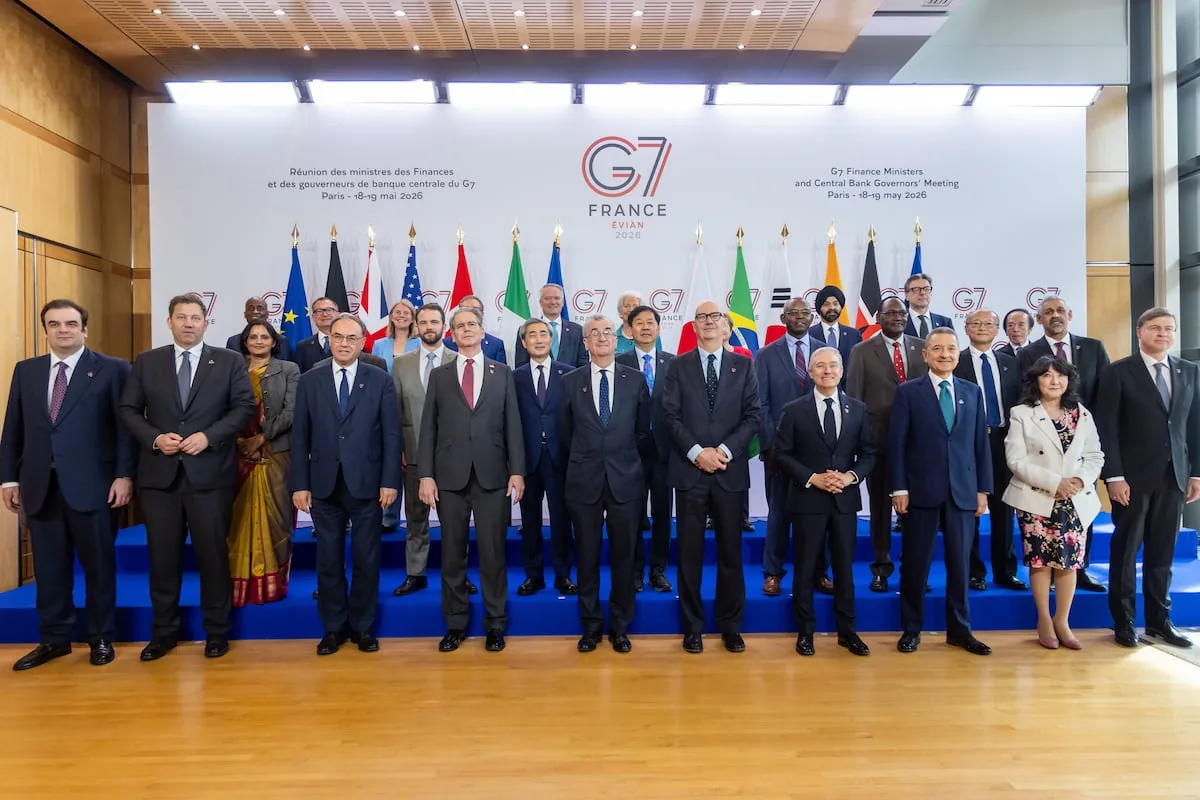
The Finance Ministers and Central Bank Governors of the G-7 countries reaffirmed this Tuesday the need to strengthen multilateral cooperation to address “inflationary risks” and the threat to growth arising from the war in Iran. “We are at a moment of gravity and this period of turbulence has demonstrated the need to continue advancing in international dialogue,” said the host minister, Frenchman Roland Lescure, at a press conference following the meeting in Paris.
Read more Justice releases the two men detained for the disappearance of Yulitza Tolosa
The economic leaders of the main industrialized economies (United States, Germany, France, United Kingdom, Italy, Japan, and Canada), gathered since Monday at a summit held in the French capital, have focused their discussions on the consequences that the conflict in the Middle East is having on the global economy, especially on trade and energy prices. In one of the joint statements published after the meeting, the group of countries warns that “global uncertainty has increased.” “Growth and inflation are exposed to increasing risks” due to the crisis in the Middle East, the statement continues, a threat that “impacts all economies and threatens global financial stability.”
The G-7 ministers recalled the effects that Iran’s blockade of the Strait of Hormuz, a strategic point for the export of hydrocarbons and fertilizers, is having on the supply chain of energy, food, and fertilizers. Therefore, they demanded its immediate opening under the same conditions as before the war began with the bombings by the United States (a G-7 member) and Israel on Tehran on February 28. “There is no need to lie, this crisis is going to last,” warned the French minister, who alerted that if the situation prolongs, it could severely affect 50 million people, especially in the most vulnerable countries.
The ministers of the most industrialized economies have committed to providing aid to the most affected countries, in coordination with the International Monetary Fund and the World Bank. Lescure cited the example of Iraq, which “has oil but cannot export it.” “They must be helped, both from within the countries and from outside,” he insisted. In addition to the G-7 countries, Brazil, India, Kenya, and South Korea participated as guests in the meeting.
The impact of the armed conflict on economic growth has also been analyzed by major international organizations. The International Monetary Fund forecasts more moderate global growth this year due to the war, and the Organisation for Economic Co-operation and Development (OECD) has announced cuts in its growth forecasts for Germany, France, and Italy for the same reason. None of these economies will grow above 1%. The average forecast for the eurozone is 0.8%, four tenths less than in the previous forecast.
Regarding inflationary pressures, the central banks of the G-7 countries have committed “to maintaining price stability and ensuring the resilience of the financial system.” “Monetary policy will continue to depend on data” and banks “are closely monitoring the impact of tensions on energy prices and other raw materials,” according to the statement.
The Governor of the Bank of France, François Villeroy de Galhau, who also spoke to the media, stated that “regarding monetary policy, there have been no country-by-country discussions, but there is a general willingness to act to bring inflation to 2% in the medium term.” “We are ready to act and take the necessary measures (…) action must be taken, but not overreact,” he warned about the central banks’ position on the decision of a possible rate hike.
In the statement, the G-7 countries also commit to continuing political and financial support to Ukraine and maintaining sanctions against Russia in key sectors such as energy or military industry. “Moscow cannot benefit from the conflict in the Middle East,” Lescure reminded. The announcement comes after the United States announced on Monday that it is extending the suspension of sanctions on Russian oil stored offshore to try to moderate crude prices.
Another topic of debate was concern about excessive dependence on critical minerals, necessary for technology or the development of electric vehicles, which are concentrated in Chinese companies. The G-7 warns “of non-competitive practices that distort markets and arbitrary export restrictions,” referring to Beijing.
France holds the presidency of the G-7 since January and, as Lescure recalled, the commitments reached this Tuesday will serve as a roadmap for the summit of heads of state to be held in Evian (eastern France) next month.