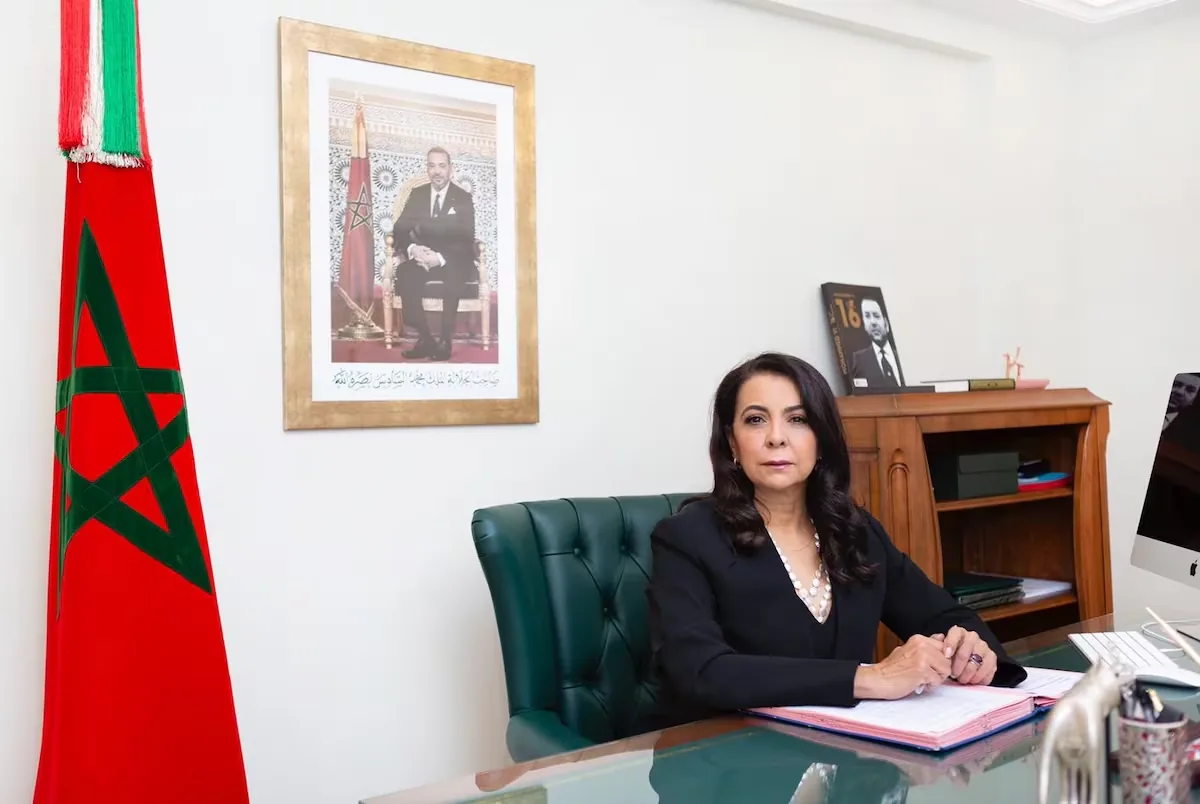
The President of the Government, Pedro Sánchez, stated in his appearance before the Congress that the Executive summoned the Moroccan ambassador to Spain, Karima Benyaich, on August 21 for the “unacceptable statements about Ceuta and Melilla” made by two Moroccan ministers. It is the first time the Executive acknowledges taking this measure after the Moroccan Minister of Islamic Affairs, Ahmed Tufiq, called to “liberate the occupied cities” of Ceuta and Melilla during an event with King Mohamed VI, while the Minister of Justice, Abdellatif Ouahbi, claimed the “historical rights” of his country over both.
The Ministry of Foreign Affairs confirms this information and assures that, although there have been previous cases of summons, this is the first time that Foreign Affairs has formally rejected the Moroccan theses on Ceuta and Melilla.
The head of this department, José Manuel Albares, already outlined last week during his appearance before the Foreign Affairs Commission of the Congress that he had “formally rejected through all available diplomatic channels the statements contrary to our territorial integrity.” But he did not clarify then whether the Government’s response included summoning the Moroccan ambassador in Madrid to deliver a note of protest. “Summons of ambassadors are rarely made public,” said the minister.
Summoning an ambassador is a common measure, and one of the least aggressive, that diplomacy has to convey a formal complaint to another country: the ambassador of the State in question is called to an appointment at the Ministry of Foreign Affairs, and the discontent is expressed. This is what was done with the representative of Morocco, add the Foreign Affairs communication department: “The ambassador was summoned, the appropriate messages were conveyed, and the embassy attended the summons at the Ministry’s headquarters.”
Benyaich, who was not in Spain at that time, did not attend the appointment, and instead, according to Foreign Affairs, the chargé d’affaires, who is the person who usually leads the embassy in the absence of the head, attended. “It is a usual diplomatic practice,” they justify. They decided not to wait due to the urgency and the need not to delay the protest. Benyaich was also sent the complaint by telematic means, they add.
This tool is widely used in relations between countries; it is a warning call to express displeasure over an incident between countries. There are also softer ways to show anger, such as summoning a lower-ranking official or sending a verbal note.
Spain has used the summoning of ambassadors in several recent diplomatic fires. In this same crisis, for example, Albares announced on July 30 that he had summoned the Italian ambassador to Spain after statements by the Italian Foreign Minister, Antonio Tajani, linking the entry of migrants into Ceuta with the extraordinary regularization promoted by the Government.
The examples are countless: in March, the Government summoned the Iranian ambassador to Spain for the launch of a drone attack against a British base in Cyprus; and in May it did the same with the Russian ambassador after a drone incursion in Romania.
Sometimes, the mechanism is the prelude to flames yet to come in relations. The next step would be to call the ambassador back for consultations in the capital of the other country. And from there upwards, as has happened in recent crises with Argentina, Israel, and also Morocco.
In November 2023, the Israeli ambassador to Spain was summoned by Foreign Affairs after the Israeli chancellor accused Sánchez of “supporting terrorism.” With the progressive deterioration of ties, in September last year, the Spanish Executive called back its ambassador in Tel Aviv, Ana María Salomón. After a few months, the Spanish Government officially dismissed her in March: the most drastic measure. Her post remains vacant.
Something similar happened with Argentina in 2024 following the Argentine president, Javier Milei, calling Pedro Sánchez’s wife “corrupt” at an international far-right convention held in Madrid: there were summons of the Argentine ambassador in Madrid, the call for consultations of its Spanish counterpart in Buenos Aires, and finally her withdrawal. A few months later, diplomatic normality was restored with the sending of a new Spanish ambassador.
The Moroccan ambassador also knows this mechanism. At the end of 2020, the Ministry of Foreign Affairs also summoned her after statements by then Moroccan Prime Minister Saadeddine El Othmani, in which he defended that Ceuta and Melilla “are Moroccan like the Sahara.”
Soon after, in May 2021, ties between the two countries soured with the sudden incursion of about 8,000 migrants into Ceuta. The then Foreign Minister, Arancha González Laya, again summoned the Moroccan ambassador to express “displeasure” and “rejection” of the massive entry of migrants. There was an underlying turmoil. Benyaich said those days that in relations between countries there are acts that have consequences “and must be assumed,” a veiled reference to Spain’s decision to provide medical attention to the leader of the Polisario Front, Brahim Gali.
Morocco then decided to call its ambassador back for consultations, who did not return to Madrid until March 2022, shortly after the Spanish Government’s change of stance on the Sahara conflict.