









(This article is a submission from the newsletter of Verne, EL PAÍS’s bulletin that explores the internet to bring you the most fascinating and entertaining stories. You can sign up here)
“This conversation has made me feel very nostalgic,” says Izon Child after talking about the Grand Prix. “I remember watching it, especially the Peque Prix (the children’s version). My favorite challenge was the mechanical bull, which shook a lot until the kids fell off.” He says this even though Child, 28 years old and a graphic designer by profession, has never been to Spain nor has he seen the program online. He is from Bungbulang, a village on the island of Java, Indonesia. Although more than 11,000 kilometers separate us, many Spaniards and Indonesians from the millennial and Z generations share a common memory: sitting in front of the TV in our childhood to enjoy Ramón García and his Grand Prix del Verano. This year, the Spanish program returns to Indonesian television, bringing with it the nostalgia of many Indonesians who also enjoyed it on their screens almost 20 years ago.
In the 2000s, Indonesian television broadcast both the Grand Prix and the Peque Prix, creating a generation of young people who know Ramón García, the super pins, or the crazy logs as well as Spaniards do. “We asked among the staff at the embassy [of Indonesia in Madrid] and several of us, especially those born in the nineties, remember very well our experience watching the Grand Prix and the Peque Prix,” Nadia Luthfiani from the Information, Education, Social and Cultural Department of the Embassy of the Republic of Indonesia in Madrid tells EL PAÍS by email. “They were broadcast on the RCTI channel in the afternoon, and it was one of the favorite programs to watch after school.”
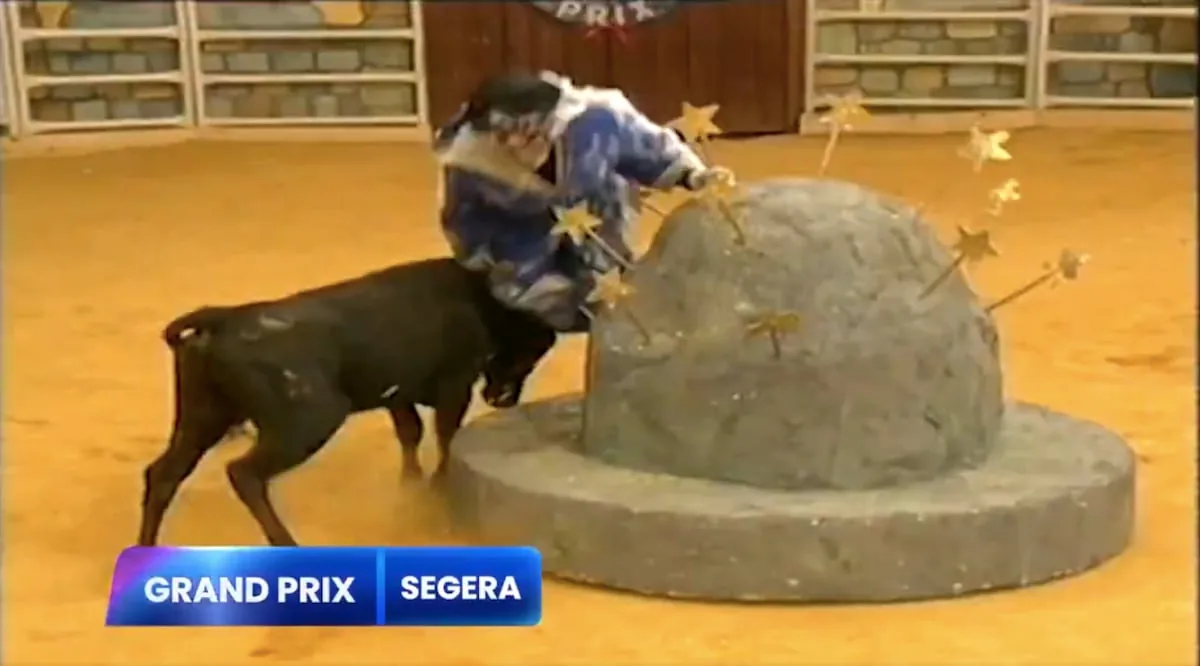
Luthfiani and the embassy staff agree with most Indonesians consulted by EL PAÍS through social media about their favorite challenge: the calf. “What we liked the most was the bull running towards the participants,” she says. “We also remember challenges like throwing a ball blindfolded at people acting as pins, or climbing to catch a bucket of water,” she recalls. “We hadn’t watched the program again after coming to Spain, but after receiving your email, yesterday we watched some old videos and also new episodes on YouTube, which made us very nostalgic. We laughed together and fondly remembered those times of our adolescence.”
Memories return
Last March, the Indonesian channel Moji TV announced that the program would return to the air almost 20 years after its last broadcast in the country. The administrators of the Spanish Grand Prix fan community obtained the TV announcement of the contest’s return, which you can see below:
🇮🇩 #GrandPrix returns to Indonesia!
📺 Moji TV channel will rebroadcast the old seasons dubbed in Indonesian, as was done almost 20 years ago. #GrandPrixTVE
🪵 💦 Will they buy the new ones in the future?
🐮 For now, here is one of the promos below: pic.twitter.com/Jcmot4QA3L
Read more This is how to get papers in Spain: «It has changed my life»
— Grand Prix del verano – Cuenta Fan (@GrandPrixVerano) March 29, 2026
The announcement assures that the return will be “soon,” but without an exact date. EL PAÍS has tried to contact both Moji TV and its parent company, Emtek Media, to find out when the launch will be and which seasons will be broadcast, but so far has not received a response. From what can be seen in the advertisement, these are old seasons, prior to its return to RTVE in 2023. According to Luthfiani, the program, at least in its previous broadcasts, was “completely dubbed in Indonesian, except for some songs that remained in their original Spanish version.”
The announcement of the contest’s return has been echoed by some Indonesian Facebook pages specialized in television, such as Dikala Anda Menonton Television, with more than 180,000 followers. The post with the news has dozens of comments rejoicing at the program’s return, appealing to nostalgia and sharing memories. And they are not the first nor the only ones: the nostalgia page Andai saja sekarang tahun 2000an (which can be translated as “If only the 2000s were back”) published five years ago the video of the program’s opening. It was warmly received by its followers, like Ghina, a 28-year-old Indonesian translator who prefers not to reveal her last name. “I remember watching the program when I was between six and eight years old, my favorite challenges were catching fish in a bucket and the human pins. And in the Peque Prix, the questions,” she says.
A golden age
Nadia Luthfiani considers that “the success of Grand Prix and Peque Prix in Indonesia can be explained by two factors. On one hand, in the 2000s there was great popularity of soap operas (many of Mexican origin), which helped bring Spanish closer as a foreign language. On the other hand, competition and humor programs also triumphed, like Japan’s Takeshi’s Castle [in Spain, translated as Humor amarillo and which was also very successful] or the Philippines’ Eat Bulaga. The Grand Prix combined both elements, which probably explains its success.”
In 2008, the EFE agency published a report, echoed by media such as El Mundo or Público, about the then success of the Grand Prix in Indonesia. According to this information, “during 2005 and 2006 the audience share of this contest on Indonesian television approached 20%, although in the last two years [referring to 2007 and 2008], these figures have fallen to currently below 10%.” Soon, Ramón García will return to Indonesian television to try, as he has achieved in Spain, that a new generation of Indonesians get to know different towns in Spain and enjoy the pins and the crazy logs.
If you liked this story, you can sign up for Verne’s newsletter to receive the next installment in your email.
Read more ICE detains an 86-year-old French woman three months after her American husband passed away