





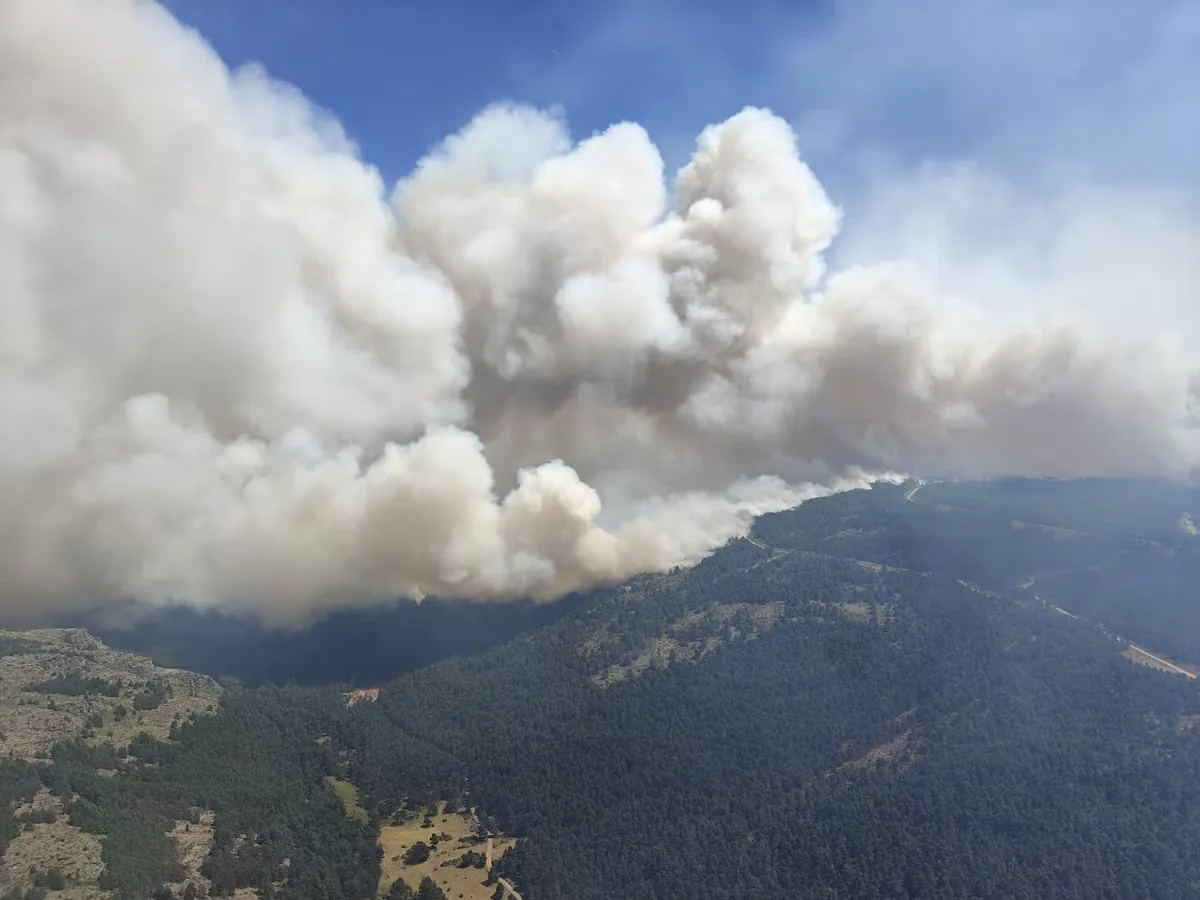
The La Mierla fire (Guadalajara) has burned 29,000 hectares and 34 municipalities have already been evacuated since it started last Thursday. The president of Castilla-La Mancha, the socialist Emiliano García-Page, assured, after his morning meeting at the Cecopi, that the possible return of residents to the evacuated municipalities is already being considered, despite this “not being the number one priority”. “We are starting to see the light beyond the smoke,” he celebrates. According to the latest report from the region’s Forest Fire Prevention and Extinction Service (Infocam), in addition to the 34 evacuated municipalities, 14 remain confined, totaling more than 1,200 affected people.
Read more Burnham announces as a first measure the abolition of VAT on electricity bills
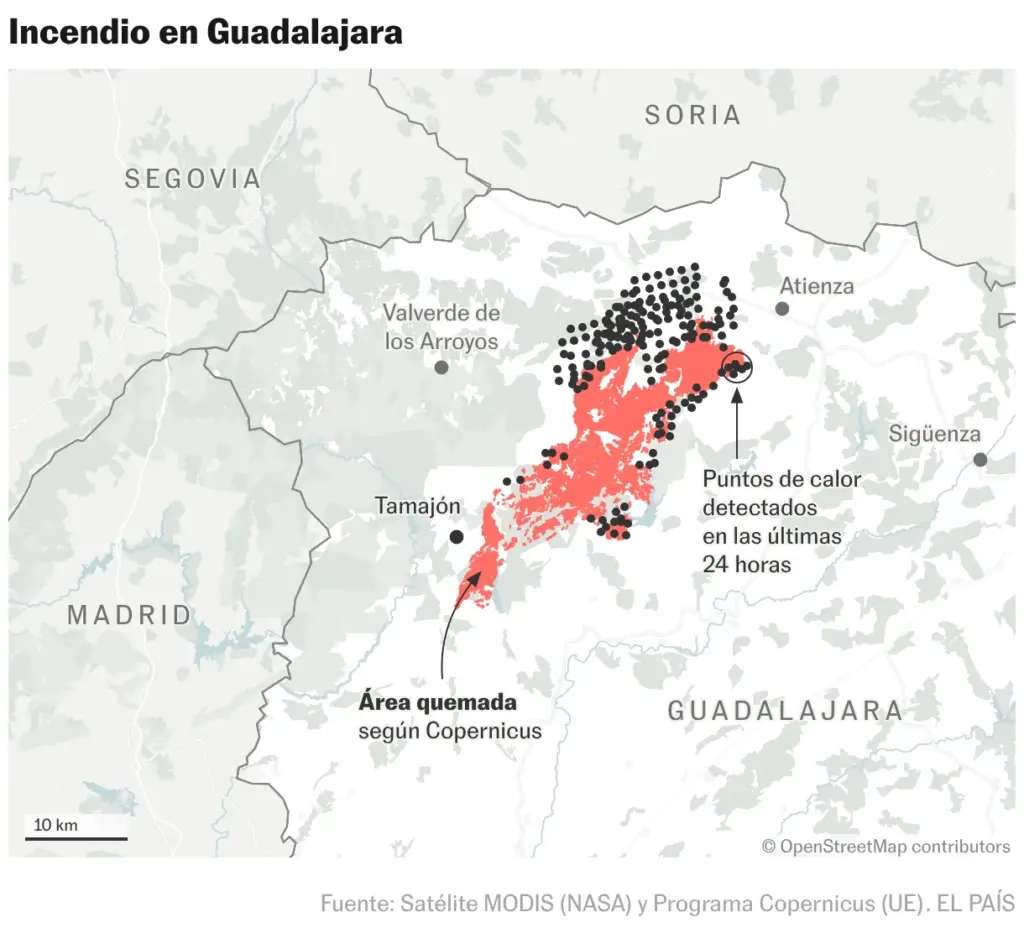
Likewise, the president pointed out that the technicians “practically consider the advance towards Soria to be halted,” and that the objective now is to keep the fire within the perimeter, “to start extinguishing from within.” Despite the optimism, García-Page called for caution: “Without ringing the bells, we are starting to see that more operations are culminating in success.” And he warns that “there can always be accidents or sudden changes in conditions.”
By mid-morning there were 72 ground resources and 394 personnel, and Infocam points out that “during the night, intense work has been carried out with technical fire and heavy machinery to expand defense lines and attack the areas of greatest fire intensity.” The Manchego president highlighted that during the night there was a deployment of 600 operators, “an unprecedented situation,” and pointed out that this is “the largest deployment in the region’s history” in terms of personnel, and “the largest deployment of the UME and aerial resources.” During Monday, there were 29 aerial resources in motion simultaneously.
After his meeting with the technicians, Page assured that “there is a feeling that the major objectives have been met in an orderly fashion.” And he pointed out two priorities: protecting residents and protecting urban centers. Regarding the first, he expressed his satisfaction so far after assessing the complications of saving “so many people in such a vast territory.” The president assured that in the evacuated villages “there were more tourists than residents.”
12:27🎥#IFLaMierla #Guadalajara
We are flying over the area in our helicopters to reconnoiter the work zone beforehand.
This is how the fire is at this hour.
We are #ForestFirefighters #BRIF from @mitecogob pic.twitter.com/Qht04OtHh6Read more The new tobacco law prohibits smoking by minors and doing so on terraces and university campuses
— BRIF TABUYO (@briftabuyo) July 21, 2026
Regarding the protection of urban centers, García-Page justified that, “in recent years, many population centers were seen burned,” and reiterated that the protection of the villages “makes the Sierra Norte fire the most complex to have been operated in recent years in Spain.” In this sense, he assured that the tranquility is “90% regarding the safety of the population centers” and that for this reason, the return of residents to their homes is being considered.
Of the approximately 1,200 evacuees, about 80 are in the shelter set up by the Red Cross in Humanes this Tuesday. They come from a dozen municipalities. “All our plant heritage is going to waste,” explains Eugenio Esteban, mayor of Tamajón, where the Advanced Command Post is located. “People are worried and very down. We are losing what we had, the forest mass,” he says, also concerned about potential water potability problems that could arise when it rains, with the dragging of ashes into the Beleña reservoir, which supplies numerous towns and factories in the Henares Corridor. Esteban implores that the fire does not cross the Sorbe river and spread towards the Pico Ocejón area and threaten the Tejera Negra Beech Forest, an area of extremely high ecological value. “I trust in the technical means and the knowledge they have and dedicate to this,” he maintains when evaluating the fire attack strategy.
Units of #ForestFirefightersCM are being sent to #IFLaMierla in Guadalajara to provide support in what has already become the worst IF in the history of #CastillaLaMancha with 29,000 ha burned at this hour.
— Bomberos Forestales CM (@BBFFMadrid) July 21, 2026
Courage to all and especially to our colleagues from… pic.twitter.com/6KyivhcOnR
The Sierra Norte de Guadalajara region is already thinking about the impact of the fire on its sources of wealth: forest management, extensive livestock farming —which will be severely affected by the burning of pastures— and rural tourism, which is suffering a deluge of cancellations. “I preferred to get ahead and notify people, who give us encouragement and are already looking for dates to come in September or October,” recounts Isabel Bancheraud, owner of an accommodation in Hiendelaencina and president of the Rural Tourism Association of the Sierra Norte de Guadalajara. “It is very possible that the season is lost and autumn remains to be seen. We will have to take stock and see what has been saved and reinforce those micro-destinations that have been saved,” she explains by phone from Algora, re-housed, along with several other people, at a friend’s house. “We are going to recover and repopulate the Sierra. We must be optimistic and resilient, learn from the past to emerge stronger. The people here are strong and fighters,” she warns despite everything.