









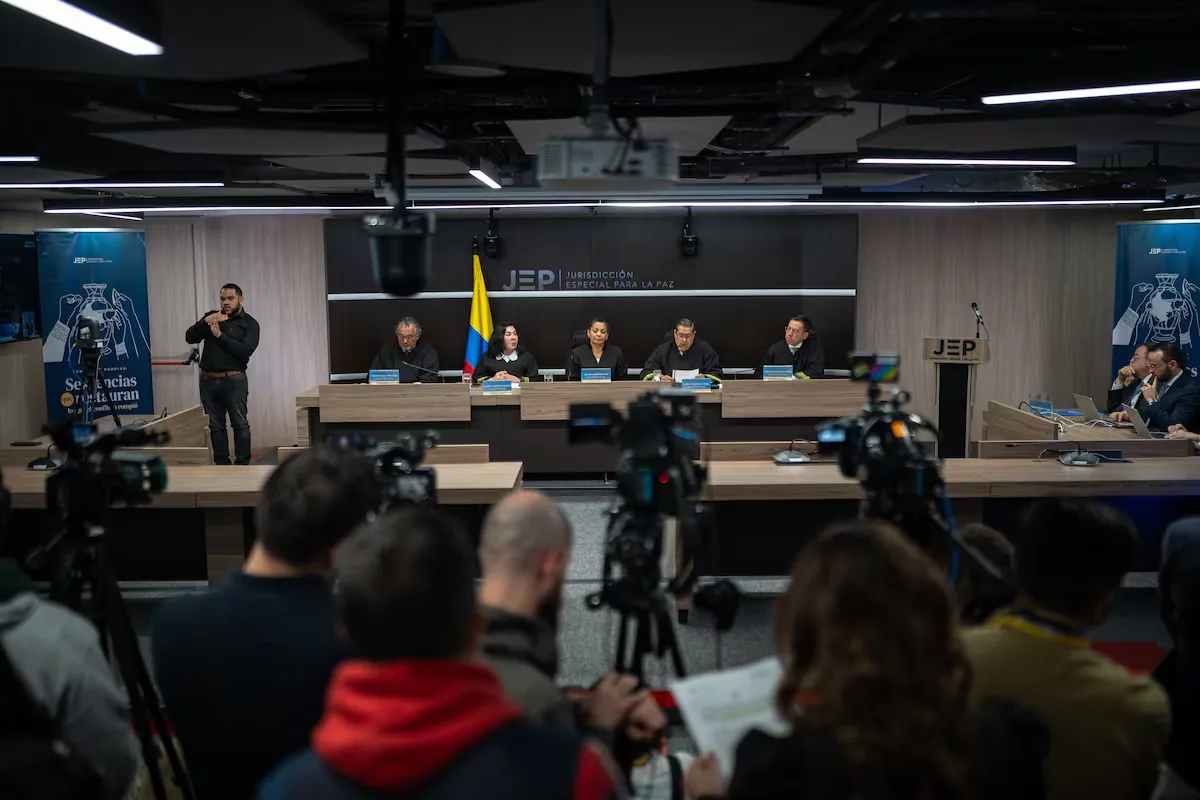
The Special Jurisdiction for Peace (JEP), the transitional justice system created in the 2016 peace agreements, has charged this Tuesday 27 former commanders of the now-defunct Revolutionary Armed Forces of Colombia (FARC) with war crimes and crimes against humanity. The investigated acts include countless forced disappearances, massacres, attacks, forced displacements, torture, and rape in 15 departments of Colombia. The accused belonged to the Southern and Eastern blocs. This is the first charge in macro-case 10, which investigates crimes not addressed in the other specialized processes within the jurisdiction. It is also the first to be made jointly with case 11, focused on gender violence.
Read more Pepe Habichuela dies, titan of flamenco guitar
“It is a milestone because it systematizes a diversity of hundreds and thousands of victim testimonies that had never been seen before,” declared magistrate Catalina Díaz Gómez, president of the Recognition Chamber, during a press conference. The crimes are very varied. Some marked the country’s history, such as the assassination of politician Álvaro Gómez Hurtado in 1995 in Bogotá and the attack on the El Nogal Club in 2003 in the same city. Others hold a lesser place in the national memory, such as the destruction of peasant towns during guerrilla takeovers. The magistrate narrated as an example an attack with a horse bomb in Chita (Boyacá), in which eight people died. “The event left a feeling of terror every time the community saw horses, animals that were part of their daily life,” she recounted.
The accused include four former members of the last FARC Secretariat: Rodrigo Londoño, alias Timochenko; Julián Gallo, known as Carlos Antonio Lozada; Jaime Alberto Marra, whose war names were Mauricio Jaramillo and El Médico; and Milton de Jesús Toncel, alias Joaquín Gómez. The other 23 commanders, meanwhile, had “command and control” over troops from the Eastern and Southern Blocs. Some were part of urban cells that carried out attacks against civilians in cities. Only 5 of the 27 defendants have been in prison for their crimes.
The charges come just three days before the presidential inauguration of far-right Abelardo de la Espriella, who has described the JEP as a court that seeks to “whitewash” the FARC leaders and leave their crimes unpunished. The president of the jurisdiction, Alejandro Ramelli, has refuted these claims without naming the elected president. “I never tire of saying it: the FARC have never been investigated as much as we have done in this jurisdiction, and this order is further proof,” he emphasized. He pointed out that with these new charges, a total of 109 former members of the old FARC have been identified as the main responsible parties. “We continue advancing, deepening investigations into the FARC and the public force,” he highlighted.
Read more Messi donates 80,000 euros for the reconstruction of the Sierra Oeste of Madrid after the fire
Díaz Gómez, for her part, referred to “the panorama of impunity” they inherited six years ago from the ordinary justice system. “In almost 10,000 files from the Prosecutor’s Office, there were convictions in only 3%. In more than 90%, the preliminary stage had not even been passed. The judicial apparatus of the Colombian state was unaware of what crimes had been committed, who the responsible parties were, and under what war logics they had acted,” she emphasized. According to the magistrate, this void was not only due to fear of reporting but also to the inability of ordinary justice to reach isolated territories under the control of armed actors. “As a result, those who waged war were almost never called to account. And when they were, they answered for only a minimal part of the crimes committed.”
As with other JEP charges, the defendants must decide whether to acknowledge these crimes. If they do, they will go to a public hearing where they must assume responsibility “before the victims, justice, and the country,” according to a statement read by magistrate Julieta Lemaitre during the press conference. Afterwards, sanctions will be imposed, such as participation in restorative projects defined by the victims, which so far have included road construction, the creation of memory centers, demining, and tree planting. Defendants who do not acknowledge their crimes will face proceedings in the Investigation and Accusation Unit (UIA), popularly known as the JEP Prosecutor’s Office. “If found responsible, they could face sentences of up to 20 years in prison,” the statement recalls.
The magistrates emphasized that a large part of the 2,436 recognized victims “were forgotten” for decades. “There are many facts in this case, but the cry we have heard with the most compassion and responsibility is that part of Colombia that has been forgotten by news coverage and sometimes by the very memory of what happened in the armed conflict,” said magistrate Lemaitre. Díaz Gómez, meanwhile, recalled a woman who sold meat in Cartagena del Chairá, Caquetá. “Some FARC men raped her and forced her to displace. They told her she did not deserve to live for feeding the Army when it arrived,” she recounted. Although sanctions are still pending, which already exist in two rulings issued by the JEP in the second instance, she hailed the charges as a first step: “Today the Special Jurisdiction for Peace reverses that atrocious legacy of impunity and delivers the most complete judicial radiography of the southern and eastern fronts [of the FARC].”