
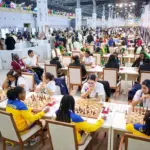







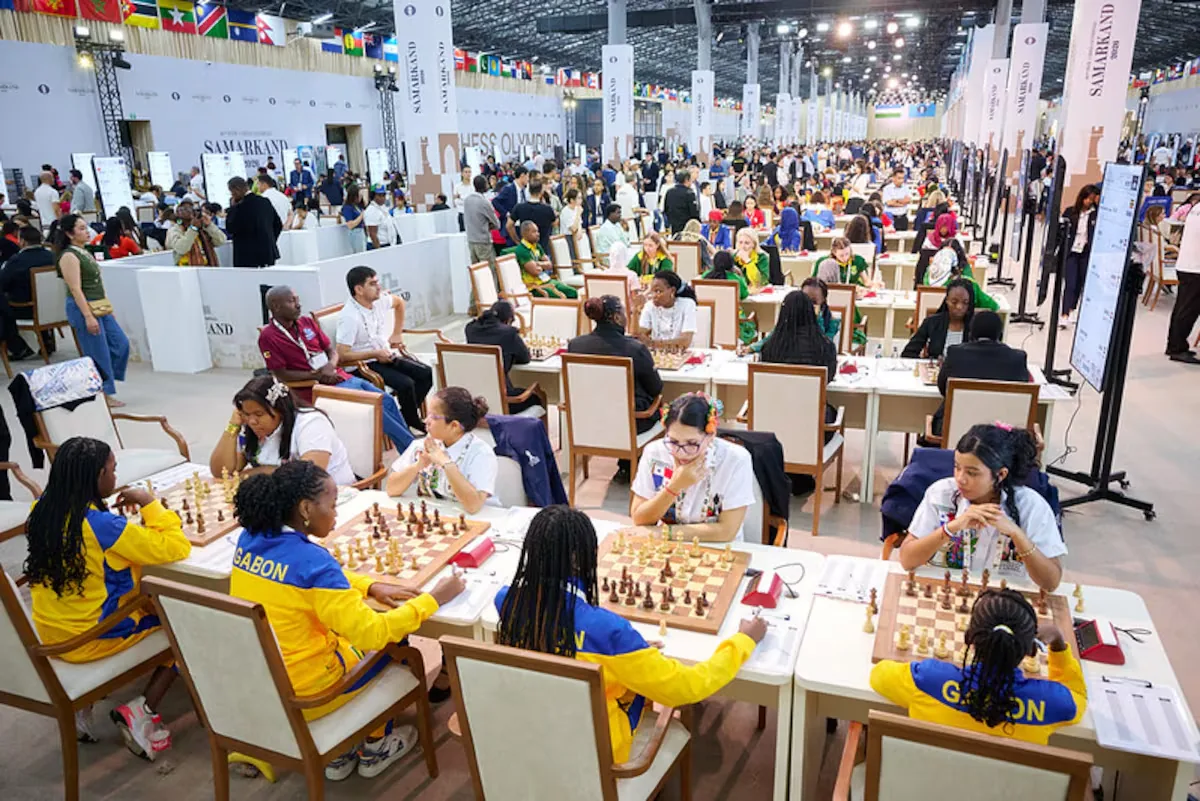
The prodigious Faustino Oro, 12 years old, on Argentina’s first board. Vedant Shetty, 10, on the 4th board for Saint Vincent and the Grenadines. Sayumi Halangoda (11), on the 4th women’s board for Sri Lanka. Eugenio Torre (74), captain of the Philippines after 23 editions as a player. These are some of the characters you can see at the vast Expo Center in Samarkand (Uzbekistan) where the 46th Chess Olympiad began this Monday (the 3rd for people with disabilities closes on Tuesday). The mix of colors (many play in traditional costumes), ages, religions, and ethnicities of about 3,000 people is a great spectacle in itself, beyond the games.
Read more Six Spanish pizzerias among the 100 best in the world
Unlike the Olympic Games, where sports are spread across many venues, at the Chess Olympiad (biennial), everyone is in the same place. “It’s like seeing part of your family once every two years,” describes Francesc Rechi, president of the Andorra Federation, where chess is included in the educational system.
The Uzbek organizers have broken the participation record: 207 teams in the open competition (the host country has three, and there is another refugee team, supported by the International Federation, FIDE) and 191 in the women’s. That is, out of the 206 countries or autonomous territories (like Jersey or the British Virgin Islands or Curaçao or Macau) members of FIDE, all compete except Russia (sanctioned) and Rwanda.
This multitude confirms that chess is in fashion — even in countries where, a few years ago, they barely knew what it was — thanks to the pandemic, the series The Queen’s Gambit (the most watched on Netflix until 2021) and the growing demand for educational chess in schools. But there is an essential nuance to explain why no one is missing: in years of FIDE presidential elections, like this one (with a more intense electoral campaign than ever), many developing countries receive aid to cover their travel costs. To the players (four starters and one substitute on each team) and captains must be added referees, journalists, influencers, delegates and other officials, businessmen, exhibitors, and companions, exceeding 3,000 people.
Among that crowd, many find peace in Samarkand, fleeing the horror lived in their land: Palestinians, Ukrainians, South Sudanese, Haitians, Afghans (where chess is banned)… Other countries are very difficult to locate on a map, except for geography enthusiasts: Palau, Brunei, Kiribati, Eswatini (formerly Swaziland), Marshall Islands… Fortunately for many, the Government of Uzbekistan has been much more generous than Hungary’s under Prime Minister Orban two years ago, which denied visas to many countries.
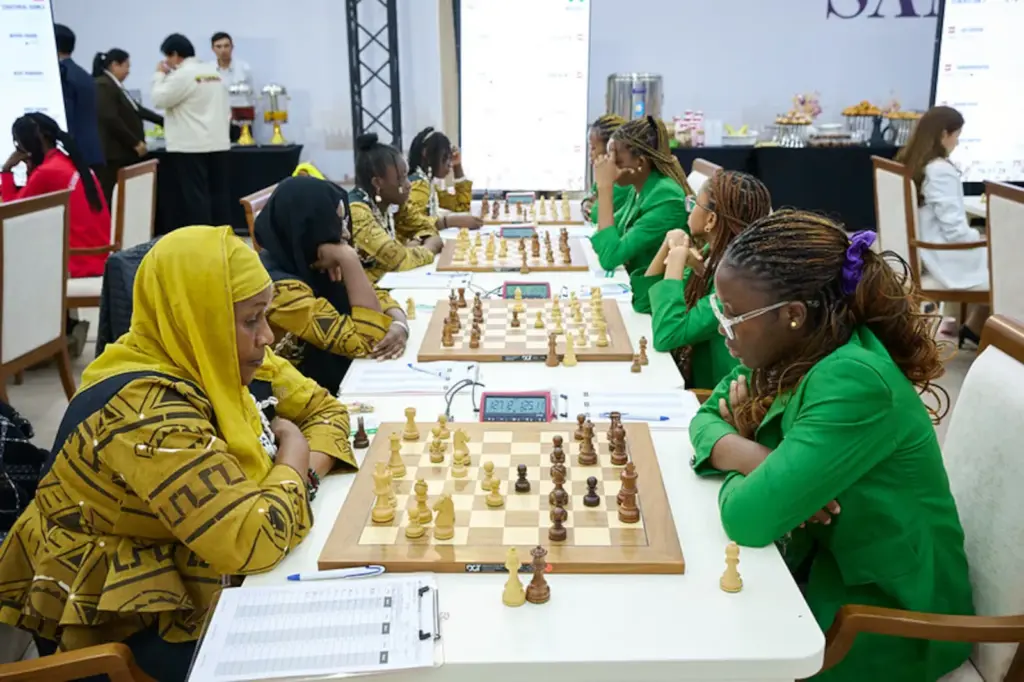
For most, the Olympiad is a permanent party, morning, afternoon, and night. But no fewer than 30 open teams (and about 20 women’s) are made up of professional players, who fight for medals or a position that satisfies the sports leaders of their countries. For them, mornings are for preparing the game, afternoons for playing it, and nights for analyzing it, with very little room for relaxation.
With Russia absent, the fight for the podium should theoretically be among the USA, India, Uzbekistan, and China; among women, six teams stand out: India, Georgia, Kazakhstan, China, USA, and Ukraine. Spain (13th in the initial open list and 19th in the women’s) could break into the top ten if their performance is splendid.
There are also focuses on the individual performance of some stars. Besides Faustino Oro, who recently became the second youngest grandmaster in history, the result of the world champion, the Indian Dommaraju Gukesh, 20 years old, will be scrutinized, in acute crisis since he won the title, two months before defending it against the Uzbek Yavojir Sindarov, of the same age.
Meanwhile, a minority of those present live dedicated to the FIDE elections, with their political background, corridor intrigues, negotiations, well-founded suspicions of bribery, and covert wars. Some of those officials, obsessed with their arduous work, did not even enjoy the lavish — and probably expensive — opening ceremony on Tuesday in a gigantic open-air theater with two stages, two orchestras, elite singers, many dancers, fireworks, and paraphernalia everywhere. For everyone else, that display of light and sound in a country where chess is very important is just the beginning of a biennial two-week party that no one wants to miss.
Read more This is the «magical world» of Shakira in Madrid, to the greater glory of the singer