








The dismissal of the 22 members of the National Science Board by the Donald Trump administration is an “unprecedented” event, Yolanda Gil, one of the dismissed board members, explains to this newspaper. Gil, born in Madrid 63 years ago and with a fruitful scientific career in the United States, confirms that all panel members were dismissed with “immediate” effect last Friday by email, without explanation of the reasons.
This scientist from the University of Southern California believes the timing is not coincidental. The Board “was scheduled to meet in person next week, and we were conducting the final votes to publish the critical report on the 2026 Science and Engineering Indicators,” she details.
The document in question is an analysis of United States research and development spending and its comparison with other countries. According to two board members who spoke to this newspaper, the 2026 report warned of the growing gap in this field between the United States, whose commitment is declining, and China, which continues to grow.
The superiority of the United States over China is one of the issues that most obsesses Trump and the rest of his administration. The president has launched a large million-dollar project to try to beat the Asian giant in artificial intelligence and quantum computing, but the results are still very uncertain. It is also a national priority—both civilian and military—to reach the Moon with astronauts before China does. These are the few projects with some scientific and technological component that Trump has spared from cuts. Since his second term as president, the magnate has tried to impose the worst cuts in research and science the country has seen since World War II. The first blow was overturned by Congress, which forced him to maintain funding for the main research agencies. The second is still unresolved.
One of the government entities most attacked by Trump is precisely the National Science Foundation (NSF). This independent agency was founded in 1950 to channel public research in peacetime, avoiding interference from the government in power. Since then, it has become the main funder of basic science in the country. Its grants have supported the work of more than 270 Nobel laureates and enabled the development of fundamental inventions such as magnetic resonance imaging, artificial intelligence, and gene editing, among others. A study estimates that this is due to public investment in research, a field in which the country has traditionally been the most advanced in the world. But some studies estimate that China could surpass it in just two years.
Since Trump came to power, the agency has lost 30% of its staff. For the second consecutive year, the government wants to cut its budget, about 9 billion dollars, in half. The National Science Board is the collegial body responsible for governing the NSF and preparing its budgets. Some of the dismissed members now wonder if they were fired precisely to remove that authority.
“I think this is another sign of the profound changes the administration has in mind for the NSF,” Gil argues. “For the second consecutive year, the White House has proposed drastic budget cuts. Since this agency funds most basic research in science and engineering, and given its emphasis on student training, this indicates that these are not priorities for this administration. In recent months, there have been significant staff reductions at the NSF, which jeopardizes the peer review process for which the agency is best known and gives more decision-making power to program directors. The White House has nominated Jim O’Neill as NSF director. Traditionally, directors of this agency have had a strong research background and deep knowledge of the agency’s processes, while O’Neill’s experience is in finance and investments,” Gil highlights.
Gil explains that the government already dismissed “all the Advisory Committees of each NSF division months ago. Now the 22 members of the Board fall, whose task is also to advise the government and Congress on science and innovation issues, but whose members are appointed by the sitting president. Gil was appointed by Joseph Biden in 2025 and was theoretically supposed to serve until 2030. After the dismissal, “we don’t know what the plans are,” she admits.
The National Science Board, whose 22 members were appointed by presidents from among people with brilliant careers in the country’s academic and business worlds, was one of the main independent advisory bodies to the United States Congress and the White House on science issues.
Read more United States prepares for a long blockade of Hormuz
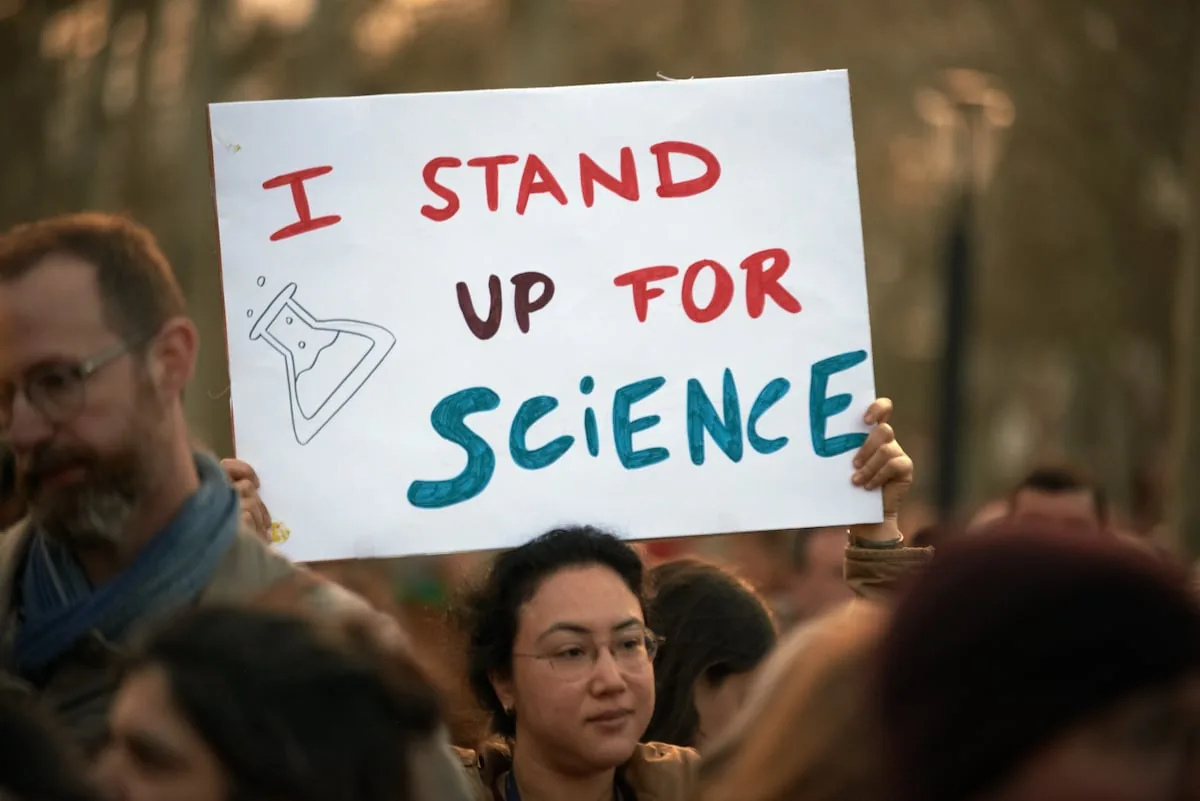
The mass dismissal of the Board has been criticized by some of the country’s leading scientific organizations. “This move, combined with other seemingly indiscriminate but momentous decisions, reinforces the following message: The United States is relinquishing its position as a world leader in science, technology, and innovation. We cannot allow this to happen,” said Sudip Parikh, CEO of the American Association for the Advancement of Science, the world’s largest scientific society and publisher of the prestigious journal Science, in a statement. The country’s Chemical Society, with more than 150,000 members, has warned of the government’s “trend” to eliminate independent advisory oversight bodies, “essential” for the country’s scientific leadership.
Roger Beachy, another board member and emeritus researcher at Washington University in St. Louis, believes that with this move, Trump is trying to exert more control over an agency theoretically shielded from government interference to guarantee research progress.
“This may be a first step to replace a nonpartisan and conflict-free board with another with its own agenda, oriented toward short-term achievable results, rather than fulfilling the mandate to support basic and undirected research, which can lead to unexpected advances that generate new economies and benefits for society,” Beachy states in an email exchange. “It is not unusual for this administration to establish boards closely linked philosophically, politically, or financially to a predefined agenda,” he adds.
Beachy confirms, in an email exchange, that the Board was finalizing a “two-page report to summarize the findings of a statistical unit of the agency, which describes in more detail the growing funding gap for research between the United States and China.” “It is important to recognize that private companies in various sectors also conduct research, which can complement the efforts of agencies like the NSF. Since that research is oriented toward each company’s goals, it is important that federal support for research on new ideas and concepts be part of the scientific ecosystem, much of which originates in universities and independent research institutes.”
Keivan Stassun, professor of physics and astronomy at the University of Connecticut and dismissed board member, explains that this sudden purge does not surprise him too much. “Judging by similar actions by the administration across the federal government, especially regarding scientific research, it seemed only a matter of time before we were fired,” he confesses. “Still,” he adds, “it is a huge disappointment.”
Stassun believes this move is much more dangerous than it seems. “The administration has been quite clear in the president’s budget requests, particularly in decimating the NSF budget. The intention is to dismantle investments in basic research and in training the next generation of scientists and engineers for our nation. Without a governing and oversight board established by Congress to stand in the way, it now seems inevitable that this will happen,” he laments.
The board members are relying on what may happen in the House of Representatives and the Senate, where both Republicans and Democrats have so far blocked many of the government’s attacks on basic science. “I hope Congress gets involved and affirms the independence of the [National Science] Board,” Beachy confesses.
Read more Microsoft earns 31% more in nine months with the market on edge due to the AI boom