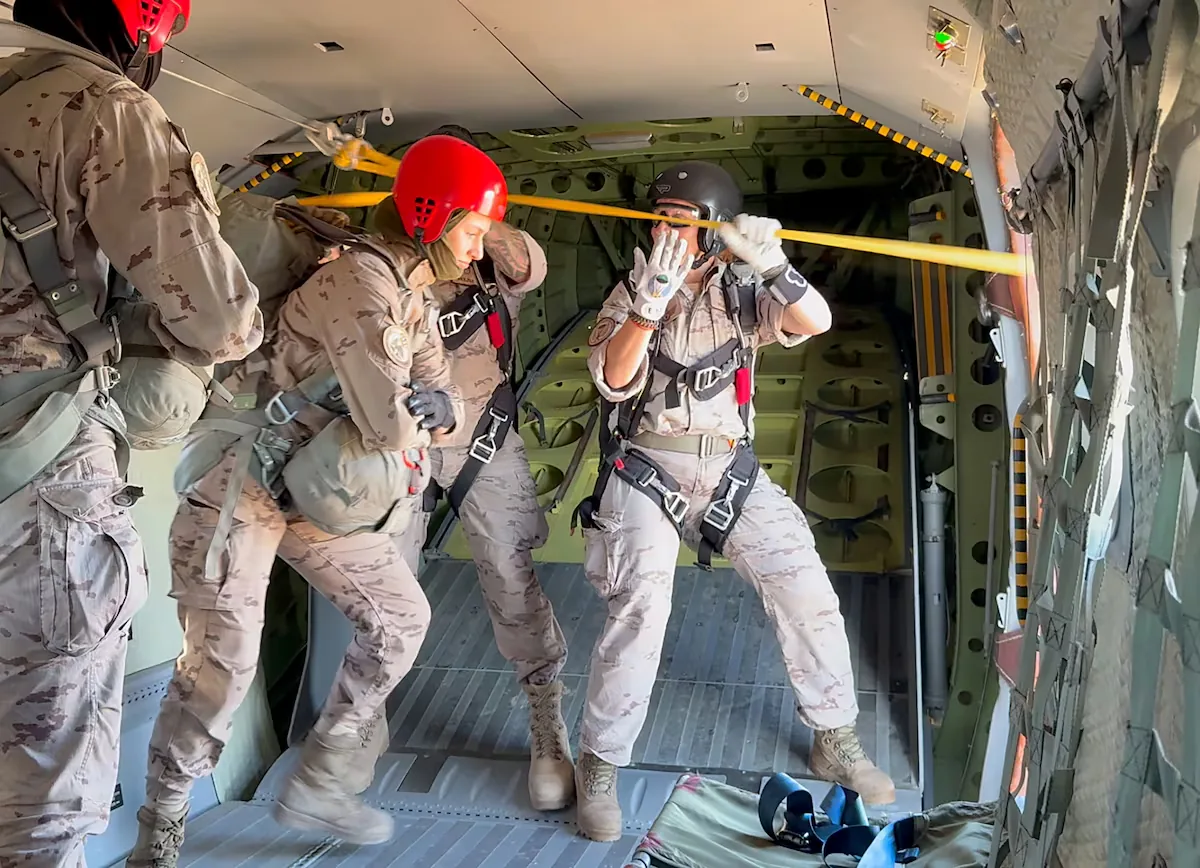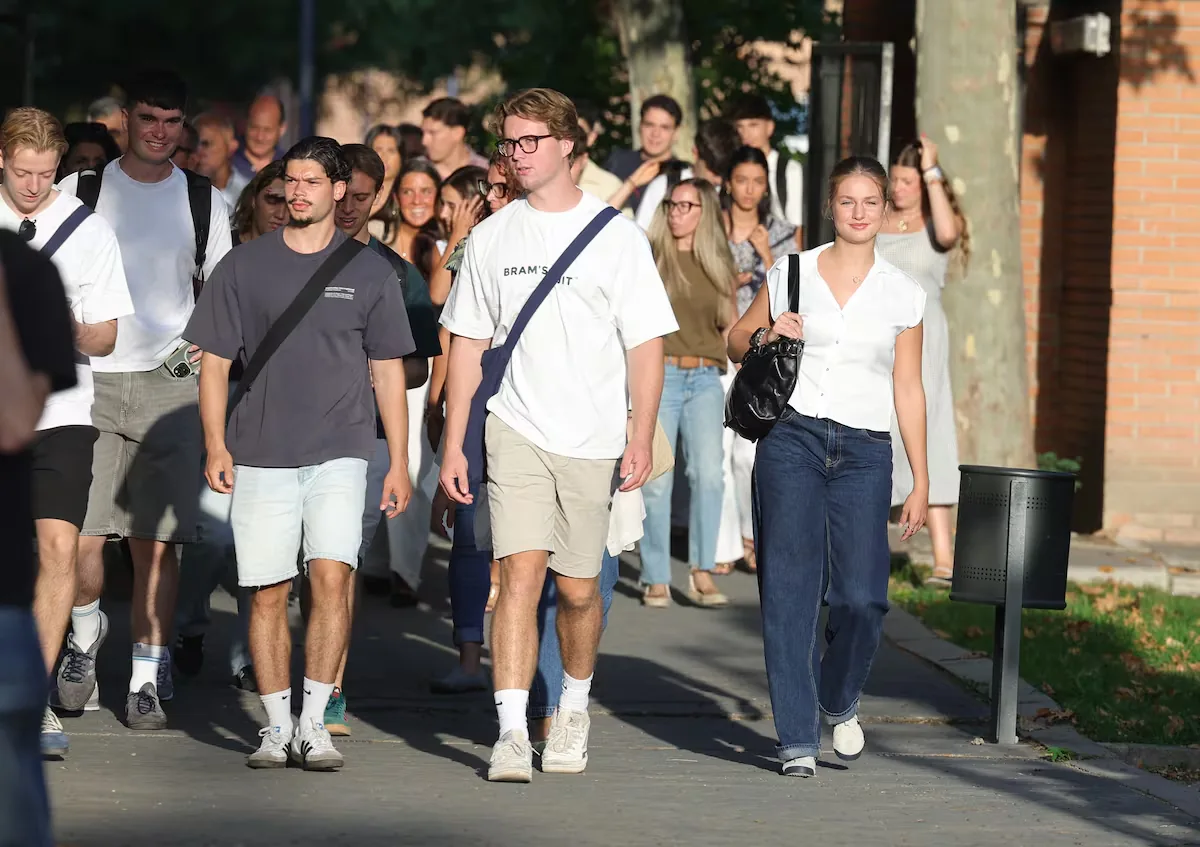
The Royal Household wanted to portray the Princess of Asturias’s first day as a university student with complete normality, though they only partially succeeded. A flood of journalists and cameras from over 50 media outlets followed Leonor de Borbón Ortiz’s steps to the door of building 9, her classroom, at Carlos III University in Madrid. The press had been warned that they could not cross it to preserve her privacy and that of the other students. For the next four years, after three years of training in the Armed Forces, she will study for a degree in Political Science, seemingly without the privileges that were formulated for the current King at the Autonomous University of Madrid (1988-1993), and which this newspaper reported on in his first days of class.
The Princess entered 10 minutes before classes began and greeted the rector Ángel Arias, the Vice-Rector for Students, Pilar Otero, and the Dean of Social and Legal Sciences, Antonio Descalzo. She conveyed to them that she was excited and eager to meet her classmates. She did not stop to speak with the media, to whom she only said she was “very eager.” Her presence did not cause much excitement on campus, neither among students ―the last to arrive, especially foreigners, gathered around― nor among staff. Only timid applause and a few “beautiful” comments were heard. About 200 students awaited her father on his first day, and the press was allowed into the classroom.
The new student had never before set foot on the campus ―her father had on repeated occasions― which resembles American ones, with lawns and discreet buildings, although nestled in a commuter town in the Madrid belt. And it was she who had the final say in choosing a degree that had to align with her training as a future queen.
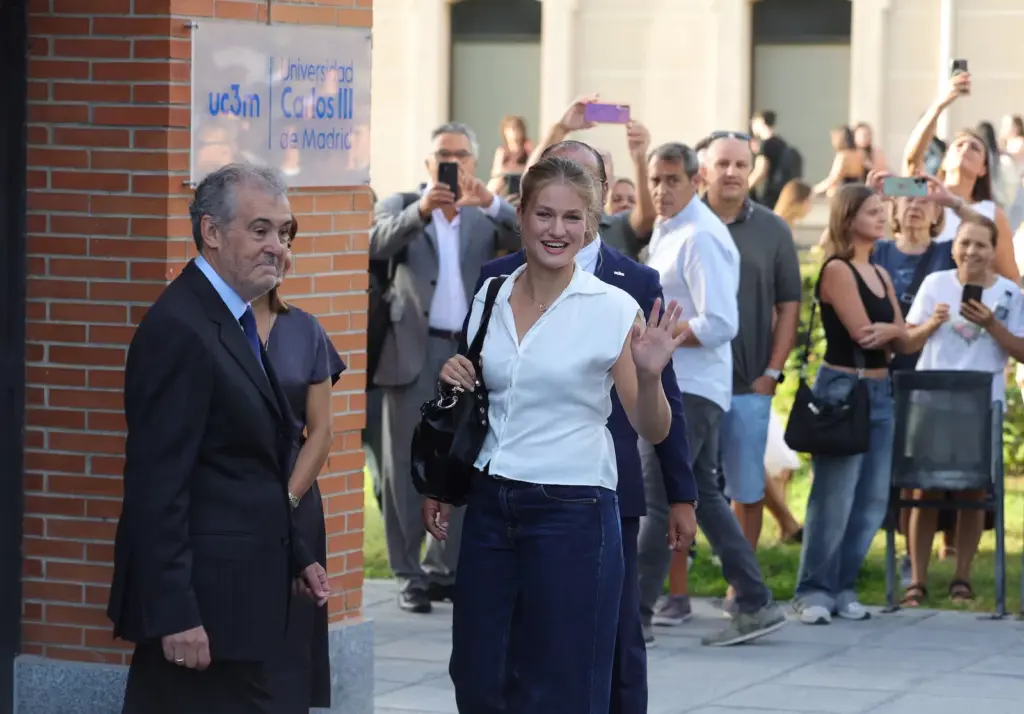
“The Royal Household has made it very easy for us. Nothing changes,” assures the relieved rector, who avoids going into details with this newspaper. Last Wednesday, he gathered the degree’s professors to address their concerns and wanted to reassure them. Everything, he asserts, “remains the same.”
On paper, the department maintains the same teaching and evaluation methods as last year, in the same classroom and with the calendar and schedules set by the Governing Council months ago. This was even before the Royal Household announced in April that the Princess had entered the program before the university entrance exam through Early Admission. This system reserves up to 8% of places for those who have completed their Baccalaureate abroad. Like her father, who studied COU in Canada, she did not take the PAU (University Entrance Exam), as most of her diligent classmates did. This fact, which complies with regulations, makes some of the public uncomfortable, as it means entering a highly demanded degree without competing in a common exam.
Rector Arias denies that any teachers have put themselves forward to teach or that others have expressed a desire to step aside, although he admits that there was some “unease” among the faculty regarding how to treat or evaluate the Princess. The well-known political scientist Pablo Simón admitted this Sunday in this newspaper that he was somewhat nervous or expectant before becoming the heir’s professor of Fundamentals of Political Science, though also proud of her choice.
While some media outlets take it for granted that a jurist will act as a tutor ―the King had one, Aurelio Menéndez, his Commercial Law professor at the Autonomous University of Madrid and former Minister of Education―, others report the opposite. Arias does not clear up doubts: “That information did not come from us.”
The Crown has opted for a young (37 years old) and innovative center, repeating the formula of the Autónoma, which was then 20 years old. But that’s where the similarities end. UC3M and the Crown have not configured a specific educational itinerary for Leonor de Borbón Ortiz, as happened with her father when he graduated in Law (1988-1993) with an economics complement. Although the Princess will receive separate lessons in constitutional law, which is barely studied. The tuition for the entire degree will cost 4,000 euros if she does not fail.
The Royal Household has expressed its interest in not disrupting the usual rhythm of UC3M. There have been no disturbances at the entrance and few prior criticisms, such as those from the student movements Contracorriente and Pan y Rosas in a video circulated on social media: “It seems that Princess Leonor has fallen from the sky [to UC3M]. Now they will have the prestige of royalty and an excuse to multiply security and with it, repression.”
The Princess’s enrollment was handled with such discretion that the rector personally delivered her application to avoid speculation, and his team did not learn of the news until half an hour before the Royal Household made it public. Leonor’s decision is met with pride on a campus with a lot of extracurricular activity ―41% of young people belong to a cultural, political, or sports association― precisely at a time of intense debate about alarming absenteeism in university classrooms after the pandemic.
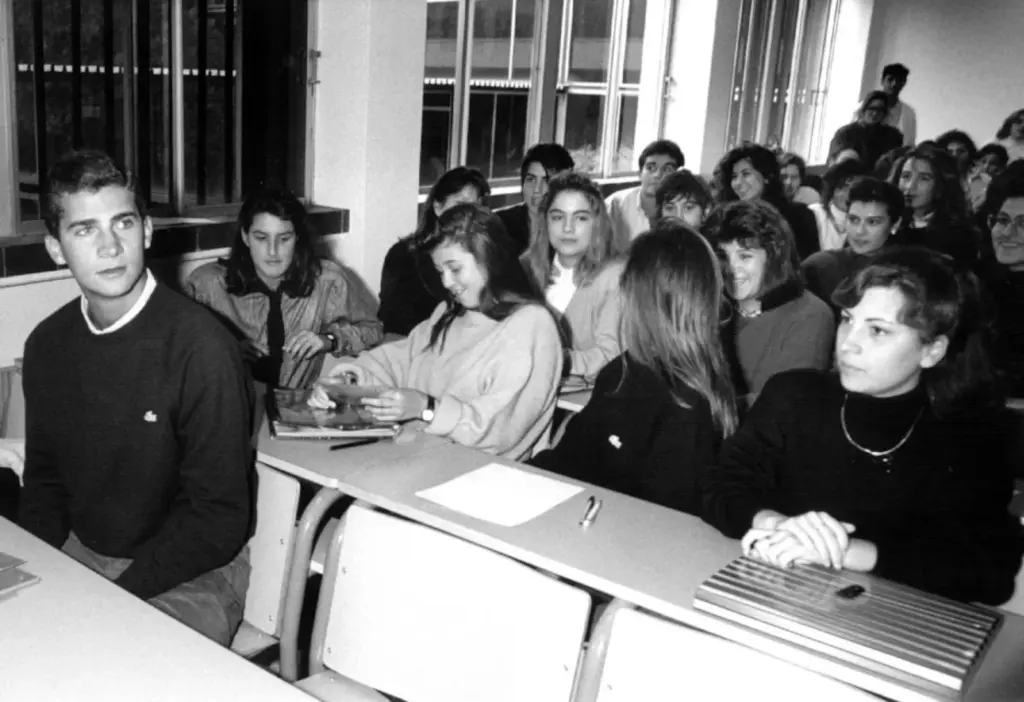
The Princess, who will have classes from nine to two in the afternoon except on Thursdays when she will have seminars, enters an academic scenario very different from what her father experienced. In 1988, personalized attention to students was not contemplated, so, in theory, the prince was going to share a classroom with 150 classmates. But, in practice, in two of the four first-year Law subjects, he did not receive lectures but attended a “seminar” with a group of 30 students chosen by the dean from among those with the best academic records (there was no grade competition; merely passing the Selectividad was almost enough). Leonor’s classmates, on the other hand, have indeed demonstrated their great worth in the PAU.
“Five out of seven students consulted before the Prince entered the first seminar yesterday had completed their Baccalaureate and COU studies in private schools. The other two came from public high schools,” reported EL PAÍS journalist Esteban Barcia in his chronicle on October 18, 1988. This informal survey suggests that the King was mainly surrounded by upper-middle-class classmates.
Read more An uphill week for Ayuso due to the penthouse crisis awaiting a power move
Renowned professors were encouraged in 1988 to teach the now King. “History of Law classes will be led by Francisco Tomás y Valiente, a professor at the Autónoma and currently on special leave due to his position as president of the Constitutional Court,” Barcia reported in this newspaper.
Now, the objective cut-off grade for the degree ―10.7 in this edition, more than a point above last year’s minimum― is what has selected students from very diverse backgrounds. 30% of the university students at this institution have a state or university scholarship, and the percentage of foreign students (close to 30%) far exceeds the average for the public network.
There are only two Political Science groups, one in Spanish ―the heir’s― and one in English. In two of the six subjects, her group will join another group of 40 International Relations students to encourage socialization. She would not choose electives until her fourth year, and since last year, she has been able to do voluntary internships.
The number of students, 40, typical of a Baccalaureate group, is lower than that concentrated in many large generalist universities. Their rectors ironize about this exclusivity that allows them to know the student well: “They treat them like in a school.”
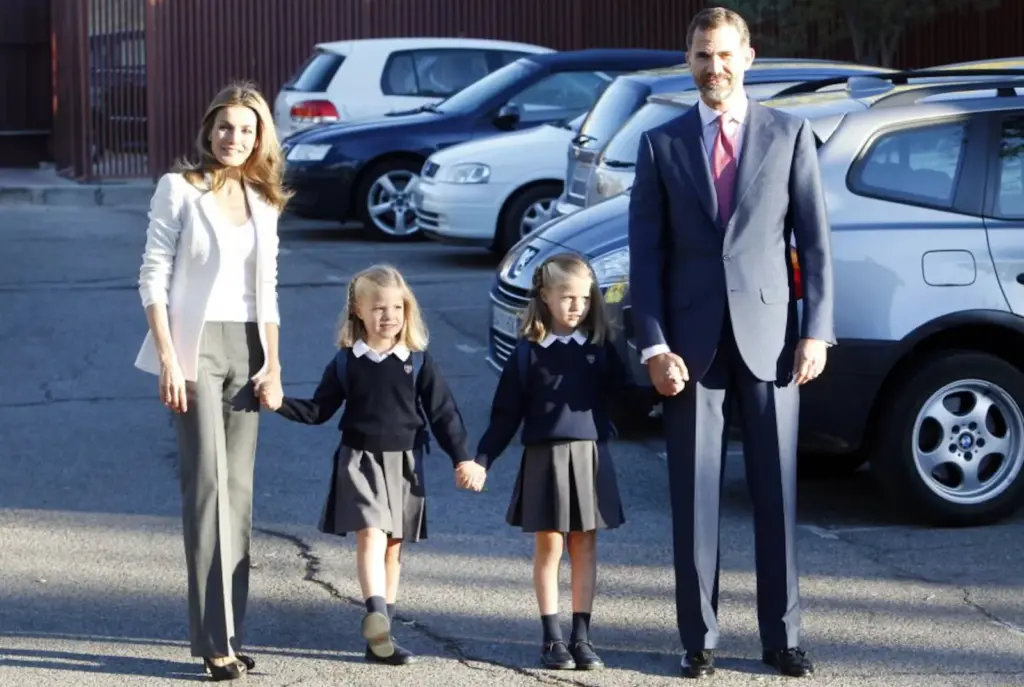
The Princess has only studied in private centers so far, from ages three to 17. But neither the Crown nor the rectors ever doubted that the Princess would enroll in a public center like her parents, unlike her sister Sofía, who will rotate through Europe (Lisbon, Paris, and Berlin) for three years while studying Political Science and International Relations at the private Forward College in the United Kingdom. The tuition alone costs the Kings 18,500 euros annually. They will also pay the Princess’s tuition.
In Norway, the Royal Household follows an identical pattern: Ingrid, the heir, connects with society by studying at public universities (Oslo and Sydney), while her brother, Sverre Magnus, has enrolled in the same college as Infanta Sofía. It is the latter who remain in the bubble of private education.
It is unknown if Leonor will enjoy an international academic stay. It’s a hallmark of the institution. 51% of students reside abroad for a period thanks to UC3M having signed 1,000 agreements with 490 universities in 80 countries. 3,600 annual mobilities are offered. “Families know that with a tuition fee of 1,000 euros, their child can go to a university in the United States that costs 40,000 dollars,” the rector proudly states. The substantial money contributed to its coffers by foreign students who stay in Madrid is reinvested in mobility scholarships.
The symbolic value of public education
This first day of class holds a symbolic value unthinkable a few years ago. The heir is entering one of Spain’s 50 public universities ―none have been inaugurated since 1998― in the academic year when private campuses (49) could become the majority. The Extremaduran Parliament is pending approval of a private center, and the Community of Madrid has three on the table..
The Princess arrives at a calm campus after last year’s strike and protests, which forced Isabel Díaz Ayuso’s government to close a funding agreement with its rectors that still fails to place Madrid, the richest region, at the forefront of university investment. Transfers per student at UC3M were 5,362 euros in 2025, according to an analysis by the CYD Foundation, compared to over 10,000 euros in Cantabria or the Valencian Community. Fortunately, its great capacity to attract external funds partly disguises its fundamental shortcomings.
The ravages of scarcity are evident in buildings approaching four decades old. That’s why UC3M is now focusing its efforts on their rejuvenation. These weeks, for example, it is renovating the roof of the library the Princess will attend. Arias denies that it is being prepared for the royal presence: “These were already planned works.”
Chance has it that the first professor to teach the heir this Monday is Rafael de Asís, the first disciple at the university of Gregorio Peces-Barba, its founder. As President of Congress, the latter led the act in 1986 where the then Prince swore the Constitution. Today, say those who knew him, Peces-Barba, now deceased, would be thrilled by the Princess’s entry into the project he fought for so much for 18 years.
Read more The PP and Vox surpass 50% of the vote for the first time amid the Ceuta crisis