









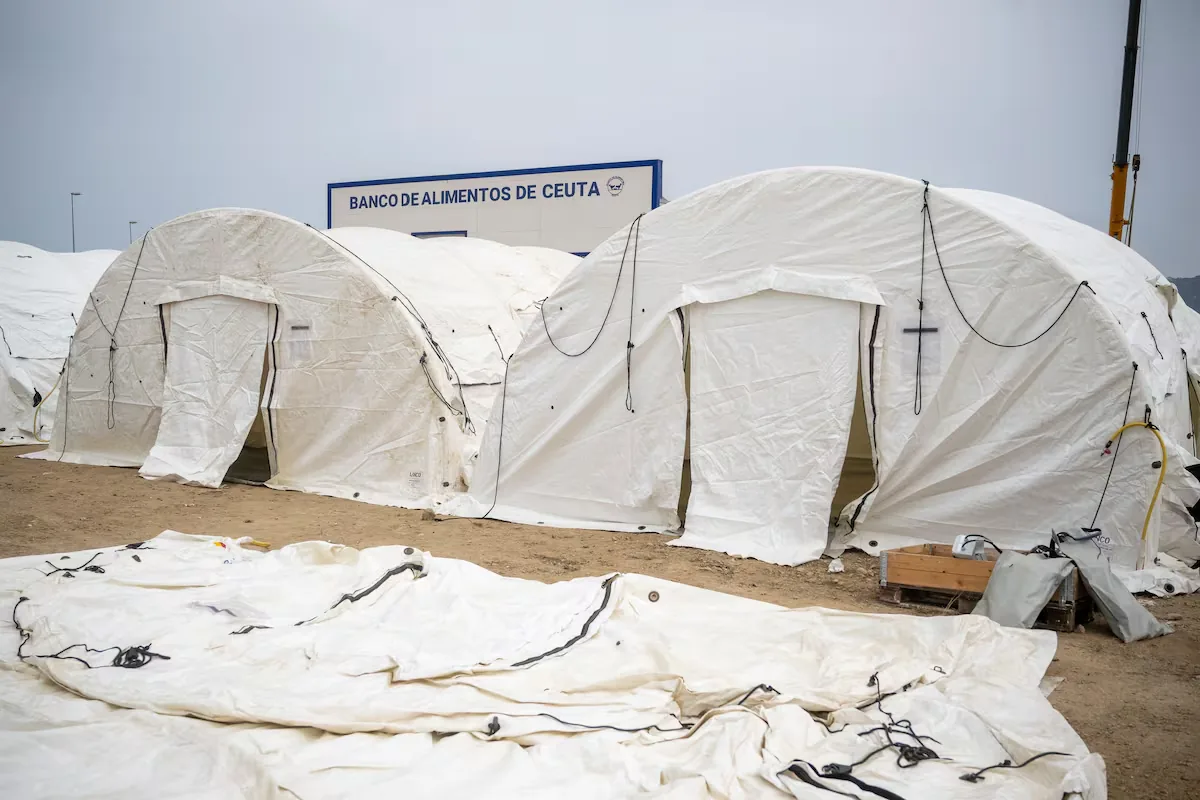
Hours after the Government took control of the port of Ceuta, the vast esplanade where the new facility for migrants will be located is a picture of urgency: excavators, trucks, construction shovels, and cranes. Three dozen workers are working on the two new locations situated on two enormous publicly owned esplanades, and they claim to be unaware of the institutional clash: “At this pace, it will be ready by Monday,” says Yasser, a worker placing the rods that will support the white tents that will house 1,000 people. He works on the smaller esplanade, the one adjacent to the food bank. On the other, things are moving slower and the infrastructure has not yet begun to be deployed. Both are located in the port’s industrial area and around them there are only dealerships, logistics warehouses, or port supply buildings. The last shops and supermarkets are in front of the ferry that connects the city with Algeciras, more than a kilometer away. Next to the tents, two giant fuel tanks for ships.
Read more Two federal police officers die in an armed attack while investigating a kidnapping in Veracruz
In the distance, the hills of the apartment blocks of two neighborhoods, Parques de Ceuta and Junta Obras del Puerto, can be seen, a fifteen-minute walk from a light crossing. It is, by far, the most isolated location of all those built to respond to the emergency, and close to population centers with higher per capita incomes than Loma Colmenar, El Tarajal, or La Hípica, where the other migrant facilities are located.
“It will be more isolated, but we refuse its construction. We don’t want them here, there are shops and schools nearby, and the continuous passage of the invaders is going to cause many problems,” says Raúl Fernández, president of the Vecinos del Puerto association. On Friday, neighborhood associations met with the City Council to express their rejection of the construction, but according to Fernández, “although they gave us their support because they understand us, they told us that with the single command they couldn’t do anything. That the government had said it would be built and they couldn’t stop it.” Throughout the week, the neighbors have marched along the docks in protest demonstrations, and although they announce they will continue doing so, discouragement is beginning to spread. “They say it’s temporary, but who knows how long we’ll have all those people there,” continues Raúl Fernández. According to the terms, the lease is dated until December 31, and it is non-extendable. “Three months is a very long time, they can’t live with us, we’ve already seen the problems they have caused in other places like Loma Colmenar, we don’t want that here,” insists the neighborhood spokesperson. The solution he proposes is blunt: “Simple, send them all back to Morocco.”
Read more The migration crisis stirs up elections that the people were turning their backs on in Morocco
The Port’s Board of Directors rejected the construction by 11 votes against and 4 in favor, and that is what the neighborhoods of Parques de Ceuta and Junta Obras del Puerto cling to. “It is unheard of that this is an imposition and that it is done without taking into account the voice of those of us who live here, those who will have to deal with it,” he insists. Fernández refers to the other gatherings the city is experiencing due to the establishment of these centers, such as the one in the Los Rosales neighborhood. “They also don’t want this space set up next to a nursery, and it seems no one listens to us. On top of that, people are already tired and we can’t be protesting every day, because fewer and fewer people show up,” he confesses. Late in the afternoon, about a hundred people gathered at the Poniente dock, walking the path to the tents with chants like “Ceuta is not a CETI,” “invaders expulsion,” and “Óscar Puente, delinquent.” Dressed with Spanish and Ceutan flags, the protesters also directed slogans at the police guarding the facility (“Police, to the border”) and at the workers (“traitors”). “Look, here they will have the chalets, they should also install air conditioning,” a neighbor snapped, passing by the pallets of metal beams.
Meanwhile, migrants who have been sleeping outside the other centers for days waiting for a spot receive the news of a new location with hope. They comment among themselves that it is far, and show each other the map of the area on their mobile phones. They zoom in and explore the area digitally. They don’t even know if they will be the ones to occupy those tents, because the Ministry of Inclusion has not yet revealed which specific groups will be assigned the new spots, but they don’t care. It is a possibility, and overall it is more than they had yesterday. The same happens in peripheral neighborhoods like El Príncipe, where improvised camps have been housing migrants for over a month with the solidarity of the neighbors. They are beginning to feel some relief, slow and still cautious, but evident.
Read more The invisible crisis: when the grade is a false positive