Six months have passed since the start of the war in Iran and nothing suggests a quick solution. The US has just announced economic reprisals against those who trade with Tehran, which will further complicate energy supply through the Strait of Hormuz. Summer is passing and Europe is not carrying out the usual natural gas storage work typical of this time of year. The shortage of supply from the Middle East has taken its toll and the level of reserves across the EU is the lowest at this time of year since 2009, at 63%, while gas operators are already warning that time is working against them. The great risk is supply cuts when winter arrives, a scenario that is not currently considered the most likely but does not allow for lowering the guard: the price of natural gas in Europe is at its highest since January 2023 and has risen 14% in August, reaching 68 euros per megawatt/hour this Monday. Thus, the extension of the Hormuz closure maintains tension over its cost, worsens competition between Europe and Asia for supply, and threatens to make the electricity bill more expensive for Europeans in the coming months.
Europe cannot afford to spend the summer like the grasshopper in the fable; it is necessary to stockpile natural gas reserves for when winter arrives and heating use spikes consumption, beyond the usual demand required by industry. But the shortage of supply from the Middle East and the rising cost of natural gas, which has increased by 110% since the start of the war in Iran, have slowed this storage work in summer to levels that are beginning to be worrying, at least compared to recent years. The current level of natural gas reserves in the EU, at 63%, is considerably lower than the 80% average of the last five years and below last year’s 75% at this time, according to data from Gas Infrastructure Europe (GIE), the association of gas infrastructure operators in Europe.
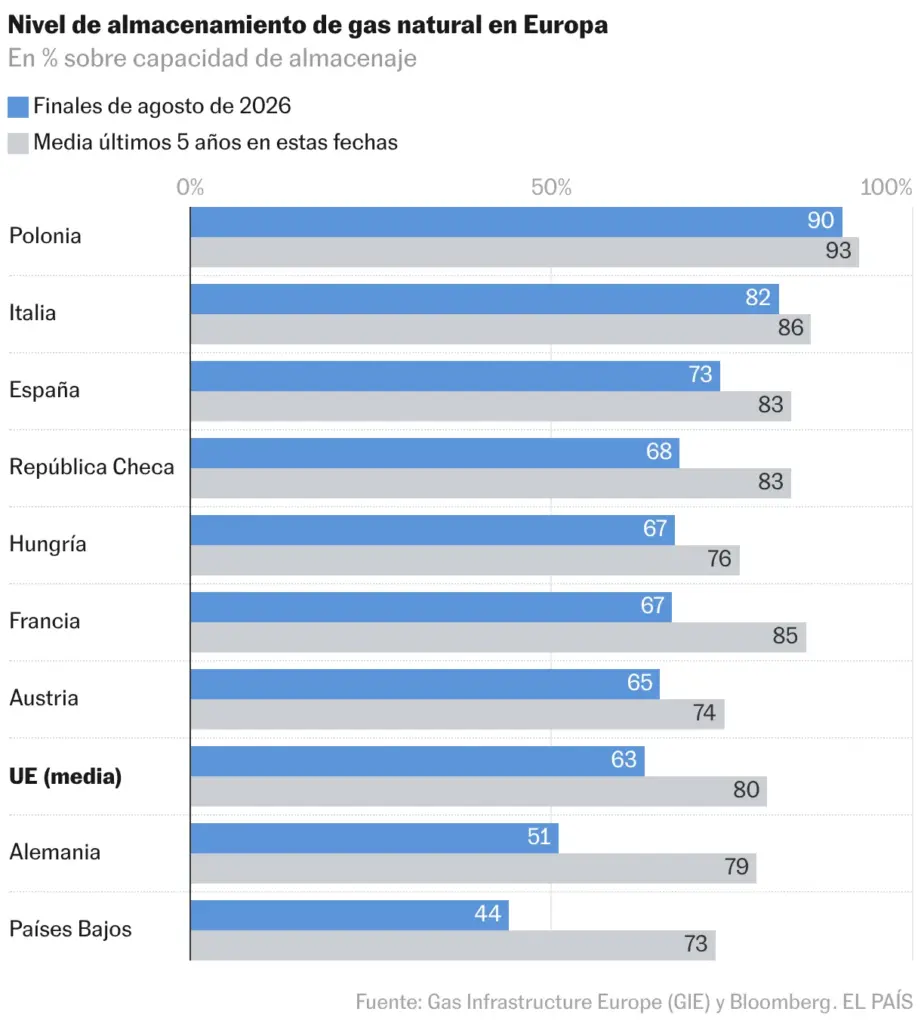
The difference is especially notable in countries like Germany, the European country with the greatest storage capacity and where reserves are at 51% capacity, compared to the 78.5% average of the last five years. Looking back five years is no coincidence since 2022, the year of the outbreak of the war in Ukraine and the cut-off of Russian gas supply, marked a before and after in the EU’s energy strategy, which has since been drastically reducing its energy dependence on Russia. Germany’s gas network operators warned last week in a statement that the country’s goal of filling facilities to around 70% by November is “now practically unattainable” and pointed out that “with critically low storage levels, the risk of supply cuts in winter increases considerably.” In Spain, Naturgy officials warned at the end of July that Europe could suffer gas shortages this winter following new sanctions on Russia, which worsen the current scenario of reduced supply from the Middle East. Thus, the sector is in full countdown for the elimination of Russian natural gas imports decided by the EU and scheduled to take effect on January 1, 2027. In the case of Naturgy, procurement from Russia accounts for more than 15% of its portfolio.
In Spain, natural gas reserves are at 73.45% capacity, compared to 84% a year ago and 87.8% average over the last five years. This is a much more acceptable level than Germany’s, although lower than Italy’s — at 81.5% — which has rushed to stockpile reserves due to the collapse of exports from Qatar, one of its main suppliers, and Poland’s, a neighbor of Russia, which already has its gas reserves at 90% capacity. The lowest stockpiling in the EU so far has been by the Netherlands, at only 44% of its storage capacity. The European Commission is currently downplaying the level of EU reserves, which it does not see as an immediate cause for concern, according to its spokesperson last week. EU regulations require gas storage to be reached between October 1 and December 1, although with a 10% flexibility margin that can leave that target at 80%. For ING, the current storage level “is not exactly a good sign for Europe in the middle of the reserve injection season,” an assessment shared by more analysts though also subject to nuances.
Read more Riki Blanco: delegated vacations
“If the average injection rate in northwest Europe’s gas storage over the last seven days were maintained for the rest of the month, storage would end August at 51% capacity, 3.4 percentage points below our base scenario,” says Goldman Sachs, which points to difficulties in accelerating that filling due to tough Asian competition. Thus, it estimates that gas prices in Europe would still have to rise considerably to discourage demand for liquefied natural gas in Asia, which would free shipments to send to the European continent. In its calculations, and in the absence of increased supply from the Middle East, 65 euros per megawatt hour is not enough for Europe to manage storage during winter. The price would have to be above 100 euros to discourage demand in Asia and direct supply to Europe. A price increase that could well ease supply concerns but would undoubtedly spike electricity bills for households and businesses.
Citi argues that 73% “should be enough.” The firm defends that concern about Europe’s ability to replenish reserves is heading in the right direction, although “its magnitude seems exaggerated.” And it highlights a crucial element that covers demand arriving in winter and resilience across the energy market: “a structural decline of 15-20% in average natural gas consumption in Europe compared to pre-2022 levels.” The consultancy Rystad Energy points to another factor that could soften the European winter and reduce gas demand, an intense El Niño phenomenon that makes the winter season warmer than usual. Even so, and although El Niño is expected to be strong this year, Rystad Energy notes that this scenario — a 2 degrees Celsius warming during the winter months capable of weakening gas demand — has only occurred twice in historical records, in December 2015 and February 2024.
Read more Women over 40: health or demands?