









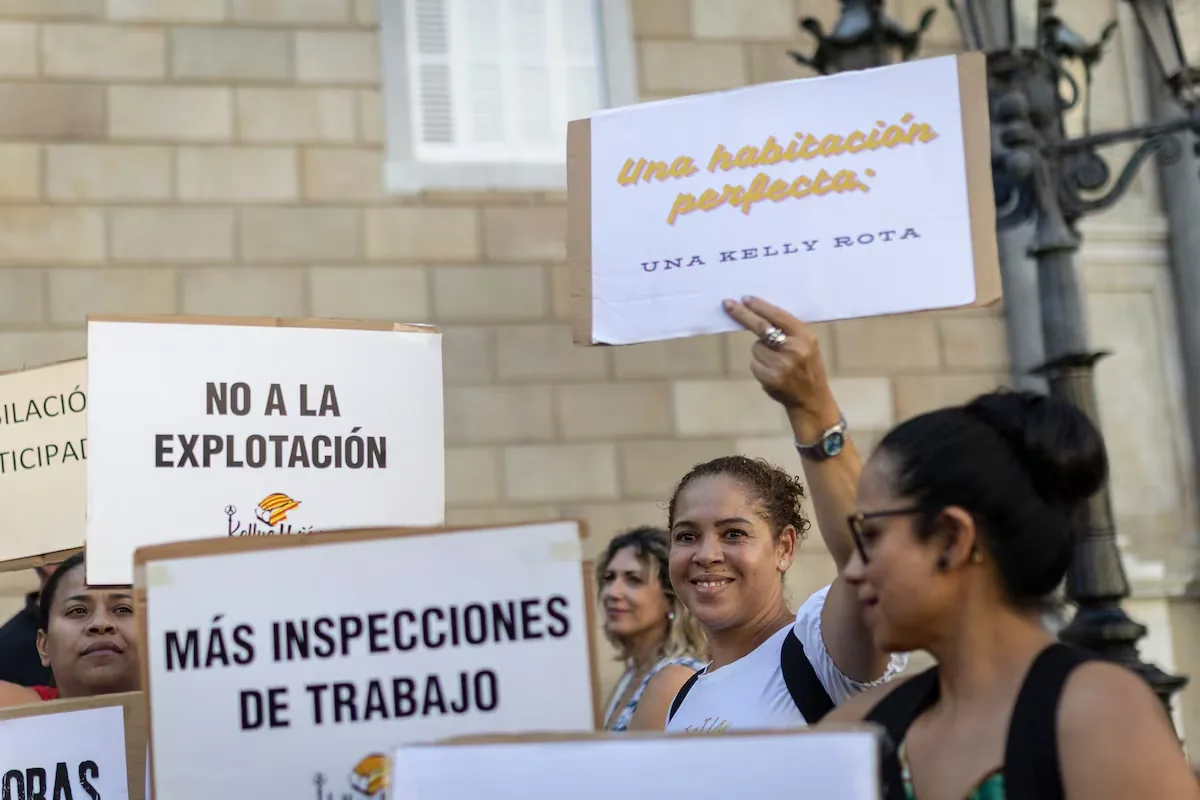
Maria del Mar Jiménez, president of Las Kellys de Madrid, the group of hotel housekeepers in the capital, traveled to Barcelona this week, but not precisely for tourism. “I don’t want these women to end up like me, incapacitated for work, with four herniated discs, Tarlov cysts in the coccyx from bending and standing up, both metacarpals in my hands ruined, shoulder and elbow pain,” she says at the annual rally the collective held this Tuesday afternoon. Every August 25th for the past 12 years, the kellys (as they like to call themselves, a play on words for “those who clean”) from all over Spain protest their working conditions. And there has been little progress. They denounce the impact of their work on health and that conditions have worsened in recent decades, when hotels stopped hiring them directly and first used Temporary Employment Agencies and then service companies: a formula to circumvent the hospitality agreement and include them in the cleaning agreement. The salary difference, they highlight, is between 600 and 800 euros.
Read more The rise in gas to new highs worsens the countdown to stockpile reserves for the winter
Jiménez and her colleagues denounce that they medicate themselves to be able to work: “We start the day with coffee, continue with paracetamol or Nolotil, and end with muscle relaxants and anxiolytics to be able to sleep.” In the case of the Madrid representative, she recounts, the pain is so strong that doctors give her morphine derivatives. Beside her, Maria Luisa Pérez, also from Madrid and 57 years old, shows the knee operations she had to undergo before being granted disability. Energetic despite chronic pain, Jiménez has calculated that, in her 35 years of working life, she made 45,000 beds “not counting extra beds,” and wrung out 31,000 cloths. “We have four different cloths, multiply that by the working days in a year and by 35 years, multiply,” she invites.
The pressure, they recount, is tremendous. From the workload, from doing it in a hurry so that rooms can be reoccupied, from supervisors checking that not a speck of dust has been left… Many take muscle relaxants to sleep with so much pain. And in the long run, sometimes, they end up with anxiolytics.
In 35 years of working life, I made 45,000 beds, not counting extra beds, and wrung out 31,000 cloths”Maria del Mar Jiménez, from Las Kellys de Madrid
Juani Pérez, who has worked in two hotels for a long time and often acts as spokesperson in Barcelona, recalls the collective’s traditional demands: “Early retirement, improved working conditions, recognition of occupational diseases, ergonomic risk studies, improvements such as adjustable beds or motorized trolleys… It’s not possible for the hotel and tourism industry to have the profits it does while our conditions are increasingly deplorable; they have no excuse, we’ve been denouncing it for 12 years. Our health is left in the hotel corridors, which remain open at our expense.”
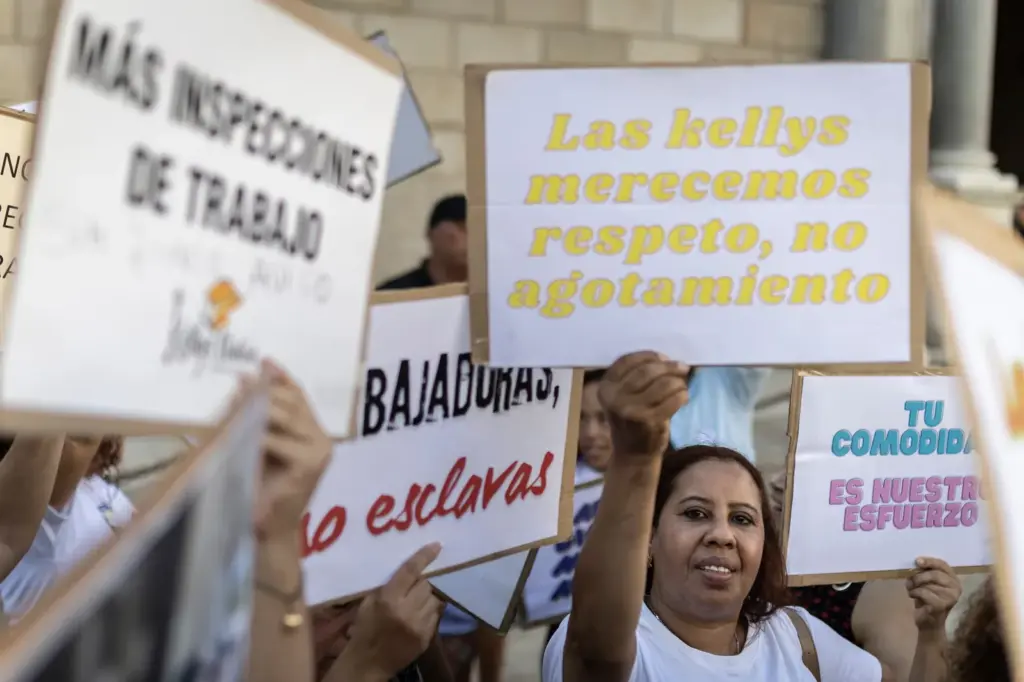
Another colleague, Magnolia Cuevas, emphasizes that subcontracting makes them “poorer and more vulnerable.” And when asked if they plan to strike, she replies no: “We only get paid for the day we work, they destroy our dignity, they promote quality tourism that is for the hotel owners.” Eulalia Corralero, one of the founders of the collective after working 45 years in a hotel in Lloret de Mar (Barcelona), is outraged to recall that “outsourcing continues, we earn less and less each day, and staff are divided so they lose strength when negotiating.” “Enough is enough,” she continues, referring to those who did not reach retirement actively, “we have been protesting for 12 years and we are a living example of what a chambermaid’s working life is like: we have permanent disabilities, social security tells us we cannot work, but we live on half a salary.” Another problem they face when considering strikes is that the kellys organize themselves into associations, and they lack union backing.
Geographer Ernest Cañada, from the Alba Sud research center on tourism and the tourism industry, warns that “the medicalization of floor workers is systemic and structural in their work: it’s not that they take substances to escape, but to be able to work.” And he confirms that “the causes of dependence are linked to the nature of their work, and how it is organized to squeeze the maximum out of them: physical, hard, and repetitive, with peaks and a lot of pressure to do a lot in a short time.” “The consequences are directly transferred to the workers’ bodies,” he says, noting that if psychosocial risk models in the workplace are analyzed, “their work fits the worst conditions, both in mental and physical health.”
Cañada also questions the lack of recognition for a task that is fundamental to tourism and the response of employers: “They usually say that the problem lies with the chambermaids themselves who do not adhere to ergonomic measures [in some hotels, beds go up and down with a hydraulic system]. They invite anyone to work for weeks, months, and years.” In the sector, no one reaches retirement working in room cleaning: they either move elsewhere or change tasks within the sector.
Read more Riki Blanco: delegated vacations